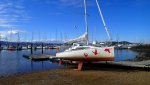
Why would anyone get a twin keel if they could have a fin?

DangerousPirate

Well-Known Member
Joined
24 Feb 2020
Messages
966
Location
N. Ireland
Visit site
Are there any advantages except for the drying out bit that it can stand up?

It slows the boat down and they don't point so well, they also have a deeper draft. There is a boat close by that looks nice, but it's atwin keel and I am not sure if this boat could be the boat for me. I intend to sail to the meds with it, and live on it, too. So it doesn't have to be a racer, but performance towards windwards might come in handy for longer tacking sessions?

Also I am not sure if Fin Keels are more stable or not thatTwin Keels? Especially at sea.

Boat in question is a Mirage 28, but I am also asking in general because I have seen a few Twin Keelers now.
 
Are there any advantages except for the drying out bit that it can stand up?

It slows the boat down and they don't point so well, they also have a deeper draft. There is a boat close by that looks nice, but it's atwin keel and I am not sure if this boat could be the boat for me. I intend to sail to the meds with it, and live on it, too. So it doesn't have to be a racer, but performance towards windwards might come in handy for longer tacking sessions?

Also I am not sure if Fin Keels are more stable or not thatTwin Keels? Especially at sea.

Boat in question is a Mirage 28, but I am also asking in general because I have seen a few Twin Keelers now.
They were popular when they were built because it was in the days before there were marinas and deep water moorings. The ability to use a drying or shallow harbour or estuary mooring was a big selling point. Of course most fin keels are better sailing performers but that was of less concern to buyers at the time. Of course you will find a lot of twin keel boats in the size price range you are looking at simply because they were far more popular than fin keels.

On your situation you are stuck with buying boats that met the needs of the original owners 40 or 50 years ago - and to be honest still suit many people. Why are you bothered about sailing if you intend living on an old cramped boat and maybe getting it into good enough condition to actually make it down to the med? Far more important is the condition and equipment of the boat and to an extent the space it offers for living. Does not matter what the keels are - living on a 28' old boat is only a little above camping and sailing it down round the outside a real challenge - but many have done it in the past because boats like the Mirage were what was available.
 
If twin keels are making a comeback, then why is it only small builders producing them? Twin keels have had their day, fin keels rule with about 98% of yachts being fin with twin and lift keels making up the rest. The Med has only a very limited rise and fall of tide so a twin keel yacht has virtually no benefit as you cannot dry out.

Dangerous Pirate, I agree with Tranona that a 28ft yacht is like floating camping - OK for a short while but not for living aboard permanently (even in warmer climates). The old maxim of buying a boat in the best condition that meets your needs. One factor you need to consider is cabin ventilation as a hot cabin is not fun during the summer months. So a yacht that was designed for norther European waters would certainly not be my choice for the Med unless plenty of additional hatches have been fitted.
 
If twin keels are making a comeback, then why is it only small builders producing them? Twin keels have had their day, fin keels rule with about 98% of yachts being fin with twin and lift keels making up the rest. The Med has only a very limited rise and fall of tide so a twin keel yacht has virtually no benefit as you cannot dry out.

Dangerous Pirate, I agree with Tranona that a 28ft yacht is like floating camping - OK for a short while but not for living aboard permanently (even in warmer climates). The old maxim of buying a boat in the best condition that meets your needs. One factor you need to consider is cabin ventilation as a hot cabin is not fun during the summer months. So a yacht that was designed for norther European waters would certainly not be my choice for the Med unless plenty of additional hatches have been fitted.

Well, I was a backpacker and literally don't need much I lived under a tarp for 2 years while travelling around. Huge boats are overrated really. What do you with the extra space? Run around in circles? All you need a place to sit (with table), somewhere to cook, a toilet, and a place to sleep while also being able to stand up in without bumping into the walls with every step. Obviously. Space is nice, but it's not such a big difference between 40 foot and 30 foot on the inside, especially after a while. It's not like you use every cm of it. You will use your 3 or so favourite spots and cycle between them.

That is just my opinion, and I have been on nice 30fters and that'll do me nicely honestly.

I know it's somewhat of a thing with boaters that everyone always wants an even bigger boat haha

Back to my question though because I really like the price (and location, notfar from here so easy for viewing and keeping for preps) but I really only heard bad things about twin keels.

How much of a difference can twin keels make in pointing ability, in degrees? As a rough estimate for comparision. Every boat is individual anyway. Even among the Fin Keelers.

And what about the sea motion? Do they roll more? Less? Someone wrote something about more noise on twin keeler or something.

Pointing ability and sea motion are what I am curious about really
 
I would say do not go for twin keel if you are going to Med. Twin keel only has value in high tide range areas where drying out /shallow draft is useful.
Now where I am (small tides like Med) I have only seen one twin keel in 50 years among so many thousands of boats seen. Fin keel rules. Though in my case a lift keel trailer sailer. Just like a dinghy it points really well. I reckon because of the keel arrangement. ol'will
 
How much of a difference can twin keels make in pointing ability, in degrees? As a rough estimate for comparision. Every boat is individual anyway. Even among the Fin Keelers.

And what about the sea motion? Do they roll more? Less? Someone wrote something about more noise on twin keeler or something.

Pointing ability and sea motion are what I am curious about really
Generally speaking a twin keel boat will make slightly less speed and have slightly more leeway. I would love to put my fin Fulmar against a twin keel Fulmar, I expect the difference to be about 3 degrees whilst on the wind. As the wind moves aft then this difference will disappear. As to speed,I can quote the Portsmouth Yardstick of 1006 for a fin Fulmar. The suggest addition for twin keels is to add 50. Change from a fixed 2 bladed prop to 3 bladed add 10 more. By comparison to change from a fixed 2 bladed to folding prop is -10. These numbers come from the WOA web site, Racing

So my fin keel with a folding prop will rate 996 compared to a twin with 2 bladed prop of 1056 or 1066 for a 3 bladed prop. So for a 100 minute race for a standard rating of 1000, I should complete it in 99 6 minutes and the twin keel 2 blade in 105.6 minutes or 106.6 minutes for the 3 bladed. In another way my boat is 5.68% faster than a twin keel with a 2 blade or 6.5% faster than one with a 3 blade prop. Just taking a 10 hour sail in the twin keel with a fixed 2 bladed prop, I would have arrived just over 34 minutes earlier provided both boats had similar quality sails and were handled the same. Personally I do not feel these numbers are really generous enough and I would expect to arrive about 45 to 60 minutes earlier.

As to sea motion there will be very little difference unless you are in some rough water and air gets under the windward keel as the hull tends to slam more as the windward keel stops water flowing up the hull. I have to admit I have not sailed a twin keel boat for a long time, but I was so unimpressed that I would never consider one for any reason.
 
Resizer_16316682173575.jpeg

There are twin keels and twin keels, there are a whole variety of owners of yachts with twin keels, some pottering about some doing more heroic passages.

If you race then a single keel boat will be more satisfying but if you are cruising and living aboard then the ability to point high is really not so critical. If you cruise across oceans then the ability to point is less critical as you focus your schedule not to be constantly beating to windward.

This one has been sailed from France by a couple and has been in Australia for a few months, they came via the Atlantic and Pacific. They spent time in Tasmania working in vineyards, and living on their yacht, to replenish the coffers and are now making their way toward Sydney. I think the original intent was to continue with a conventional circumnavigation but they are pondering heading north, instead of west and completing the NW Passage. No inboard diesel - just an OB.

I have not met the couple, but know them well(ish) as when they arrive in Sydney they will pick up their new 6mm high tensile chain rode (replacing their existing 8mm rode) that I have arranged for them. The new rode is currently sitting in my workshop along with the matching shackles etc. If you had interest I had a short thread, on PBO YBW on re-galvanising their 10kg Spade.

Anything is possible with twin keels and twin keels are not restricted to older models. The deciding factor on what use is made of twin keel, or single keel, yachts is the owners - not by what they look like. I suspect this twin keel yacht will outsail many single keel yachts - even some slightly longer. Most single keel yachts are never, ever, sailed to their potential - this one seems to have been sailed well beyond what the builder imagined - anything is possible.

Open your mind, think outside the box

Take care, stay safe

Jonathan
 
@Concerto I remember there was a twin keel Fulmar in one of the early ARC rallies in the late 80's when it came to Barbados, before being transferred to St Lucia.
This Fulmar had twin keels, and after arriving here she took part in the Mount Gay regatta, which started then on Boxing Day.
And she impressed everybody by her performance - she did very well over the ground, and I think she won her class on corrected time.
 
Pointing ability is completely irrelevant in the med. No one beats to windward in the med as the lack of tide means you will always be fighting a foul current set up by the wind you're trying to beat into.

On the other hand, as already said, ability to dry out is of no benefit as such a small tidal range.

Hence, few twin keeler in the med.

Why not buy a boat locally in the Med? More likely to find something suitable, and if its in good nick go for it.
 
I would imagine if cruising on a budget, then a bilge keeled would be of an advantage. Getting lifted out is expensive and if you can do hull cleaning, new anti fouling and change anodes on a beach somewhere of a nice sunny afternoon would be preferable to spending £1000 on being lifted into a boat yard for a few days.

Obviously this benefit doesn’t exist in the med on account of no tides, but in general I’d say that the ability to drive out is worth the 6% penalty as alluded to by Concerto.

(I have a fin though)
 
Boat in question is a Mirage 28, but I am also asking in general because I have seen a few Twin Keelers now.
My first boat was a Mirage 28. I cracking boat, but I grew out of it and my sailing changed to longer passages and I quickly moved to my current Gib'Sea.

I was planning to dry out a lot, but rarely did, hence moved to a fin keel. If I understand you correctly you are planning to move to the Mediterranean, a sea with no tide, the drying out ability will not be available to you there. Pointing wise I get another 20° to windward, new sails might also help there.
 
Depends on where and why you sail. If the destination is as important as the journey to you and you are lucky enough to sail in an area such as the South West of England an boat that can dry out is a major advantage.

I have a Southerly which could be argued as the best of both worlds - not going to win any races to windward but opens up a lot of places to visit.
 
I would not swap my twin keel for a fin. The shallow draft means I can set off earlier on a rising tide and can get in later on a falling tide. You may also fare better in canal systems if you want to get to the med that way.
The hydro dynamics of the twin were considered in a technical article on a post long ago and on a reach a twin was shown to be faster- as an experiment try overtaking an old westerly on a long reach in a strong breeze- they go fast !
 
Horses for courses, IMO.

I've always enjoyed being at anchor, sipping a nice rosé on a sunny afternoon. The ability to dry out level means you can arrive at a crowded anchorage and tuck yourself away in a quiet corner, out of reach of the mob who need a couple of metres of water. That suits me, but when I retired, We seriously considered moving to France. We considered several areas, including the Med, but one downside was that our bilge keeler was ill-suited to the area. Far better to go to Brittany, where we could dry out on beaches.

If you're going to the Med, unless I already had one that suited me, I wouldn't consider a twin keel, unless that means one on each hull, which definitely has advantages for a liveaboard.
 
Top