Why use I and J measurements for symmetrical spinnaker sizing?

EMAFC10

New Member
Joined
28 Apr 2020
Messages
8
Visit site
I replaced a mast where the old one didn't have a masthead spinnaker sheave and the new one does but it's still a fractional rig. So the spinnaker sheave is now 2 meters higher but the I measurement is exactly the same. In theory, I can fly a bigger spinnaker, but if I use I and J as the starting point, nothing changes in the recommended spinnaker size.

Delving in a bit deeper, we know that the I measurement is the vertical distance from where the forestay attaches to the mast and the deck. But if the spinnaker sheave is 2 meters higher than the forestay tang on the mast, it would seem that the correct measurement is the vertical distance between the spinnaker sheave and the forestay attachment at the deck. But this begs yet another question.

A symmetrical spinnaker is flown from a spinnaker pole, and the spinnaker pole attaches much higher up the mast than the forestay attachment on the deck. So why isn't the starting point for measuring a symmetrical spinnaker the vertical distance between the pole ring and the spinnaker sheave?

Forgive me if there is also a thread on this, I've only seen one after the other where people discuss I and J, which is the same for every sailmakers website.

Thanks for any help in educating me on this.

Erik
 
I and J measurements are used for headsail measurement by sailmakers and for yacht ratings.

Having a masthead sheave on a fractional rig suggests this is intended for an asymetical kite rather than a symetrical one. What boat are you talking about? Do you have a bowsprit fitted?

On my ¾ rigged Fulmar there is no masthead sheave for a spinnaker and if I raced with a large masthead spinnaker compared to the regular spinnaker from the forestay height, my rating would be heavily penalised.
 
I replaced a mast where the old one didn't have a masthead spinnaker sheave and the new one does but it's still a fractional rig. So the spinnaker sheave is now 2 meters higher but the I measurement is exactly the same. In theory, I can fly a bigger spinnaker, but if I use I and J as the starting point, nothing changes in the recommended spinnaker size.

Delving in a bit deeper, we know that the I measurement is the vertical distance from where the forestay attaches to the mast and the deck. But if the spinnaker sheave is 2 meters higher than the forestay tang on the mast, it would seem that the correct measurement is the vertical distance between the spinnaker sheave and the forestay attachment at the deck. But this begs yet another question.

A symmetrical spinnaker is flown from a spinnaker pole, and the spinnaker pole attaches much higher up the mast than the forestay attachment on the deck. So why isn't the starting point for measuring a symmetrical spinnaker the vertical distance between the pole ring and the spinnaker sheave?

Forgive me if there is also a thread on this, I've only seen one after the other where people discuss I and J, which is the same for every sailmakers website.

Thanks for any help in educating me on this.

Erik
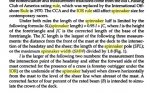
Once upon a time (IOR rating rules) spinnakers had maximum allowed dimensions determined by I and J, one could design a bigger spinnaker but then it was subject to such hefty penalties that no one did.
IIRC, SMW (Spinnaker Medium Width) for example could not exceed 1.85 J. Also, the spinnaker pole had to be = J, if bigger then JC (corrected J) spinnaker pole length had to be used for the whole sail area computation : obviously no one exceeded J.
In the end, apart from racing rules no one prevents you from using a longer spinnaker pole for example or a wider sail.


edit, this explains it a little

iorspi.jpg
 
Last edited:
Under the IOR rule the spinnaker could be double the J dimension without any penalty, so that is what the sailmakers worked to along with yacht designers. In the 1970's I recalculated our IOR rating numerous times using the rule book and a desk calculator which had a square root button (handheld calculators did not have square root and computers had not entered the domestic market).
 
Once upon a time (IOR rating rules) spinnakers had maximum allowed dimensions determined by I and J, one could design a bigger spinnaker but then it was subject to such hefty penalties that no one did.
IIRC, SMW (Spinnaker Medium Width) for example could not exceed 1.85 J. Also, the spinnaker pole had to be = J, if bigger then JC (corrected J) spinnaker pole length had to be used for the whole sail area computation : obviously no one exceeded J.
In the end, apart from racing rules no one prevents you from using a longer spinnaker pole for example or a wider sail.


edit, this explains it a little

View attachment 130328
Thanks for your reply. I was aware of the IRC ratings but I'm still perplexed that sailmakers selling spinnakers for cruising boats use the I and J measurements for sizing a symmetrical spinnaker.

If you don't mind me asking, can you help me interpret the IRC rule? The last paragraph explains how to measure I. If I have a fractional spinnaker sheave and a masthead spinnaker sheave, which is used to measure I?

Thanks
 
N.b. that isn't the IRC rule.
The IRC measurement manual is here.

But, as a basic rule of thumb, IRC will work off the larger sail (i.e. MH). If you're really keen, you could do trial certificates and some testing/VPP modelling to see if the extra speed from a MH Kite is worth the rating hit. Or not.
 
edit, this explains it a little

View attachment 130328
I was googling some spinnaker data and this thread came out top, so (at least) one correction for the above text I took from I cannot remember where, which is related to IOR rule (not IRC):
SL (as Spinnaker Luff) is not as indicated by the above image.
IOR specified a ''LL'' dimension, equal .95*sqrt ( I squared + JC squared), basically .95 the length ot the forestay.
Per IOR (1981 Edition) the Spinnake area SPIN = 1.01 JC * (LL or SL, whichever the greater).
Point 829 of the Rules specified that if SL was above LL, the double of the difference should be added to I, which of course made spinnaker measured luffs to align to LL dimension.

Re SMW (Spinnaker Measured Width), Point 825.4 specified 'If greater than 1.8 J or 1.8 SPL, the difference would increase JC'', which of course made all spinnakers SMW align to 1.8 J.
Again, this was IOR so just historical interest.
Copied from original written rules under my eyes right now. :)
 
Top