Why I like boating on the SoF

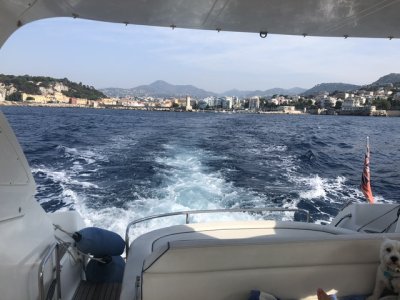
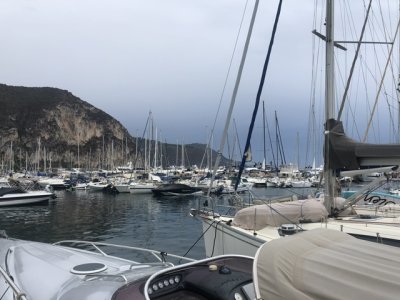
Our anchorage today .It’s mad with Italian families obviously as there last week closes .
Fuel .Yes there‘ s not much in it for short trips .This island is 8 miles from our marina .
D speed @ 9.6 knots 890 rpm gobbles 20/21L hr and the plotter says approx 45 mins to run .
So 3/4 of 40 = 30 L each way .
P speed say 1780 rpm it cruises at 75 % load @ 29 knots , plotter says something like 12 or maybe 15 mins ? Burn rate is 85 L or 170 L for the boat .
So 1/4 that ( 15 mins / hr ) = about 44.5 L .

For a 15 L difference it’s not worth pissing about @ D. If it’s 12 mins that diff is lower .

View attachment 162650
View attachment 162651
Gallinara?
 
Given the high cost of fuel, this year I've been experimenting a bit more with different speeds to see what the real consumption is with clean bottom, stern gear, etc. It's really interesting to see how speed and revs affect, or more importantly for me, don't affect the consumption. In litres per nautical mile, I achieve the following with my Sunseeker P57 and two D13-900s. The boat is almost always quite "heavy" with full fuel and water tanks, Williams 345 tender, water maker and it's fitted with the less dynamically efficient fin stabilisers.

8 knots - 4.0 l/nm
9 knots - 5.0 l/nm
10 knots - 6.0 l/nm
12 knots - 8.5 l/nm
14 knots - 10.0 l/nm
20 knots - 10.5 l/nm
25 knots - 11.0 l/nm
30 knots - 11.5 l/nm

The conclusion is that once you are above 14 knots or so, any further increase in speed makes very little difference to the fuel consumption per mile. You can choose the cruising speed based on comfort, conditions and looking after your engines without worrying about additional fuel burn.

The most economical speed is around 8 knots ... at this speed, I have a range of about 500 nm with a 10-15% reserve.
Very believable figures DAW. I got same shaped curve on my last few boats. The only way to make a difference is to go very slow, but not many of us want to.

I’m always amazed how people all over the boating world, and on here, talk in LPH. All that matters in my head is LPM. LPH makes sense for generators and diggers, but not boats, imho.

I’m just back from a Croatia charter on a 78 footer. Captain was a really nice guy but not a mathematician. One day he was going a bit slow and I asked him why. He said to save me some fuel. His display was LPH so I tapped it (Garmin) to show LPM. Then we tried a few speeds, and got the same shaped curve as in your data above. He was amazed, and went faster :).
 
Very believable figures DAW. I got same shaped curve on my last few boats. The only way to make a difference is to go very slow, but not many of us want to.

I’m always amazed how people all over the boating world, and on here, talk in LPH. All that matters in my head is LPM. LPH makes sense for generators and diggers, but not boats, imho.

I’m just back from a Croatia charter on a 78 footer. Captain was a really nice guy but not a mathematician. One day he was going a bit slow and I asked him why. He said to save me some fuel. His display was LPH so I tapped it (Garmin) to show LPM. Then we tried a few speeds, and got the same shaped curve as in your data above. He was amazed, and went faster :).
100% agreed with DAW.
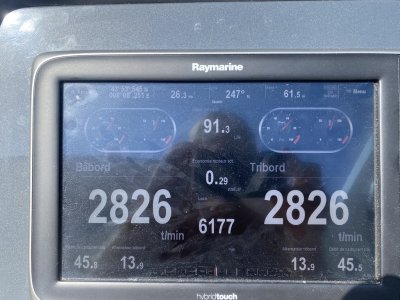
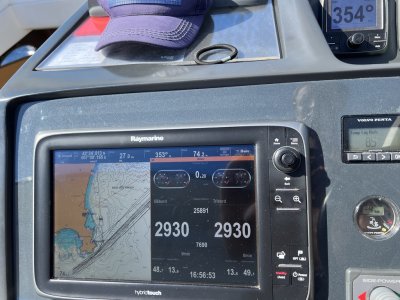
I always display L/NM on my screen, as it also helps me find the best setup (trim & flaps) for any given speed:
here are my very best conditions.
0.29 nm/l = 3,45 l/nm @ 26 knots
0.28 nm/m = 3,57 m/nm @ 27 knots

UNADJUSTEDNONRAW_thumb_2fbf.jpg


UNADJUSTEDNONRAW_thumb_5fac.jpg
 
Very believable figures DAW. I got same shaped curve on my last few boats. The only way to make a difference is to go very slow, but not many of us want to.

I’m always amazed how people all over the boating world, and on here, talk in LPH. All that matters in my head is LPM. LPH makes sense for generators and diggers, but not boats, imho.

I’m just back from a Croatia charter on a 78 footer. Captain was a really nice guy but not a mathematician. One day he was going a bit slow and I asked him why. He said to save me some fuel. His display was LPH so I tapped it (Garmin) to show LPM. Then we tried a few speeds, and got the same shaped curve as in your data above. He was amazed, and went faster :).
Agree totally. I think the only debate is whether you travel at displacement speed or planing. If latter then I reckon for me circa 26 knots is most economical - loosely said! But the difference between total fuel consumption at 26 knots versus 10 knots for a given distance is quite substantial. Ergo if you have time you will save quite a bit of money.
 
I have noticed at anchor after a prolonged D speed run tiny oil films washing out of the fart pipes .Suggesting unburnt fuel ? Or not fully combusted .As if the injector set up s not quite optimal at 800 rpm ( tick over 600 ) .
No biggie as the next run will be P .Anchoring after a P run it’s doesn’t occur .

Both sides

The other parameters re fuel , the burn rate , EGT s and load are identical per side .So it’s not a single injector issue and as said it effect both fart pipes .

So i just push , just a bow wave at D get 20-23 L/H at 9.7 knots .60 % load .This oily films doesn’t happen . 900 rpm
At lower say 850 rpm the loads 50 % and speed marginally lower say 9 knots but the fuel burns 18 L /H .

L / H is what I have ( old screen ) but I don’t find it a issue , plotter tells me TTG so it’s easy to mentally calc the total burn . Hrs X burn rate .


Hooligans right at under bow wave push low loads they seem to sip fuel in totality but it takes ages in comparison to P

Getting there quick has the disadvantage of arriving too early .Say 3 hrs at 30 knots - man maths 100 miles .

My fuel burn starts to rise above 29 , so say 30 knots 180 + 3 = 540 L which is just over 1800 rpm say 1840 ish

Same 100 miles at 9.6 knots call it 10 hrs X 40, or 46 = 400 or 460 L @ under 900 rpm .

Tick over 600 rpm ( which I never cruise at ) , speed is a reasonable 7.6 knots and fuel burn down to 12 , so 24 all up .


The boats draggy compared to others at D speeds, the deadrise means a lot of acreage dragging .So I don’t get that greater miracle fuel saving at D , or as much as others experience.

I understand ( researched it ) modern CR with there elecrotwackery ECU s can cope at D , near tick over because the brain is very accurate to lower the level of fuelling .Where mine are pre CR although electronic it’s run on algorithms pre factory set .Factory set to cover the best likely use ie P speeds , or at least N of 1450 rpm the turbo spool cut in .They are optimised up the rpm range .

But there are other issues of low running , the injector tip soot build up .Basically at lower EGTs ( 5-600 *C is optimal)
The fuels kinda partially burns and soot clumps up . So at my D speeds quoted I see 350 *C not the optimal 560 or what ever .
Thats fine with a old school single or maybe 2-3 canuli nozzle on the injector tip .A quick blast up to post turbo full spool and hit 5-600 *C it burns off .

How ever the CR injector tips have multiple far tiny canuli and not only that multi event squirts of fuel = get better mist thus better burn = better fuel economy and more HP per event + the important bit lower emissions.

I would worry with a modern CR in a planning boat running at D , excessive time @ D .
Although as I said the “ brain “ can and does lower fuel , it’s measuring every millisecond and reacting …….sure I get that .But you can’t change , get over the nozzle tip architecture .

Does with a CR set up , a short occasional bast at P do the trick of cleaning up those tiny cannula ? ?
And remember tip failure stuck open leads to hosing and cylinder melt down .Not that uncommon on engine forums btw .It’s out there guys .

Contrast that with a bit of oil unburnt fuel in the exhaust at anchor you get with none CR after a prolonged D run .
 
My boat’s idling speed is 600 rpm, and in gear this delivers about 6 knots. The ”economical“ cruising speed of 8-9 knots referred to in my post above is achieved at about 900 rpm.

I discussed this with the local Volvo Penta service agent, who checked with VP headquarters for their views on extended running of the D13-900s at low speeds. The feedback I got was that there should be no problems, although they recommend against this as a normal method of operation mainly because the turbos never really kick in properly and various parts of the engines, gearboxes and exhaust system do not reach optimal design temperatures, creating unpredictable load and wear conditions. Short blasts at high speeds following extended running at low rpm for long periods was not considered to be a real solution.

I know many people happily run at low speeds for extended periods without any issues. This year I did a couple of long trips cruising with another boat at its cruising speed of 9-10 knots (the reason for my query to VP) and it was a very enjoyable experience. But the main function of a planing boat with big engines is to get you where you want to go quickly. For my boat, the sweet spot is 1800-2000 rpm (max is 2350 rpm) which delivers 20-24 knots depending on conditions and a theoretical engine loading of 70-75%, while burning 10-11 l/nm.

Someone said “ouch” at the idea of burning this much fuel, but it’s worth remembering that fuel is only one of the expenses of owning a boat. For me, fuel has been only 10-15% of the annual cost of keeping and maintaining my current boat, and that’s before you even start to consider depreciation and money spent on upgrades.
 
My boat’s idling speed is 600 rpm, and in gear this delivers about 6 knots. The ”economical“ cruising speed of 8-9 knots referred to in my post above is achieved at about 900 rpm.

I discussed this with the local Volvo Penta service agent, who checked with VP headquarters for their views on extended running of the D13-900s at low speeds. The feedback I got was that there should be no problems, although they recommend against this as a normal method of operation mainly because the turbos never really kick in properly and various parts of the engines, gearboxes and exhaust system do not reach optimal design temperatures, creating unpredictable load and wear conditions. Short blasts at high speeds following extended running at low rpm for long periods was not considered to be a real solution.

I know many people happily run at low speeds for extended periods without any issues. This year I did a couple of long trips cruising with another boat at its cruising speed of 9-10 knots (the reason for my query to VP) and it was a very enjoyable experience. But the main function of a planing boat with big engines is to get you where you want to go quickly. For my boat, the sweet spot is 1800-2000 rpm (max is 2350 rpm) which delivers 20-24 knots depending on conditions and a theoretical engine loading of 70-75%, while burning 10-11 l/nm.

Someone said “ouch” at the idea of burning this much fuel, but it’s worth remembering that fuel is only one of the expenses of owning a boat. For me, fuel has been only 10-15% of the annual cost of keeping and maintaining my current boat, and that’s before you even start to consider depreciation and money spent on upgrades.
Yep, it was me that said ouch, I'm sure my fuel costs are a similar proportion of my overall running costs as yours are,despite being a smaller absolute amount
 
The feedback I got was that there should be no problems, although they recommend against this as a normal method of operation mainly because the turbos never really kick in properly and various parts of the engines, gearboxes and exhaust system do not reach optimal design temperatures, creating unpredictable load and wear conditions.
Short blasts at high speeds following extended running at low rpm for long periods was not considered to be a real solution.
Did you get that in written?
I never heard of any engine manufacturer clearly recommending against running for a long time at very low RPM/load.
And neither that short blasts at higher RPM are not enough to "compensate" that.
 
Did you get that in written?
I never heard of any engine manufacturer clearly recommending against running for a long time at very low RPM/load.
And neither that short blasts at higher RPM are not enough to "compensate" that.

It wasn't that kind of discussion ... it was a friendly conversation about the pros, cons and potential risks of running the D13 engines at very low rpm for extended periods of time. I feel the response I received was measured and well balanced ... not something the engine is designed for but not likely to create any problems in normal use, some examples of the issues that could arise over the longer term, and some informal views about the curative benefits of short blasts at high rpm ... all of which seemed credible to me. I got the reassurance I was seeking for my trip and wasn't expecting anything in writing.
 
It wasn't that kind of discussion ... it was a friendly conversation about the pros, cons and potential risks of running the D13 engines at very low rpm for extended periods of time. I feel the response I received was measured and well balanced ... not something the engine is designed for but not likely to create any problems in normal use, some examples of the issues that could arise over the longer term, and some informal views about the curative benefits of short blasts at high rpm ... all of which seemed credible to me. I got the reassurance I was seeking for my trip and wasn't expecting anything in writing.
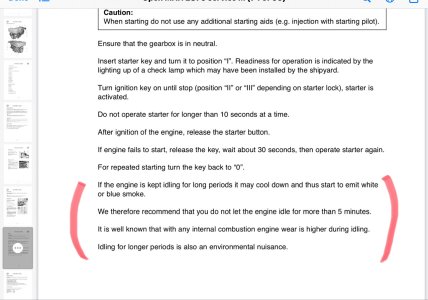
Additionally the MAN manual does say avoid prolonged tick over or time at low loads ….words to that effect .
Surly that counts as a manufacturer in writing , the evidence MapishM requests ?
 
Additionally the MAN manual does say avoid prolonged tick over or time at low loads ….words to that effect .
Surly that counts as a manufacturer in writing , the evidence MapishM requests ?
That's nowhere to be found in my manuals.
Do you mind posting an abstract?
 
That's nowhere to be found in my manuals.
Do you mind posting an abstract?
0839EFB1-C0EF-4BC0-959F-BC46A392BE9E.jpeg

It will be the lower EGTs , poorer ring fit , excess oil betting burnt as the rings let more through .Plus contamination the other way soot , abrasive particles getting of un properly burnt fuels ( 350 *C as opposed to 560 *C ) down past the loose rings and adding grit to the oil .

You could shorten the oil change Fq to mitigate ?

Also as I said earlier it’s the crap sticking to the injector cannuli which is risky .knackers the spray pattern up .
Not so much with old fashioned tips like you and me have , more so with CR set ups .
 
Top