Why do so few cruising sail boats have a protected helm?

There's truth in all of the above comments but the plain truth is you spend a surprisingly small amount of time at the helm of a sailboat on passage. Much more time is spent making around with the sails and it's far better to have a protected place where you can keep a lookout and do basic sail trimming than to have a protected helm. The true blue water cruisers these days aren't the likes of Malo or Halberg-Rassy at all to my mind, it's the French aluminium centreboard jobs - exemplified by Garcia.

 
You conveniently omitted Southerly, who I feel developed the inside sailing station design very effectively.

I mourn their demise, although i don't think it was because they didn't design and build a (series of) successful and attractive 'wheelhouse' sailing yachts of smaller size over a considerable period of time.

I wouldn't say the interior wheel steering was particularly effective on older Southerlies. Have you ever tried to sail something like a Southerly 95 using the interior wheel? I had one for about 24 years and used the wheel twice when wet and windy in around 19,000 miles. Very little feel and you needed to twirl the tiny wheel constantly. Just about OK in light weather. I always used the autohelm when down below in wet weather or overnight.

I did really appreciate the ability to go below when not very windy. I do remember one sail in light wind and steady drizzle. We slowly overhauled a similarly sized yacht and I gave a polite wave and smiled as we slowly passed. His response was to scowl, mutter a profanity and hunch back down in his oilies. I suppose that the sight of me in shirt sleeves in a centrally heated cabin with a mug of coffee in my hand was the last straw. :D:D:D
 
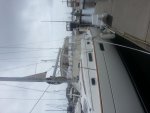
Hdre in Florida most boats have bimins at least and many convert to full enclosures. A boat down the pontoon from us had a hard top made to cover the cockpit, with a windscreen as well and the canvas/clear sides and back zipped in. We had a full canvas conservatory set up and in the ICW where motoring is most often required, ( shallow winding channels) we kept it up rather than fold it all down and away. if sailing we simply removed the sides and central roof section for a better view of the sails although we did have a clear roof panel to look through. Rain was only part of our 'problem' because shade from Florida sunshine was the main need to have it all up. We had a full bimini/ cockpit enclosures on our last two UK boats too, but always folded them away out of harbour. I much prefer to be out in the air and dodge behind the sprayhood as and when and autopilots are there to earn their keep! This one was on our USA boat just sold, excuse the sideways pic, the original is right way up and it fell over on loading here.
20150416_132435(0).jpg
.
 
Last edited:
It's all subjective, there is no answer. Whatever boat you go sail long distance, most of your harmony will be used up fixing broke things miles from anywhere whilst being anxious, permanently.

Top tip. Read The Martian.

The easy life off planet wise ass!
 
I feel sick in rough or rolling seas unless I am outside. I expect many sailors are like me and simply don't want to be confined under a roof. The Bimini which came with my boat has never left the garage. If it's wet the auto helm steers and I peek round the spray hood.
 
Another point not mentioned is the vulnerability of a high structure in a big sea. I am surprised that modern designs are moving towards such big windows. I already know of some models of Hanse where the windows have just dropped out. I can imagine the carnage in a storm if a breaking wave hit the side of a large deck saloon with big windows & caved in a window
 
This is a subject oft debated here, particularly if sybarite or dancrane are feeling bored.

There was a time 30 years ago when wheelhouses or hardtop wheel shelters were common - but mainly on larger boats (40'+) and at the custom end of the market. It is very difficult to make a practical and good looking superstructure on boats less than 35'. There simply is not space to fit full headroom and big enough to have good visibility. Even worse on today's wide boats with high freeboard.

Some mass producers have tried with smaller boats in the UK (Westerly Konsort Duo, Hunter 27 Pilot and Horizon 323, Moody Eclipse etc). However the price premium for the extra work and the need for two helm stations etc is quite significant - sort of equivalent of going up the next size in boat. So all ended up as 7 day wonders and the limited real demand was satisfied very quickly.

The Scandinavians have had more success from a design point of view, reflecting the fact that sailing conditions, particularly extending the season mean that people seem to be prepared to pay the premium. However, most of the smaller ones like the LMs have disappeared from the market.

The reality is that the compromise of a good sprayhood and other canvas cockpit covers is a good one and a fraction of the cost of permanently installed shelter. You do see some DIY attempts at hard shelters, but mostly they are ugly and out of proportion to the rest of the boat.

I liked the boat which Maurice Griffith's designed for his own retirement. It had a fixed shelter which was high enough to sit under and look out through, or to stand and look over. Kylix 27' (also a 29' version)

http://www.eventides.org.uk/Kylixclass.htm

I have got past the stage where I enjoy being cold and wet on a night watch.

Another interesting boat was the Trintella 44A which had an open wheel house but also had a second wheel in the aft cockpit.

https://www.antipode-yachts.com/fr/TRINTELLA-44-A-occasion-TRINTELLA-ANNE-VEWER/1067.html

Or the VILM 117 ??

https://www.google.fr/search?q=Vilm...&biw=1600&bih=794&dpr=1#imgrc=nghnHRGopb1MAM:
 
Last edited:
I don't subscribe to the masochistic idea that you have to be out in the wind and the rain to properly enjoy sailing. The reason I'm out in the cockpit is to do with keeping the boat sailing properly and to do that you need to be where the sails are controlled. Even sailing a Nauticat, the place you need to be under sail is at the aft steering position because that's where the sail controls are. So nice and warm when motoring but no protection whatsoever when sailing - go figure.

On Rampage, I have a sprayhood and bimini which together do quite well at keeping me reasonably protected from the weather. As others have said, there's no real market for wheelhouse sailing yachts, as you simply can't control the sails from inside without good no down the route of large glass panels in the overhead cover plus electric winches to work the sails: not going to happen in a medium sized yacht.
 
Some people, who have cars for fun rather than practical transport, absolutely do buy cars without roof or windows...

They do; that's often been my point, Pete, because such cars are always what might be called the family's "third car" - bought as a toy, only after genuinely useful and usable cars which serve everyday (including rainy day) purposes...

...I'm in a position now to buy one of the many small yachts always for sale, but I don't want what I can afford, because I want more weather-protection than the dinghy gives me. I acknowledge that the dinghy is a toy for summer weather, like a third car, with no roof...

...when I buy a yacht, she'll need the option to helm indoors, or I may as well be in the dinghy. ;)
 
Sprayhood and autopilot or vane gear seems like a good compromise to me.
Also sailing a yacht is a lot less physical than a dinghy, so it's comfortable to wear effective clothing which wouldn't work on a dinghy.

Somebody should dredge up a photo of one of those MAB's with astrodome looking like it came off a washing machine?
 
I do not understand the need on a cruising boat to have a big wheel right at the back with nothing to stop the person steering falling overboard.
But as most boats are not designed for the relatively few people who cruise in the temperate latitudes, then we are stuck with what sells elsewhere and for other purposes.
I suppose the only way around this for a cruising boat is to purchase one of the few designed specifically for cruising or one of the older boats that suits.
 
Here's what Clark Beek says about the Salar 40 :

"Condesa’s most distinctive, and in my opinion her best feature is her prominent wheelhouse. While perhaps not the most pleasing to the eye, the wheelhouse accomplishes three major functions:

It protects the crew from wind, waves, sun, sleet, hail, spray, and the general beating of the elements.
It provides relatively dry and convenient place for all of the instruments.
It provides a perfect exposed surface for mounting an array of solar panels.

I cannot imagine cruising without it. I guess I would be much more at one with the elements, meaning cold, wet, and having skin cancer. In a recent passage down the coasts of Patagonia and Tierra del Fuego we had rain, sleet, and hail being driven by fifty knot winds. From behind the protection of the wheelhouse it was nothing more than a curiosity; step outside and we were being gunned down by an icy firing squad. Consider strictly the ravages of the sun in the tropics: By having a roof over my head all these years I have saved my skin untold damage.

I have all of the instruments—GPS, depthsounder, radar, and VHF radio—all mounted on the ceiling, hanging down in easy view just in front of the helm. These instruments are all water-resistant, but even the worst of weather can’t get any spray up there. I can also connect a computer for electronic chart navigation, but I usually keep it below. This arrangement allows me to fly by instruments in zero visibility, as everything is right there in easy view of the helm. Boats that have a navigation station down below are putting all the instruments where they are useless to the person who needs them most, the helmsman. I realize this is usually a necessity of the design, but it’s cumbersome in practice. Having someone yell up the companionway what they see on the radar is inferior to seeing the radar oneself.

Many boats have solar panels in precarious places on adjustable mounts. Condesa’s are securely bolted down on top of the wheelhouse where they are always in the sun. I made rounded teak guards for the sharp corners of the panels to protect crewmembers from injury and rigging from getting snagged.
 
Here's what Clark Beek says about the Salar 40 :

"Condesa’s most distinctive, and in my opinion her best feature is her prominent wheelhouse. While perhaps not the most pleasing to the eye, the wheelhouse accomplishes three major functions:

It protects the crew from wind, waves, sun, sleet, hail, spray, and the general beating of the elements.
It provides relatively dry and convenient place for all of the instruments.
It provides a perfect exposed surface for mounting an array of solar panels.

I cannot imagine cruising without it. I guess I would be much more at one with the elements, meaning cold, wet, and having skin cancer. In a recent passage down the coasts of Patagonia and Tierra del Fuego we had rain, sleet, and hail being driven by fifty knot winds. From behind the protection of the wheelhouse it was nothing more than a curiosity; step outside and we were being gunned down by an icy firing squad. Consider strictly the ravages of the sun in the tropics: By having a roof over my head all these years I have saved my skin untold damage.

I have all of the instruments—GPS, depthsounder, radar, and VHF radio—all mounted on the ceiling, hanging down in easy view just in front of the helm. These instruments are all water-resistant, but even the worst of weather can’t get any spray up there. I can also connect a computer for electronic chart navigation, but I usually keep it below. This arrangement allows me to fly by instruments in zero visibility, as everything is right there in easy view of the helm. Boats that have a navigation station down below are putting all the instruments where they are useless to the person who needs them most, the helmsman. I realize this is usually a necessity of the design, but it’s cumbersome in practice. Having someone yell up the companionway what they see on the radar is inferior to seeing the radar oneself.

Many boats have solar panels in precarious places on adjustable mounts. Condesa’s are securely bolted down on top of the wheelhouse where they are always in the sun. I made rounded teak guards for the sharp corners of the panels to protect crewmembers from injury and rigging from getting snagged.

Couldn't agree more :)
 

Attachments

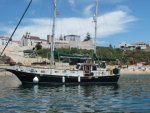
  • Sines @ anchor 003.jpg
    Sines @ anchor 003.jpg
    93.8 KB · Views: 0
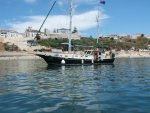
  • Sines @ anchor 001.jpg
    Sines @ anchor 001.jpg
    93.7 KB · Views: 0
Last edited:
So why don't cruising sail boats have any models with protected a helm?
You can't feel the wind on your face or the rain on your cheek when you are stuck indoors, nice and warm with the heater on, Brahms Third Symphony on the sound system and drinks being served from the cocktail bar.

Us old mountaineers think it a luxury that we don't have to walk everywhere!
 
Some people, who have cars for fun rather than practical transport, absolutely do buy cars without roof or windows:Pete

I forget the brand, but there was one that advertised with the strap-line (as I think they are called) "Has 93-million miles headroom".

(Even more at night, I suppose!)

Mike.
 
It may be worthwhile me adding that I reckon a sailing boat with an inside helm instead of an outside helm, is only a small improvement in my view; the big step forward is to have both, allowing as much masochism or hedonism as the owner feels he deserves, hour by hour.

Having said that...beautiful boat, Sandyman. :encouragement:
 
I am a huge fan of the Boreal and love the concept of their doghouse, BUT it is designed as a high latitude vessel.
 
There's truth in all of the above comments but the plain truth is you spend a surprisingly small amount of time at the helm of a sailboat on passage. Much more time is spent making around with the sails and it's far better to have a protected place where you can keep a lookout and do basic sail trimming than to have a protected helm.

Certainly it's not about having a protected helm per se, rather a protected watchkeeping position.

Maybe that's something else the OP might have missed, coming from motorboats? He sees all these exposed wheels and assumes he'll be sitting behind it in all weathers? Whereas in fact for many of us the autopilot does the steering while we sit wherever's comfortable (and has a view of the surroundings).

Pete
 
Yes, this.

Our IP has a central helping position at the stern which we sometimes sit at but mostly use when motoring. If the weather is fine we usually sit out on the stern quarter seats or if it's inclement closer in behind the spray hood while Otto the Ottopilot does his stuff. The trick is to have access to the necessary instrumentation from wherever you sit and of course keep a good watch - but that's more likely if you 're comfortable and alert not half-frozen and drenched hanging on to the wheel.
 
You conveniently omitted Southerly, who I feel developed the inside sailing station design very effectively.

I mourn their demise, although i don't think it was because they didn't design and build a (series of) successful and attractive 'wheelhouse' sailing yachts of smaller size over a considerable period of time.

The Southerlies had (mostly) the benefit of size to carry the superstructure. However, they were prime examples of such features resulting in a very expensive boat so limited market.
 
Top