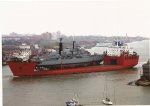
Why do Frigates need tugs?

Incidentally, the ferry captains are all qualified pilots for the ports they use.
Not always. The Northlink ferries out of Aberdeen always pick up the pilot for entry to the harbour. It always struck me as odd as they berth their boats there every day so you would think they know exactly what and when the pilot is going to tell them to do.
 
Not always. The Northlink ferries out of Aberdeen always pick up the pilot for entry to the harbour. It always struck me as odd as they berth their boats there every day so you would think they know exactly what and when the pilot is going to tell them to do.
That's crazy, you'd think that considering how often they visit that they would have someone with a Pilotage Exemption Certificate (PEC) on board, unless of course Aberdeen don't issue them!
Especially as needing a pilot ends up constraining your operations as you are relying on a pilot being available for every move, and weather for the pilot boat too.
 
Modern warships are also very thin-skinned and filled with pretty delicate stuff. The days of armour plating to defend against a broadside are long gone - the idea is not to be detected first and formost and, if detected, to avoid being hit by anything. They are designed to be at sea, doing their job, and are not optimised for harbour manoeuvring.

There are only so many warships to go round (generally fewer than ever) and the impact on the wider Fleet schedule for unexpected repairs is significant.

Plus - they belong to all you UK taxpayers out there. Not sure you would be too happy if they kept being laid up for fixing holes in the side.
 
Modern warships are also very thin-skinned and filled with pretty delicate stuff. The days of armour plating to defend against a broadside are long gone - the idea is not to be detected first and formost and, if detected, to avoid being hit by anything. They are designed to be at sea, doing their job, and are not optimised for harbour manoeuvring.

There are only so many warships to go round (generally fewer than ever) and the impact on the wider Fleet schedule for unexpected repairs is significant.

Plus - they belong to all you UK taxpayers out there. Not sure you would be too happy if they kept being laid up for fixing holes in the side.

They do keep being laid up. We taxpayers are extremely unhappy about it. They are either waiting to have their engines fixed, or “in refit”, or alongside for lack of crew, or alongside so the crew can spend time with their families, or alongside because HMG can’t afford the fuel, or under repair because they have hit something, or having building defects sorted out, or waiting for parts.DF8B067E-2B43-4A6D-BF15-7517B865A803.jpeg

HMS Nottingham, berthing without tugs!
 
Last edited:
They do keep being laid up. We taxpayers are extremely unhappy about it. They are either waiting to have their engines fixed, or “in refit”, or alongside for lack of crew, or alongside so the crew can spend time with their families, or alongside because HMG can’t afford the fuel, or under repair because they have hit something, or having building defects sorted out, or waiting for parts.
Its hard to disagree - and I suspect a discussion on the route cause would result in this thread vanishing.
 
"We taxpayers"

"families"

""afford fuel"

C, care to provide citations for your denigrating Hyde Park Corner-style generalisations ?


BTW, that pic of HMS Nottingham is 20 years old, which perhaps says something about the currency of your other claims.
 
Still meets the criterion 'quite expensive' in my book. Not to mention, that's avoiding the value of cargo.

If you're trying to suggest that there's no business case for using tugs on commercial shipping, then I'd disagree.
If you're trying to suggest that one very expensive thing is even more expensive than another very expensive thing, then I'm afraid I don't follow the relevance to the topic at hand.
I'm not trying to suggest anything. You asked an open ended question and I answered it with the fact that a frigate is about 10x more expensive than a large commercial ship.
I think the business case for most commercial ships using tugs is made by the fact that most commercial ships do use tugs.
 
They do keep being laid up. We taxpayers are extremely unhappy about it. They are either waiting to have their engines fixed, or “in refit”, or alongside for lack of crew, or alongside so the crew can spend time with their families, or alongside because HMG can’t afford the fuel, or under repair because they have hit something, or having building defects sorted out, or waiting for parts.View attachment 138838

HMS Nottingham, berthing without tugs!

Ah so that Old Saying , 'I joined the Navy to see the Sea' is a tad out of date then ? {:-))#
 
"We taxpayers"

"families"

""afford fuel"

C, care to provide citations for your denigrating Hyde Park Corner-style generalisations ?


BTW, that pic of HMS Nottingham is 20 years old, which perhaps says something about the currency of your other claims.

1. The RN’s own website, which tells us that one of the two carriers is alongside, as are both of the amphibious assault ships, whilst two of the six Type 45s Diamond and Dragon, are alongside “on deployment” at Portsmouth and three are in refit. One, Defender, is actually on deployment.

Of the frigates deemed to be “on deployment”, Richmond and Sutherland are alongside at Plymouth, and St Albans is alongside at Portsmouth, whilst Westminster is the “fleet ready escort” which means that she is alongside but able to proceed to sea. Three frigates - Kent, Montrose and Northumberland are actually operating. Five are in refit and in a somewhat Ruritanian touch the RN has included, as “not on deployment”, two Type 26s that are being built.

2. Conversations with serving officers. Including some remarkable information on the Type 45s main engines, and the time already taken and yet to be taken to sort them out.

3. Fuel: Conversation with a member of the Treasury Solicitor’s Office.

Yes, it’s an old picture. (Count the tugs…)

So are Captain Sensible’s?
 
Yeah, six months.

Should you look on occasion at the website I linked to, you will gain a much better idea of how the RN is spending your taxes. Its also a site that criticises where deemed necessary. But in a different way to the.....Daily Mail.
 
Yeah, six months.

Should you look on occasion at the website I linked to, you will gain a much better idea of how the RN is spending your taxes. Its also a site that criticises where deemed necessary. But in a different way to the.....Daily Mail.

Do you mind!! I would not be seen dead reading Viscount Rothermere’s Organ!
 
I'm not trying to suggest anything. You asked an open ended question and I answered it with the fact that a frigate is about 10x more expensive than a large commercial ship.
I think the business case for most commercial ships using tugs is made by the fact that most commercial ships do use tugs.
Not only is it vastly more expensive they are designed differently to a cross channel ferry. A Ferry is designed in the knowledge that it will need to dock in harbour perhaps twice a day, every day for years. it also needs to be cheap to run and have quick turn arounds to boost the economic case so the ability to avoid using tugs is valued . A Frigate may dock once or twice a month or less over her lifetime so the cost implications per docking are much lower, the benefit from making her an easy ship to moor are less and the consequences if she damages something are much greater.
 
I am reminded of the late, great, Donald Sinden’s account of the filming of “The Cruel Sea”.

The whole interview is fun - the sea scenes - and they are sea scenes - a tank was only used for the “sinking of Compass Rose” sequence - had to be filmed with a camera on land, so the filming was done on the South Coast and when they wanted “bad weather” they steamed through Portland Race.

Jack Hawkins, the other actors and the camera crews had the open bridge to themselves and Captain Jack Broome (who was “the real thing” and had commanded the escort of PQ17) actually conned the ship from a real bridge, built one deck down, peering out through holes made for the purpose.

Anyway the very last scene to be filmed involved the frigate “Saltash Castle” coming alongside in Devonport, without tugs, into a space that she could only just fit into. Captain Broome did this perfectly and in the ensuing celebration some rum may have been taken… alas one of the cameras hadn’t been running and the scene had to be done again… this time the film frigate clouted the very real destroyer ahead of her!
 
Last edited:
I am reminded of the late, great, Donald Sinden’s account of the filming of “Thr Cruel Sea”.

The whole interview is fun - the sea scenes - and they are sea scenes - a tank was only used for the “sinking of Compass Rose” sequence - had to be filmed with a camera on land, so the filming was done on the South Coast and they wanted “bad weather” they steamed through Portland Race.

Jack Hawkins, the other actors and the camera crews had the open bridge to themselves and Captain Jack Broome (who was “the real thing” and had commanded the escort of PQ17) actually conned the ship from a real bridge, built one deck down, peering out through holes made for the purpose.

Anyway the very last scene to be filmed involved the frigate “Saltash Castle” coming alongside in Devonport, without tugs, into a space that she could only just fit into. Captain Broome did this perfectly and in the ensuing celebration some rum may have been taken… alas one of the cameras hadn’t been running and the scene had to be done again… this time the film frigate clouted the very real destroyer ahead of her!

What is interesting is that those Rivers class frigates were about 60% of the displacement of the Rivers Class OPVs currently in the Royal Navy and about 30% of the displacement of a T23
 
What is interesting is that those Rivers class frigates were about 60% of the displacement of the Rivers Class OPVs currently in the Royal Navy and about 30% of the displacement of a T23
It's amazing how much space you can save if you stack the offwatch like cordwood.
 
What is interesting is that those Rivers class frigates were about 60% of the displacement of the Rivers Class OPVs currently in the Royal Navy and about 30% of the displacement of a T23
Two of the current ones are on a minimum five year deployment in the Pacific.
 
Top