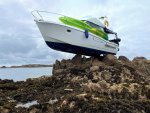
Whoops - Boat Crashes in Ecrehous (Jersey)

Also, among the key safety features of traditional techniques of navigation are healthy doses of uncertainty and of fear!
I remember my days of navigation training in those sleek grey messengers of death ... traditional methods of navigation weren't for the faint hearted, it certainly got the heart rate/blood pressure up and saw grown men reduced to tears. At the end of the day planning helps and chart plotters don't encourage detailed planning.
 
Of course i aim to use charts and tide tables for planning and then use the chart plotter as navigation

So are you saying that if i was to plot that course using Navionics it wouldnt tell me the location and depth of those rocks?

I thought that was the whole point of them of the software etc

To further answer your question, taking the 2.2m draft boat in that I help out on, I'd probably use a chart plotter to get to a waypoint a bit offshore- probably chosen with the help of the Shell Channel Pilot (always with the relevant charts out on the chart table ready to be cross referenced).

I'd then use the first transit (a pointy rock between two flat rocks) and follow that in (NB. due to the tide, straight in along the transit may actually require pointing off to the side a bit). Checking with the compass that I was heading in the direction expected

Then I'd follow the second transit (a black day mark in line with a white pole). Again with compass checks

In the back pocket would be my notebook with expected depths, directions to turn if I feel it's starting to go wrong and a basic hand drawn route with directions, and methods to check I'm on the safe route (like minimum depths, clearing bearings etc.)

I wouldn't be looking at any chart plotters by this point, pilotage is the art of being certain where I'm not. That requires mk1 eyeball.

Making an unknown landfall and entering an unknown anchorage is one of the greatest pleasures.
 
ignore the echo sounder and transits and clearing bearings at your peril.
Genuine question: how do you, practically, use clearing bearings? I completely understand the principle (typically based on a limiting danger line, offset for the standard to stern distance) but when/how do you utilise this in a mobo? The advantage of trusting a hand magnetic compass or a set of binos with a magnetic graticule in a bobbing boat over a modern chart plotter isn’t immediately obvious (hence the question) . I do, however, use radar clearing ranges, when there’s a good cut and totally agree on transits.
 
Genuine question: how do you, practically, use clearing bearings?
By having them pre planned on the chart and/or note book ... annotating not more than or not less than NMT/NLT i.e. NMT 260° so as long as the bearing doesn't go above 260° you are in safe water. Alternatively look down the bearing and check you are on the safe side, I was always taught 1° at 1 mile = 35 yards.
 
By having them pre planned on the chart and/or note book ... annotating not more than or not less than NMT/NLT i.e. NMT 260° so as long as the bearing doesn't go above 260° you are in safe water. Alternatively look down the bearing and check you are on the safe side, I was always taught 1° at 1 mile = 35 yards.
I also have a habit of writing "SAFE S" or SAFE P" so I don't have to waste time working out which way to turn if I go unsafe.
 
forget all these electronic gizmos-----if going into an unfamiliar rocky area----slow speed and someone standing on the bows to guide you in should keep you safe-------------ps fished the paternoster reef a few miles up the coast for 7 years
 
Top