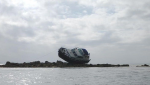
Whoops - Boat Crashes in Ecrehous (Jersey)

... yacht in the Volvo Ocean Race around the world literally crashing into a reef in the Indian Ocean at full speed at night - simply because they did not know it was there, because nobody had zoomed in enough on the plotter to bring it up.

There was a similar accident in the Pacific when we were there (2017 or 18ish?) and I think it was Navionics which that crew held to blame for their stranding/yacht loss.
Being in the area I pulled out our tablet to have a look at this 'uncharted' reef and discovered that you did indeed need to zoom in to a very small scale before seeing that the reef was actually at or just above sea level. However, at a scale still displaying about half of the South Pacific, the screen showed a dark blue area amidst tens of thousands of square miles of white; if my route had been passing directly over that blue bit, I'd have probably thought it worthwhile to have a closer look - you're not exactly 'busy' out there.
 
There was a similar accident in the Pacific when we were there (2017 or 18ish?) and I think it was Navionics which that crew held to blame for their stranding/yacht loss.
Being in the area I pulled out our tablet to have a look at this 'uncharted' reef and discovered that you did indeed need to zoom in to a very small scale before seeing that the reef was actually at or just above sea level. However, at a scale still displaying about half of the South Pacific, the screen showed a dark blue area amidst tens of thousands of square miles of white; if my route had been passing directly over that blue bit, I'd have probably thought it worthwhile to have a closer look - you're not exactly 'busy' out there.

Ive used Navionics for chart plotting practice and it tells you if your boat is on a collision course.

Just as long as you put in the correct boat draft in the boat settings

:unsure:
 
Interesting that the examples given for groundings when the crew were using a plotter relate to operator error (not zooming in) as opposed to something not being charted.

I don’t disagree about having paper aboard and using it occasionally to keep skills up and we often have a paper chart on the chart table that I will cross reference with the plotter when in unfamiliar waters, but in reality we do what most do and that is to navigate quite safely using electronics as the primary source.

When passage planning I always go along the track and zoom in to the lowest level to ensure that there aren’t any hidden nasties and when under way will use other sources (e.g. radar, pilotage), particularly in tricky spots such as river entrances, to make sure we are in the right place. But the plotter is the primary tool.
.
 
This is very relevant: Vestas Wind on the Reef
Excerpt: It takes thought to have sufficient redundancy after a move to electronic charting, but even that is not enough. Nothing shows that more clearly than how the 2014-2015 Volvo Ocean Race ended for Team Vestas Wind, with the boat lost on a large reef in the Indian Ocean. On board were some of the most experienced ocean sailors in the world. The captain was an Olympian sailor with 20 years professional experience. The navigator brought an extensive sailing resume with experience from America’s Cup, Admirals Cup, TP52 Med Cup, Middle Sea Race, Fastnet, TransPacific Cape Town to Bahia, two TransAtlantic races, and Sydney to Hobart. These are pros and yet their raced ended early on a reef in the Indian Ocean.
 
For someone looking to buy my first boat this is my worst nightmare.

I'll buy buying a boat that has Garmin or Simrad systems installed. And an iPad with Navionics

What do you think is the cause?

Poor planning or not having the right equipment/software that wouldve warned them?

Or both

:cautious:


Errors like this often have at their root a Loss of Situational Awareness.

You get into a tight corner, under stress, fail to appreciate the warning signs, something unexpected happens and when you return concentration to the task in hand, you fail to pick up where you left off, making irrational or just rushed decisions, having lost the thread.

In places like that you sometimes only need a short out for a few seconds to be in trouble, Particularly at any speed and with the tide setting hard. As a prospective first boat owner, it may be a worry for the future, not now.

.
 
this reminds me of one of my almost-sunk moment .. we came out of a channel in Germany, on the Elbe river close to the mouth of the river and wanted to motor towards Hamburg. So we clear the lock and Im all busy stowing fender and pumping out ballast water when I notice a enormous 20" steel buoy rushing towards us ... I was thinking well this is an unusual boat that looks like a buoy ..... wait a minute ... I "forgot" that the Elbe river is a tidal river and it was the current sweeping us full steam towards it. So I jump in the cockpit and steer out of the way.

And we had all the experience you would need.
 
In my day job I'm an airline Captain, ex RAF. In both flying and boating you are likely to have an incident early on that defines your career. How you react to it and learn from it is what really matters.

When we brief an approach into an airport, its similar to pilotage. Reading off the clearing bearings/transits/landmarks is the easy bit. We dig down into the HOW's.
How will you do it?
What will you say and what response do you expect?
How can you tell if it's not going to plan?
What do you want your crew to say?
What is plan B or C and how will you execute it?

The 6 P's never let you down ?
 
Ive used Navionics for chart plotting practice and it tells you if your boat is on a collision course.

Just as long as you put in the correct boat draft in the boat settings

:unsure:

I've no problem whatsoever with electronic charting, including Navionics, those are what we use 95% of the time; but my advice to you for when you take to the water is always carry at least basic/passage paper charts for the area that you're sailing and never accept what either, but most especially those electronic charts are telling as the gospel truth - question everything and look around to see what you can see for yourself.

"...it tells you if your boat is on a collision course. Just as long as you put in the correct boat draft in the boat settings"

But does it?
Are you absolutely sure that you've input that draft info correctly? Are you sure that nobody's changed it since? Are you 'bet your life' sure that the unit's working correctly anyway?
Does the Navionics system adjust for the predicted tidal height? and even if that too is a yes, does it do so for that 'precise' location? Even if the answer's yes, are you sure that this info too has been correctly loaded and also that your iPad's set to the correct local time/date?
if the answers are still all yes, then how is your iPad adjusting for the current air pressure? and also the wind strength and direction; not only right now, but over the last few days too? If you're inshore in a river estuary or similar, it'd be as well to tell your iPad how much it has rained both locally and upstream in the river's catchment area during the last few days too. Tidal 'predictions' are fine when you're practicing ashore, but they can bite you once you're afloat
I'm sure that my list of what ifs & what abouts isn't exhaustive, but I'm hoping that it's demonstrative? Consider too, that if you're sailing on top of 1000m of water an in the midst of it you 'safely' clear a 5m deep shoal, you're still likely to find yourself in some very deep sh1t.

Electronic charting coupled to GPS - I never even started on trusting to the signal that's giving you, they seem to drop out particularly regularly in the eastern Pacific and the area to the north of the Virgin Islands - is a truly wonderful tool, but it's exactly that 'a Tool' and it can slip and hit your thumb just as hard as any hammer; use it with caution and keep a good all around look out. (y)
 
We've already had one aircraft pilot on here, and there's plenty of others too, but here's how I approach navigation based on my flying experience, which is surprisingly relevant.

My Druine Turbulent which I flew around Europe and as far south as Casablanca had what's called a limited panel - no artificial horizon , no direction indicator, no AIS, no VOR, just a compass. And no GPS - it hadn't been invented. So all my navigation was dead reckoning with a watch and some snazzy mental arithmetic which I probably couldn't do now. I will admit that I did get lost once, in northern Spain, but that was because in those days there were no reliable VFR charts west of Santander and north of Oporto so I had to use Michelin roadmaps, which meant that on one glorious occasion I was forced to do something I'd always wanted to do - descend low enough to read the name of a railway station.

I've never lost the old habits and although I love the GPS on our boat when coastal sailing I always, always, always regard it as confirmation of my position, not the primary source. On one memorable occasion I had a professional crew on board who were steering in the dark straight for a charted obstruction at the entrance to a harbour and when I questioned the course I was told they were following the GPS.

I prefer raster Admiralty charts to any of the vector charts, because I trust the Admiralty cartographers a bit more than some underpaid and overworked coder in Mumbai or wherever, and I use the VMH chartset on my plotter (and paper backup although I admit these are gradually getting out of date).

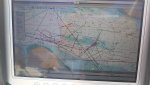
The second picture is relevant to navigation - AIS is a wonderful thing, and I do use it , but look what can happen on a busy day in the Solent. Try spotting a navigation hazard in all that clutter! On days like that I turn the AIS off, rely on the Mk.1 eyeball to spot traffic, turn NAV off on the autopilot, and either hand steer or use AUTO with lots of adjustments.

Lagos.jpg

20190330_132747 resized.jpg
 
...relevant to navigation - AIS is a wonderful thing, and I do use it , but look what can happen on a busy day in the Solent... On days like that I turn the AIS off, rely on the Mk.1 eyeball to spot traffic.

I'd forgotten all about the AIS; another fantastic 'tool' and perhaps the one which brought us the nearest to disaster? I was off watch while sailing south down the Florida coast, below Cape Canaveral when something - I suspect the VHF radio squawking, but perhaps a first five blasts? - woke me. The next five blasts had me leaping from my bunk to push past/over/through my crewmate sitting on the top step of the companionway where it was warmest, to discover we were on a collision course and within 200m of a well and correctly lit tug alongside a barge and pulling another one! I frantically re-directed the windvane blade and worked the sails to turn us through 40-50* and sail down the side of them, with a soundtrack of an unimpressed tug-boat Captain on the radio and my crewmate complaining bitterly about the barge's failure to transmit any AIS signal, or trip our AIS's proximity alarm.
 
If you want to have a really good cringe about AIS read the report of the loss of the Helge Ingstad: Norway Releases Frigate Helge Ingstad Collision Report
I recently heard a call on VHF Ch.16 from American "Warship 76" (might have been 67) while I was approaching Plymouth. He was calling "the white motorboat west of me". I replied, identified myself and gave my position, and asked if I was the boat he wanted to speak to. He wasn't sure. I asked him to look at the AIS to see if our boat name was the one he was concerned about (we transmit AIS class B). "I don't have AIS" he replied.
This was a freakin' US Navy warship conducting live firing exercises (so he was saying on his occasional gabbled broadcasts) close inshore off Plymouth. And he didn't have AIS.
I called NCI on 65 and they confirmed I was transmitting AIS correctly.
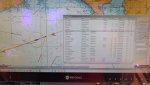
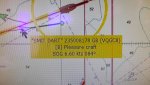
The warship was attended by the Smit Dart range boat. Never heard a peep out of them. And the range boat was transmitting on AIS that it is a pleasure craft. See the screenshots. Anyone in the Plymouth area can have a look next time it goes to sea and see if it's still doing that.
US Navy warships are never the sharpest tools in the box, after reading other recent accident reports, so none of this is a surprise. I followed the Colregs and maintained my course, heading and speed because there was no danger of collision with anything.
I'm beginning to think the typical UK recreational sailor and motorboater with a bit of RYA training, a habit of preparing passage plans, and a healthy attitude towards risk is no worse than some of the so-called professionals out on the water these days. Shane will be as good as any with a bit of practice and experience.20210420_133035 resized.jpg20210420_133157 resized.jpg
 
Learn the basics first, day skipper and yacht master. Go out with friends first, if you buy a boat, buy a small one first and work your way up.

Basic navigation, tide tables , paper charts, pencil and paper. Chart plotters are an aid to navigation only, use experience, common sense and Mk one eyeball, do not rely on an an electronic gizmo.

I have seen people navigating and driving by looking at a plotter and not out of the windscreen its scary.
 
Lots of people who hit rocks etc, or go aground think they know exactly where they are.

Indeed they do. As Tom Cunliffe puts it, though, pilotage is more about knowing where you're not!

Also, among the key safety features of traditional techniques of navigation are healthy doses of uncertainty and of fear!

Plotters are brilliant, but ignore the echo sounder and transits and clearing bearings at your peril. The only thing that tells you reality in real time is the echo sounder and your eyes.

I heartily agree. In my view, the two key dangers of plotters etc., useful and wonderful as they are, are (a) in giving a false sense of certainty and accuracy, and (b) in distracting the user from actually, and actively, looking around. (I have some expertise in this area, having fallen into those traps more than once myself!)

All of us who venture to sea get ourselves in a pickle from time to time, but those who are overly reliant on plotters and the like may well not realise they are in a pickle until it is too late.

I find it difficult to believe that a large rock such as the one this boat came to grief on, in strongly tidal waters, would not have been evident from the disturbance of the sea surface in its vicinity. It would in any case have been been revealed by the cheapest and most basic echo sounder, had anyone cared to look at its display.

What do you think is the cause?

Poor planning or not having the right equipment/software that wouldve warned them?

Or both

You don't need any electronic nav aids at all to safely navigate, so unless they were lacking basics like a compass, binoculars, chart, and echo-sounder (or even a hand lead line!), that doesn't seem the cause. (The only 'software' needed is in your head!)

Quite whether this boat came to be there through navigational failure or loss of control of the boat, I don't know, but the former is the most likely, I think. That would fall under, but not exhaust the possibilities of 'poor planning'.

Even losing control of the boat (e.g. engine, rudder or anchor failure) could amount to poor planning: it's always wise to be thinking when you're in a dangerous situation (off a lee shore, uptide of something hard) 'what will I do now if the engine suddenly stops' (or wind dies, as the case may be) - in most case it will be simply a case of giving yourself more room to recover the situation.

So I don't know, but guess the cause is most likely to be poor navigation, and in particular the navigator's poor appreciation of the limitations of his/her own skills and equipment (it's what gets most of us!). It could be failure to provide an adequate safety margin to deal with equipment failure (though this is challenging to achieve in the demanding waters where this happened). It could be sheer bad luck. (Though research shows most accidents are a sequence of failures, and if any one of them could have been avoided (e.g by the maintenance, diligence or quick response by the skipper) the adverse outcome would have been avoided.)

For someone looking to buy my first boat this is my worst nightmare.

Please don't be disheartened or very worried by this accident, or the various advice given in this thread. While occasionally vengeful, the gods of the sea are generally quite benign if not overly provoked. Despite being potentially very dangerous, serious accidents in boats are exceedingly rare. Even this one, in challenging and dangerous waters, seems to have turned out OK.

There can be few of us sailors who have not got it wrong some (or even many) times, but most of us have lived to tell the tale and simply gained experience (if only the knowledge of how not to do it!).

The basics of navigation etc., are easily learnt, and from then on it's hard not to go on developing and refining both your knowledge and skills, and your awareness of their shortcomings.

I hope you get your boat and have a great time in it.
 
Last edited:
If you want to have a really good cringe about AIS read the report of the loss of the Helge Ingstad: Norway Releases Frigate Helge Ingstad Collision Report
"I don't have AIS" he replied.
This was a freakin' US Navy warship conducting live firing exercises (so he was saying on his occasional gabbled broadcasts) close inshore off Plymouth. And he didn't have AIS.

Just a thought, a warship transmitting AIS would surely give the game away?
 
I find it difficult to believe that a large rock such as the one this boat came to grief on, in strongly tidal waters, would not have been evident from the disturbance of the sea surface in its vicinity. It would in any case have been been revealed by the cheapest and most basic echo sounder, had anyone cared to look at its display.

You may well be right about the tide, but the tricky thing about rocks for those of us who normally sail in muddy places is that they don’t shelve like we’re used to and the depth sounder may not give any warning. If he’d come at it from the direction the top-right picture was taken from - remember the boat may very likely have swung around on hitting the rock or while settling onto it - how much warning would he have had from the depth dropping off?

Pete
 
Whoever was at the helm on that boat could have taken his / her eyes off the ball for a couple of seconds, that's all it takes around there. Of course, being a local vessel they probably should have known this too.

Indeed there would have been some disturbance on the surface but with the tidal eddies, mini-overfalls and inconsistent flow directions, it can be hard to spot especially if it's a bit overcast.

In my profile photo is the boat I used to go fishing in around that exact area - notice where the wheel is - it's there for a good reason.
 
Top