Whitlock King Cobra mk6

MickToo

New Member
Joined
13 Jun 2024
Messages
19
Visit site
Yet again I've got knocking / clonking being experienced through the helm, which is almost certainly emanating from the "maintenance-free*" bottom bearing of the vertical shaft in the Whitlock Cobra steering pedestal.

I know that the steering arm is welded to the bottom of the vertical shaft and that has to be removed - however, given that the bevel gear quadrant at the top end is secured with stake-pins, my question is: 'is there any good reason not to drill and through bolt the steering arm to the shaft rather than renew the weld?'

Bolting all the way through will have the effect of clamping the bracket to the shaft and will have the added benefit of improved ease of removal / replacement when the offending bearing next fails, as surely it will.

* By "maintenance-free" I mean it's a sealed ball-race bearing and there's no facility to undertake any maintenance of it without major disassembly of the pedestal, currently requiring grinding off the welds on the steering arm and re-welding same on reassembly.
 
Not clear of your exact details but if the bottom bearing of your pedestal is a 90 degree bevel box with play, you may be able to adjust the.bearing clearance with the shims built into the casing without removing the shaft.
 
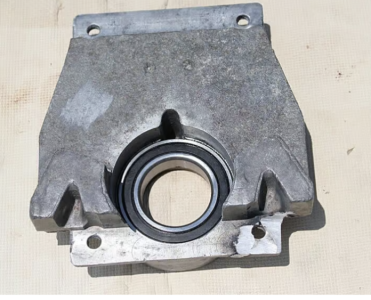
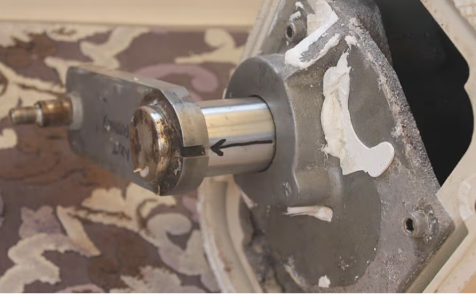
The bottom bearing is not adjustable - here's some images copied from someone else's blog to help illustrate the issue - it's not the same Whitlock model but it's the same design concept.

The first image shows the underside of the bearing housing (pedestal fully assembled, laying on its side), the second shows the ball-race in its housing as viewed from above

1000026994.png1000026993.png
 
Understood. Clearly needs the clamping bracket unwelded and removed. Removable bolts makes sense but would that stop any play between shaft and quadrant. Not sure how other Lewmar systems do this but I would have expected a clamping system - but that probably means replacing the quadrant.
 
Why not simply drive out the roll pins then the shaft can be withdrawn. Probably not in situ as there is unlikely to be clearance between the cockpit floor and the hull so you will have to remove the pedestal.
 
Ah, if only Whitlock had made disassembly so easy - the vertical shaft has a greater diameter immediately above the bottom bearing, indeed the shaft bears down upon the bottom bearing and thus replacing the bottom bearing requires removal of the bearing carrier plate which in turn is dependent upon removal of the steering arm (which is welded to the bottom of the vertical shaft)
 
For what it's worth: I have just renewed the bearings on my Cobra. The decision I took was that the welded steering arm was too slim to safely through- bolt. Looking at drawings of the older models, the bolt on steering arm was a considerably beefier item. The fact that a friend is an expert welder may have helped the decision!
 
Thanks Martin, not as hoped but useful nevertheless.

Mine is circa 2002 - I've not yet measured the thickness of the arm but based on your comments, drilling & bolting is likely not going to be an option.

Thus it appears I may be stuck with having it ground off and welded back 🤬
 
So, to continue the saga - now that our sailing season is finished for the year I've removed the Cobra 6 pedestal, ground away the output arm to vertical column weld and removed the output arm, removed the bottom bearing carrier and cut away the remains of the bottom bearing races.

I think that only 3 or 4 of the balls remained identifiable as such, the rest had rusted and eroded to dust, and thus both the inner and outer races separately required careful slicing to enable their removal.

I'm intending to also replace the input shaft bearings (x2 - slightly worn) and the outer nitrile seal (largely disintegrated). I have yet to commence this task but I believe these parts to be 55mm o/d x 30mm i/d (x 13mm and x 7mm depth respectively)

I have a couple of exploded diagrams for the entire pedestal as attached - can anyone provide any "hands on" advice concerning dismantling of the input shaft assembly?

Is it simply a matter of removing the 4 bolts securing the cover, removal of the input shaft assembly from the pedestal and thereafter removal of the circlip retaining the outer bearing to disassemble? Or is there another fixture holding the input shaft assembly together?

TIA!
 

Attachments

Regarding bearing replacement, you can get stainless steel bearings with the seals, talk to a bearing supplier and he'll get them for you. From experience they are not much more expensive.
 
Regarding bearing replacement, you can get stainless steel bearings with the seals, talk to a bearing supplier and he'll get them for you. From experience they are not much more expensive.
Yep indeed - replacement bottom bearing already on order in stainless. I'll take the same approach for the input shaft. Whether Lewmar/Whitlock as OEM spec'd stainless steel is open to conjecture...

I am intending to coat the bearing casings with a film of anti-seize mineral grease to hopefully increase their longevity. It could of course be time and effort wasted.
 
A most helpful gentleman in the US has confirmed from recent first hand experience that it is solely the circlip that holds together the input shaft assembly - in case anyone is wondering!
 
Yet again I've got knocking / clonking being experienced through the helm, which is almost certainly emanating from the "maintenance-free*" bottom bearing of the vertical shaft in the Whitlock Cobra steering pedestal.

I know that the steering arm is welded to the bottom of the vertical shaft and that has to be removed - however, given that the bevel gear quadrant at the top end is secured with stake-pins, my question is: 'is there any good reason not to drill and through bolt the steering arm to the shaft rather than renew the weld?'

Bolting all the way through will have the effect of clamping the bracket to the shaft and will have the added benefit of improved ease of removal / replacement when the offending bearing next fails, as surely it will.

* By "maintenance-free" I mean it's a sealed ball-race bearing and there's no facility to undertake any maintenance of it without major disassembly of the pedestal, currently requiring grinding off the welds on the steering arm and re-welding same on reassembly.
Bolting it through is a common workaround people end up doing when they get tired of cutting and re-welding that joint every time the bearing goes. It does make future removal easier and it clamps the arm more reliably than a tired weld.


The only caution I’d have is to make sure the bolt you use is properly sized and aligned so you don’t introduce play or stress points in the shaft. If the quadrant is already pinned at the top, the system isn’t relying on that weld for primary strength anyway.


Plenty of folks have gone the bolt route without issues. Just take your time with the drilling and keep everything straight.
 
Top