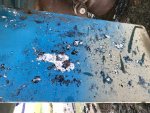
White deposits on rudder

Keith-i

Well-Known Member
Joined
4 Jul 2012
Messages
1,475
Location
Jersey
Visit site
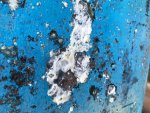
My rudder accumulates these hard white mineral like deposits which appear quite quickly after relaunch, perhaps within a month this year on a drying mooring. It is a bronze rudder and not electrically connected to the zinc anode or for that matter any other electrical path. Any thoughts please?
 

Attachments

  • IMG_1703.jpg
    IMG_1703.jpg
    438 KB · Views: 0
  • IMG_1701.jpg
    IMG_1701.jpg
    505.4 KB · Views: 0
They look calcareous to me, and some parts within the white mass look like the remains of barnacle shells, but it's impossible to say with absolute certainty from a photograph.
 
It certainly gives the appearance of being calcareous but I'm pretty sure it is not marine life based as the rudder was cleaned down and anti-fouled a month or so prior to it appearing.
 
Could it be the corrosion you get on poor quality bronze, due to impurities? It looks like there are quite a few corrosion craters. Maybe Vyv Cox can help with identification.
 
Could it be the corrosion you get on poor quality bronze, due to impurities? It looks like there are quite a few corrosion craters. Maybe Vyv Cox can help with identification.

Yes, if it's not calcareous the only white compound that occurs to to me is a zinc sulphide compound of some kind, and perhaps Vyv can help with his knowledge of bronze corrosion when subject to periodically anaerobic conditions.

Edit: or perhaps periodically anaerobic conditions are not implicated, and it's some form of zinc carbonate or oxide.
 
Last edited:
I've seen zinc carbonate deposits like that, but that was in a very non-typical situation (volcanic fresh water lake with highish carbonic acid content). Seems unlikely that its that in salt water in UK. A Mystery?
 
Starting from the assumption that it could be calcium carbonate (you believe it isn’t, I realize) or a zinc compound, then if you scraped off a little of the top of the deposit and tested it with a few drops of hydrochloric acid (e.g. ‘brick acid’) then all the above zinc solids, and of course calcium carbonate, should dissolve - with bubbling of gas (CO2 from a carbonate or H2S from a sulphide) or without (oxide/hydroxide or chloride).

But your interest would presumably be if it is zinc or calcium, and you could try to find out by subjecting the resulting solution to a flame test, in which calcium gives a red colour. That would be my thought about distinguishing them without special reagents, but somebody else might have a better idea. (https://en.wikipedia.org/wiki/Flame_test; appropriate precautions, of course.)
 
Thanks for the chemistry lesson. I’ll scrape a sample off later and run some tests.

One thing I should have added: first rinse the deposit to be scraped with deionized water; otherwise Ca from seawater (or even from a hard fresh water rinse) might give you a red colour.
 
Having donned the white coat and goggles I can now tell you that it fizzes nicely in HCl (no smell of rotten eggs so presumably not H2S) and produces a pronounced orange glow when in the flame of a blowtorch. Orange means sodium, does it not?
 
Did you catch my post about rinsing the deposit with deionized water to remove any seawater dried on it, which might otherwise contaminate your scraping with sodium and calcium?

Another point occurs to me, belatedly (I’m ashamed to say :(): a cheap acid might itself contain calcium or sodium if it was diluted with mains water at manufacture, so you should do a flame test ‘blank’ with just the acid. Sorry I did not think to add that, but it’s easy enough to do.

If the acid alone gives the same colour and intensity, the test is no good of course, and you’d need to find a purer acid if you wanted to persist.

If the acid blank proves OK but you did not rinse, I’d have another go.

But if the acid blank proves OK and you did rinse before scraping, it does suggest calcium.

Wiki says the calcium flame is seen as light green through blue glass, so you could try that - and you could dissolve a scrape of a shell and a scrape of zinc from a galvanised object to check the calcium and zinc colours in your own flame (zinc is supposed to be ‘colourless but perhaps appearing blue green’).

On the other hand, if it’s important enough you could seek an instrumental analysis of the deposit– perhaps try a local college?

Or if it’s just a curiosity, take a closer look with a magnifying glass?
 
Thank you for your informative post Hydrozoan. I ran my tests before seeing your post to rinse the sample first, but I have enough scrapings to have another go tomorrow. I also misunderstood the process of using the flame test on the residue from the acid test. I just placed a bit of the fresh sample in the flame so I guess that was meaningless really. Will report back after another go! Must also find a suitable crucible now.
 
Thank you for your informative post Hydrozoan. I ran my tests before seeing your post to rinse the sample first, but I have enough scrapings to have another go tomorrow. I also misunderstood the process of using the flame test on the residue from the acid test. I just placed a bit of the fresh sample in the flame so I guess that was meaningless really. Will report back after another go! Must also find a suitable crucible now.

I hope it's clearer now - and don't forget the flame test blank with just the acid alone. Best of luck.
 
Well I gave it my best shot but I'm not sure it was up to laboratory standards. I can't seem to get any colour other than orange showing whatever I do so I'm going to work on the basis that it's some calcium product. Quite why it should form on my rudder in such random lumps and so quickly is intriguing though.
 
Well I gave it my best shot but I'm not sure it was up to laboratory standards. I can't seem to get any colour other than orange showing whatever I do so I'm going to work on the basis that it's some calcium product. Quite why it should form on my rudder in such random lumps and so quickly is intriguing though.

You say you got only orange - I hope that you got it much more intensely/clearly in the flame test with the dissolved deposit than in the 'blank' flame test with the acid alone (otherwise your conclusion would be invalid).

Assuming that was so, although such a relatively crude test cannot be absolutely definitive your working conclusion seems at least reasonable. It is curious. Have you looked at the photographed patch of deposit under magnification? I keep seeing hints of barnacles (the appearance of a few shapes resembling volcano craters) in your photographs - but it's probably just me!
 
Last edited:
Top