Which way round do you fit your anode?

Which way round do you fit your anode?


  • Total voters
    74
I fitted my anode today with the thinner end forward and fat end aft. Seemed logical to me as its more streamlined. Couple of chaps from one of the boat services businesses commented that I had it the wrong way round. So, I wondered, what do other people do? (I would have just looked at other boats, but there are too few of us out of the water at the moment, to get an idea).

I dont have one so I guessed the thin end first.
Now looking at the poll results it appears the majority go for the fat end. In practice it surely can't make that much difference either way.
 
Indeed. I was going to suggest that Phil not bother swapping it as the difference in drag must be unmeasurable, but I suspect he will do so anyway :)

Pete

Yeah, done while watching the paint dry. I am sure it won't harm my racing strategy of "start from the back and follow everyone else". But should we broach, at least nobody can laugh at my anode fitting skills :)
 
I had exactly this dilemma last year on a big refit. So I called the technical manager of the McCompany. Asked which way round he assured me that there is there a correct way to mount them and its important to adhere to this (apparently)....answer...its important to put the flat side against the hull. So there we have it, from the horses mouth. Glad to clear this up.
 
I had exactly this dilemma last year on a big refit. So I called the technical manager of the McCompany. Asked which way round he assured me that there is there a correct way to mount them and its important to adhere to this (apparently)....answer...its important to put the flat side against the hull. So there we have it, from the horses mouth. Glad to clear this up.

;:D
 
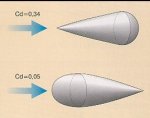
Drag coefficients are not very intuitive.

It is easy focus on the "leading edge", when the profile of the "trailing edge" is actually more important.

Have a look at these drag coefficients and you can see that reversing a teardrop shape so the blunt edge faces forward has about 1/7 of the drag of installing the shape the other way around.

I think most would expect the results be reversed, or at least be very surprised by the dramatic difference, which is why so many anodes are installed backwards.
 

Attachments

  • IMG_1806.JPG
    IMG_1806.JPG
    16.3 KB · Views: 1
Last edited:
This was sussed out by Elizabethan or earlier ship builders, when they realized the ideal shape for a fast hull was "Cod's head and Mackerel tail" - that is, a blunt bow with a tapered aft section. Hull shapes have to be modified to incorporate wave cutting forms at the waterline, but look at the bow of any freighter there days and you'll see that the under water profile has a bulbous bow profile, as do "hunter killer" submarines.
 
This was sussed out by Elizabethan or earlier ship builders, when they realized the ideal shape for a fast hull was "Cod's head and Mackerel tail" - that is, a blunt bow with a tapered aft section. Hull shapes have to be modified to incorporate wave cutting forms at the waterline, but look at the bow of any freighter there days and you'll see that the under water profile has a bulbous bow profile, as do "hunter killer" submarines.

The purpose of the bulb is to deliberately create a bow wave separate to the one mad by the main part of the bow. Thsi has a neat effect of reducing the main wave and that apparently reduces drag.

So why blunt at the front? if you can get away with it, it means there are fewer tricky to use nooks and crannys. Water is easy to push (youll see what I mean when you get to the end of the sentence) but a real bugger to pull. So you can have a bow that shoves it aside, but if you have a blunt rear end it ll goes horribly wrong, creating turbulence which is possibly worse than trying to exceed "hull speed"
 
Top