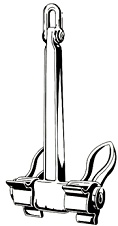
Which main anchor?

Voile et Voilier tested lots of anchors in their May 2003 issue.

The rankings had: (rank, type, weight, pulls in sand and gravel, price)

1 CQR 16.5Kg 900+650Kg 445 Euros
2 Brake 21Kg MPI 1000+650Kg 349 Euros
3 Spade (galv) 15Kg 900+300Kg 388 Euros
4 Kobra Plastimo 16Kg 750+400Kg 165 Euros
.
10 Delta Lewmar 15.5Kg 400+300Kg 299 Euros

If price is at all relevant, this makes the Kobra Plastimo interseting.

However, the Brake and Spade were the only ones not to lose traction at the limit.
 
That must be what he meant, I did wonder, but it isn't fair to say that it doesn't need to be reset any more than any other anchor. All anchors have a tendency to pull out when the tide and wind change and the issue is how quickly they reset. On that score, the Bruce comes out best, I think. The Bugel Anker is little more than a spade with a ring to stop it rolling on the bottom upside down. I looked into it a year ago and it was horribly expensive. You don't see any on the bows of larger fully-equipped blue water yachts, where the CQR and Bruce seem to have the market (based only on my wandering around UK marinas).
 
Check the Delta will stow on your bow roller!

The Delta is an excellent anchor but the double angle along the length of the shank means that it will not stow on many bow rollers. Make sure you try one out before you part with your cash.
 
they work fine, about the same as the equivalent weight of pig iron. i believe the smallest is around 50kg. that should hold your dinghy in calm weather /forums/images/graemlins/wink.gif
 
Re: which is

I'm sorry Snowleopard, that is utter rubbish.

My main anchor is 35kg, I've only used it twice. Both times in an emergency, 1st in 4kt of current.

It grabbed and held very quickly.

The boat is 50ft, about 18ton. (see pic left).
 
Re: which is

do you mean admiralty pattern like this:
fishanchor.gif

or a stockless anchor like this:
anchors_3.jpg
 
Re: which is

Stockless.

I would call the 1st one a 'fishermans'.

Anchor tests done in an Aussie mag indicated that the 'fishermans' had the best holding of all in rocky bottom. They suggested that if you had a CQR or plough type that your second anchor should be a 'fishermans'.

I have not come across any tests on the stockless, which is why I was asking. I know mine is adequate in a strong current, light winds. Dunno how it compares to other types.
 
Re: which is

which brings me back to the original point. stockless anchors work reasonably in the large sizes carried by ships but in comparison to modern yacht anchors like CQR, delta, fortress or spade they are little more than mud weights. the holding power is a fraction of the modern types.

the MCA code of practice refers to the modern types as 'high holding power' and defines them as having at least twice the holding power of a stockless anchor of the same weight. in the same document it says that if using a fisherman the weight should be increased by 75%.

for a 50ft boat, a 20-25kg anchor would be normal according to the manufacturer's tables and this would be expected to hold reliably in a force 8. see example here. anchoring in a current imposes a steady load which is not a great test for an anchor, what pulls them out of the bottom is snatching loads produced by squalls or swells.

if your boat is the one pictured in the avatar i would suggest a minimum of 50kg for a stockless anchor.
 
Re: a Spade by another name.

Hi charles_reed

Do you mean that the Delta Anchor and the SPADE are the same anchor with a different name??

If yes, compare again the two models.. they have nothing in common.

The penetrating angle of the Delta is like a "Spreader"
The penetrating angle of the SPADE is like a "Chisel"

Weight on the tip of the Delta is around 28%
weight on the tip of the SPADE is 50%

The flukes of the Delta have a plough shape
The fuke of the SPADE is concave

The shank of the Delta is cut in a plate of steel
the shank of the SPADE is trapezoidal and hollow...

The only thing they have in common.. they are both an anchor.. Otherwise they are completely different anchors...
 
Re: Fisherman test??

"Anchor tests done in an Aussie mag indicated that the 'fishermans' had the best holding of all in rocky bottom."

I would be very interested to see this test??
On flat rock surface no anchor will hold...

On rocky bottom, anchoring is like "Russian Roulette" : any bloc of metal wedged between two rocks will have a perfect holding..
Quite often it is the chain wich is around some rocks wich hold the boat..

I don't think it will be possible to make a serious test on rocky bottoms..
 
Re: Fisherman test??

i have a 16kg delta. unfortunately i have no plans to go down to the boat in the next few days but if y're still stuck for the info next week i should be able to help.
 
Re: Fisherman test??

Well, I found it by googling on anchor and test.

As I recall, the test found that CQR, plough, bruce designs tended to 'capsize' when they caught on a rocky bottom - not suprising, when you look at the shape. The 'Fishermans' didn't tip over so much.
 
Negative

I was comparing the Bugelanker with the Spade.

I was using two anchors, almost identical to the Spade, on either end of a ground chain, in 1978 in the Dovey estuary. They were plasma-cut out of some old 1/2" (12mm to you) boiler plate.

Very effective in the deep sandy bottome of the Dyfi estuary with 6 knots spring ebb.
 
Re: Negative

there seems to be a more fundamental difference between the spade and the plough-type anchors (cqr, delta) than you would think from their superficial similarity. the profile of the spade tends to dig the blade in and hold rigidly. the plough type do just what the name suggests- they plough through the ground. i have seen a test report which shows these anchors moving very slowly through the ground when under very high loads.

a consequence of this difference is that i would expect a spade to perform better in sand where the low cohesiveness of the ground lends itself to the spade digging downwards and the ploughs ploughing. in sticky mud there is more resistance to movement so the ploughing will be slower and the spade will bury less easily. an observation from spade users is that in mud they collect a cone of mud on the fluke which effectively changes the shape.

in soft soupy mud the ploughs are pretty useless, i suspect that the spade would be better but would like to hear others' experiences.
 
there is no such thing as

a perfect anchor - they're all compromises.

Really there are 3 main continua for anchors

1. HOLDING POWER. Directly proportional to fluke area and usually the only thing the yottiemags test (very badly).
Top are anchors like Spade, Danforth, Brittany, FOB.
At the bottom comes the Fisherman, with the Bruce probably just above it.

2. SETTING POWER. This is really a function of the shape, weighting and sharpness of the anchor. This is where the Bruce score, sets and resets far better than most others and can even find purchase (sometimes) on that worst of all holding, thin sand on rock. For weed and broken rock bottom the Fisherman is quite good. Bottom is the Admiralty stockless anchor (patented and made in the West Midlands it was great for using lots of steel).

3. HANDLING. Weight, shape and area all come into this. Nothing can touch the aluminium Fortress for holding power/weight ratio, the Bruce, Delta and (to a lesser extent the CQR) self-launch and don't take up too much space.

The CQR comes in the mid-range on all 3 continua - does nothing very well but doesn't come bottom anywhere. In fact my experience is that the Delta sets more quickly and stows more easily than the CQR.

Having said that my bower is a CQR (the genuine one is narrower, sharper and longer in the fluke than copies as well as being forged). My kedges are Delta, Studland (So'wester Danforth copy with forged shank), and a Swedish grapnel.
 
Re: Negative

I inherited the Bugelankor with my boat thanks to the previous post I now know what it is called. Believe me it sticks like sh*t to a blanket.
I have had to heave it over in a serious emergency when my engine failed. I did not know what type of bottom it was but it stopped me 5 meters from the rocks and held us there untill we could blead the engine. After that I was allways singing its praises but did not know the name and it is difficult to describe.
By the way it allso sticks in non emergency situations and is easy to retrieve.
 
Re: there is no such thing as

i'll add one more factor to consider - ease of breaking out.

when my main delta dragged in soft mud i used my small fortress kedge which buried itself rapidly and apparently headed off on a voyage to the centre of the earth. when i came to leave it took an hour to get it up again. if i'd used the other giant fortress i keep as a storm anchor there's no way i'd ever have lifted it.
 
Top