Which antifouling is best

jaminb

Well-Known Member
Joined
7 Jan 2021
Messages
450
Visit site
At the risk of starting a fiery debate, any advice for a newbie fouler?

My boat is berthed at Shamrock Quay, Southampton, I am sure I read a review that the area was exclusively prone to some type of antifouling resistant worm - but I now can't find the article now so maybe this was just the start of the antifouling nightmare experience!

With lockdown, survey and subsequent work the boat has been without a fresh coat for at least two seasons and has been jet washed at least twice in that time so I am expecting the worst, she definitely feels slower, so any tips would be most welcome. I am cruising not racing. The get someone else to do it is not an option unfortunetely and I would like to buy now to avoid any shortages and delays in the new season.

Thanks Ben
 
At the risk of starting a fiery debate, any advice for a newbie fouler?

My boat is berthed at Shamrock Quay, Southampton, I am sure I read a review that the area was exclusively prone to some type of antifouling resistant worm - but I now can't find the article now so maybe this was just the start of the antifouling nightmare experience!

With lockdown, survey and subsequent work the boat has been without a fresh coat for at least two seasons and has been jet washed at least twice in that time so I am expecting the worst, she definitely feels slower, so any tips would be most welcome. I am cruising not racing. The get someone else to do it is not an option unfortunetely and I would like to buy now to avoid any shortages and delays in the new season.

Thanks Ben
The rule of thumb often supplied on these forums is check the fact sheets of any antifouls you think you can afford . Then compare the amount of copper they contain and pick the one with the biggest copper content.

If you can find what the locals use more the better. You might consider hard antifoul if you have a drying mud berth. Also, make sure you apply plenty of paint that the maker suggests.
 
Value for money has to be the cheapest you can find ! Have a look on ebay and facebook market as there are often 10 or 20l cans that can be had for not much more than a premium 2.5 l can... and you will get many antifouling sessions from a 20l can.. 20l is usually commercial so supposedly a little better...
Ive antifouled more boats than i care to mention and i would not recommend a single one, hence whatever is the cheapest.
 
Long Keeler's post contains the nub of the answer.

But there is no one correct answer - much depends on how you use, or don't use your yacht. Modern anti fouls for leisure vessels assume the vessel will be used - if it sits idle then the movment of water over the AF is missing and the creatures that foul your vessel are not washed off. I'd tend to say you get what you pay for - the expensive AF are better than the cheaper ones - they tend to contain more copper and their resin technology is better.

The best AFs are commercial, Hempel's Globic and Jotun Sea Quantum Ultra the next best is International's top of the range (whatever it is called in your market).

The cost of AF application includes all the ancillaries: the wash down, the slipping, rollers, turps, tape (your time) - so if you go for the cheapest it will not last so long yet the overheads are the same. Don't eke out the paint - a double thickness will last, roughly, twice as long. When you get to the end of the exercise and have paint left over - use it to give an extra coat to the leading edges and waterline - front of keel, rudder, bow - they wear more rapidly. Buy decent tape or if you use cheap tape - remove at the end of the day - don't leave on overnight - you will spend hours trying to remove the adhesive.

For your prop and sail drive - look at Velox, search the forum search engine for comments. Prop Speed gets good reports but it commonly professional application only and is thus expensive (there is an alternative Prop One - but it may not be available in the UK, but it can be sold to we gifted amateurs - I'm an authorised applicator.)

Warning 20l cans are very heavy (I don't recall but think 50kg) - they are full of copper - you may not be able to lift a can (been there, done that). They are also very difficult to mix. Commercial paints see the Hempel and Jotun brands above - but its really expensive if you need a chiropractor? and I stress inordinately difficult to mix.

Take care, stay safe

Jonathan
 
Thanks all. So in summary responses for 1 for cheapest 1 for best quality you can afford and 1 recommendation for highest copper content and 1 link to an article recommending an anti fouling for my location with no copper.

Clear as mud ! Thanks for taking the time to try and help. May be I should quarter the hull and try all 4 suggestions!
 
Thanks Sandy. The very experienced boat builder who did our post survey keel repairs really didn’t rate copper coat. More confusion!
 
Thanks Sandy. The very experienced boat builder who did our post survey keel repairs really didn’t rate copper coat. More confusion!
Really, I wonder what he knows that lots of boat owners don't? I did listen to one surveyor, who was very anti, spout a load of tosh about it. When challenged about how long it would take all the sub atomic movements of moisture he was wittering on about his reply was, '100's of years'. I replied in my usual dry, west highland cynical tone, 'well after our grandchildren are dead then'.

I have had it on for 3 years, I was lifted for the first time in June for a jet wash and all I had was a coating of slime. Given the boat hardly moved in 2020 due to COVID I was delighted and looking at the amount of weed forests I saw round boats from Plymouth to Peterhead this summer it clearly worked better than anything. I've been lifted for the winter to do a lot if internal work and it was not worth getting yard to do the jet wash! I've given the boat a wipe down and she is ready to relaunch.

Another two years and it will have payed for itself just in lift outs and antifoul. The extra knot saved me about a days sailing time on this summers wee trip.
 
The great improvement in using the 20l cans is not only the extra copper [ hempen quote 90 months between docking} but also because there is lots in the tin, and having mixed it well with a stirrer run with an electric drill, you are more inclined to add at least a plentiful 2nd coat.
2 seasons far with the first, and looking forward to another season of use , before at least 2 more applications left in the tin. 9-10 years should see me out.
 
Thanks all. So in summary responses for 1 for cheapest 1 for best quality you can afford and 1 recommendation for highest copper content and 1 link to an article recommending an anti fouling for my location with no copper.

Clear as mud ! Thanks for taking the time to try and help. May be I should quarter the hull and try all 4 suggestions!
That is because there is not a simple answer, and actually more than one good answer.

The ultimate currently is Coppercoat in most situations BUT it has to be done properly which on an existing boat means blasting the hull and keel to a very high standard, immediately coating the keel if it is iron with epoxy and then applying Coppercoat exactly as the instructions. Professionally done a lot of money because of the labour and usually they want to take the mast down and do it inside. However it is possible to DIY outside in the right conditions. Typically lasts 10 years and more than pays for itself in reduction of haulout costs and applying new AF at least every 2 years, often annually. worth considering if you plan keeping the boat a long time.

Otherwise, if you come out annually then in most cases a cheap eroding AF is probably the most economic unless you are in a heavy fouling area when it may be worth going for a premium one that is known to work in your area. Unsurprisingly there is a big choice of products on the market to meet differering neecs.
 
The great improvement in using the 20l cans is not only the extra copper [ hempen quote 90 months between docking} but also because there is lots in the tin, and having mixed it well with a stirrer run with an electric drill, you are more inclined to add at least a plentiful 2nd coat.
2 seasons far with the first, and looking forward to another season of use , before at least 2 more applications left in the tin. 9-10 years should see me out.
A 20 litre tin of Hempel globic/olympic type stuff shared between two or even three boat owners is the way to go. Cost about £200 ish if you look hard enough on Ebay.
 
Jotun Seaforce 30 has served me well in N Wales, Brittany, N Spain and Algarve. In all those locations I've moved the boat between saline and fresh/brackish waters over the season which I think makes an enormous difference, based on much higher fouling in the one year the boat stayed in a purely marine environment. Maybe a jaunt up to Newport a couple of times a year would be an idea?


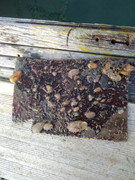
This is for no antifoul at all. Period July/Aug/Sept 2021. Thames Estuary U.K.
This was a piece of plastic that I left near my hull suspended from a cleat about 3 feet down.
Next year I plan to do the same, but coat one side with antifoul and compare the two.

What's interesting is that one side of the plastic was more grainy than the other. The smoother side had about 40% less fouling than the grainy side. So it seems that a smooth hull can make a difference. I don't have Coppercoat , but I have noticed that Copper coated hulls do seem quite smooth.
 
Last edited:
I painted my boat one year in patches using lots of left overs from previous jobs, all different colours and cheapest to the most expensive.. On haul out the boat had a very even layer of weed on it.. told me what i needed to know , hence i go for cheapest..
Ive currently got jotun megayacht, works out at £220 per 2.5l . Suited for slow moving mega yachts and long periods along side :) . Does not appear to be doing any better than any other cheap stuff ive used..:cry:
The problem with commercial is that its for vessels that are mainly moving around 18knts so it can fare worse than chandelery bought a/f on a pleasure yacht.
Location is everything.. A paint can work extremely well for some yet another user in a different location might conclude that its the worst paint ever used.
A few years ago i asked at least 50 different people who had coppercoat what they thought.. At that time it was 50/50 . It worked brilliantly for some, and others were so disgusted they applied antifoul over it.
 
I painted my boat one year in patches using lots of left overs from previous jobs, all different colours and cheapest to the most expensive.. On haul out the boat had a very even layer of weed on it.. told me what i needed to know , hence i go for cheapest..
Ive currently got jotun megayacht, works out at £220 per 2.5l . Suited for slow moving mega yachts and long periods along side :) . Does not appear to be doing any better than any other cheap stuff ive used..:cry:
The problem with commercial is that its for vessels that are mainly moving around 18knts so it can fare worse than chandelery bought a/f on a pleasure yacht.
Location is everything.. A paint can work extremely well for some yet another user in a different location might conclude that its the worst paint ever used.
A few years ago i asked at least 50 different people who had coppercoat what they thought.. At that time it was 50/50 . It worked brilliantly for some, and others were so disgusted they applied antifoul over it.

You mean some areas have a better class of biofouling organisms than others i.e higher class of antifoul needed in Cowes and any old stuff will do in Southend. :eek:
 
A reason for the variety of replies is simply a financial consideration.

If you slip your yacht for the winter then the cost of slipping for renewing AF is not an issue. You programme the quality of the AF to last a season. If your yacht is in the water 365 then you might programme the life of the AF to roughly match the life of the anodes, which might be 2 years. If you are looking for 2 year life - you will need a better (and more expensive AF).

Because owners don't define how they use their yacht you are going to receive a cross section of suggestions - don't shoot the messengers - we are clever and are trying to be helpful but cannot guess the OPs circumstances :( . If the OP is confused - next time provide more detail and your replies will be more focussed.
Jonathan
 
Jotun Seaforce 30 has served me well in N Wales, Brittany, N Spain and Algarve. In all those locations I've moved the boat between saline and fresh/brackish waters over the season which I think makes an enormous difference, based on much higher fouling in the one year the boat stayed in a purely marine environment. Maybe a jaunt up to Newport a couple of times a year would be an idea?

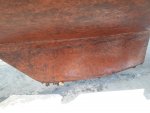
Seaforce 30 works for me as well, photo below taken on haul out in March after 12 months on the mooring in fairly high fouling area. Just slime except for a few patches I missed on bottom of keel.
Keel.jpg
 
Top