Whereisit?

tillergirl

Well-Known Member
Joined
5 Nov 2002
Messages
8,795
Location
West Mersea
Visit site
We have been a bit slow with new threads what with laying up and all that so how about a whereisit? without a photograph.

Taken from Irving, 1933, obvious names removed.

"This is a very lengthy cross-sand passage to undertake, unless under power with a good turn of speed or given ideal weather conditions and a steady commanding breeze. A least depth of 3ft (on the crown of the ?(a)? Shoal) can be carried along the route at half-tide - 6ft over the ?(b)? Spit. At HW springs there is 10ft least water, and at HW neaps 7.5 ft. Over the ?(c)? and ?(d)? Sands there is 4ft least water between half-flood and 2 hours ebb. At the ?(e)? there is 10ft least water at half tide.

Craft with a draught of 4.5 ft and under can make the passage from half-flood to 2 hours ebb. The total distance, along the course suggested, from the ?(g)? to the deep water channel of ?(f)? is 10.3 miles.

Pass close SW of the ?(g)? lightbuoy. Bringing this mark astern, shape a course North (made good) [he means magnetic north in 1933!) over the ?(d)? Sand, across the ?(h)? channel and over the ?(e)? sand to the ?(e)?. Due allowance should be made along this section of the passage for the general south-westerly set of the flood in the whole area, particularly down the ?(h)? channel, and for the general north-easterly trend of the ebb stream over the ?(c)?, ?(d)? and ?(e)? sands, and the strong north-easterly scour through the ?(h)? channel.

The above course passes some 600 yards east of a ?(i)) on the (c) Sand, and half a mile east of a prominent ?(j)? on the ?(c)?

At the ?(e)?, course should be altered to N1/2W (made good).

A cast of the lead, the ripple, and the changing colour of the water will afford useful checks as to when the edges of the various banks and shaols are passed.

Can you name

?(a)? Shoal. It's not called a shoal now
?(b)? Spit. It's still there.
?(c)? Sands
?(d)? Sand
The ?(e)?
The ?(f)?
The ?(g)? Lightbuoy. It's not there anymore but there's something similar nearby which will do as an answer.
?(h)? channel
?(i)? A what?
?(j)? Another what?

g is the start and f the destination

Is this all too tedious?
 
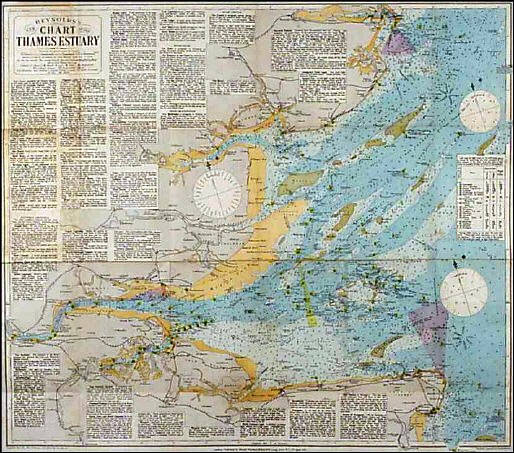
Weel, its on the Reynolds chart of the Thames Estuary. I'm working on it but I have run out of time.
Booze cruise starts at 5 in the morning.
 
Err, right, clever stuff Roger, made my feeble brain ache. Got some of it, I think, but there are gaps:
It's about travelling from down by the Maplin buoy, across the Maplins and Foulness Sands, the Buxey Sand, and on north to the Blackwater.
So:
?(a)? Shoal. It's not called a shoal now
- dunno.
?(b)? Spit. It's still there.
- Batchelor Spit.
?(c)? Sands
- I don't know....thought it might be the Dengie Flats but that's not '...Sands'.
?(d)? Sand
- Foulness Sand
The ?(e)?
- Buxey Sand and Buxey Beacon.
The ?(f)?
- the Blackwater
The ?(g)? Lightbuoy. It's not there anymore but there's something similar nearby which will do as an answer.
- Maplin buoy
?(h)? channel
- Whitaker Channel
?(i)? A what?
?(j)? Another what?
- as I don't think I got (c) right, I don't know. If (c) was Dengie Flats then (i) and (j) could be wrecks/beacons.

I have to confess I didn't do this very scientifically. But the comments about the flood running SW pointed to it being around here somewhere, and so I looked for a 10.3 mile stretch that ended in deep water!
 
Correct

"This is a very lengthy cross-sand passage to undertake, unless under power with a good turn of speed or given ideal weather conditions and a steady commanding breeze. A least depth of 3ft (on the crown of the Buxey Shoal) can be carried along the route at half-tide - 6ft over the Batchelor Spit. At HW springs there is 10ft least water, and at HW neaps 7.5 ft. Over the Maplin and Foulness Sands there is 4ft least water between half-flood and 2 hours ebb. At the Buxey Beacon there is 10ft least water at half tide. (There certainly isn't now)

Craft with a draught of 4.5 ft and under can make the passage from half-flood to 2 hours ebb. The total distance, along the course suggested, from the Maplin Spit Lightbuoy to the deep water channel of Blackwater is 10.3 miles.

Pass close SW of the Maplin Spit lightbuoy. Bringing this mark astern, shape a course North (made good) [he means magnetic north in 1933!) over the Foulness Sand, across the Whitaker channel and over the Buxey sand to the Buxey Beacon. Due allowance should be made along this section of the passage for the general south-westerly set of the flood in the whole area, particularly down the Whitaker channel, and for the general north-easterly trend of the ebb stream over the Maplin, Foulness and Buxey sands, and the strong north-easterly scour through the Whitaker channel.

The above course passes some 600 yards east of a Wreck Buoy on the Maplin Sand, and half a mile east of a prominent wreck on the Maplin Sand. (There were a lot more wrecks after the war!)

At the Buxey Beacon, course should be altered to N1/2W (made good).

A cast of the lead, the ripple, and the changing colour of the water will afford useful checks as to when the edges of the various banks and shaols are passed."

Maplin Spit is more or less where the Maplin Edge is today. The first wreck appears still to be marked on charts but not marked by buoyage. A course making good North (m) would today not take you to the Buxey Beacon (although close enough).

Well done Dick. Not sure this captured the imagination of the forum, loads looked but nobody has charts at home any more - and not many have charts on board?
 
Certainly did catch my imagination.
I am now ordering the book from Amazon, and the only reason I didnt get back was that I was en France getting my hooch for Xmas and didnt get back till late last night.
Harumph.

I love stuff like this.

Here is Reynolds....
H20091ThamesEstuaryReynolds.jpg
 
Thanks tillergirl. I was one of those who looked but was too lazy/busy-at-the-time to contribute but thought it make a fascinating change from the usual (which I always enjoy)
 
Likewise - had a rough idea where it was but not yet familiar enough with the area to be honest to be confident about posting :rolleyes:

Got the Maplin, Buxey and Blackwater bits though so would probably only have run aground two or three times en route...
 
Certainly did catch my imagination.
I am now ordering the book from Amazon, and the only reason I didnt get back was that I was en France getting my hooch for Xmas and didnt get back till late last night.
Harumph.

I love stuff like this.

Here is Reynolds....
H20091ThamesEstuaryReynolds.jpg


That's an interesting picture. Do you have it in a better resolution? What date is it, and what is the datum for the drying patches?

Nice puzzle. Pity I only read it after it was cracked!
 
Give me a couple of days and I'll do another one.

Reynolds doesn't quite do the cross sand route. The faint line on Full Circle's chart you can see is a reference to the old Maplin Lighthouse but does show that the light only becomes visible once you are past where I guess the Buxey No 1 is now. So presumably it was used then to show the cross sand route. However, by the time of Irving, the Lighthouse had fallen over (20's I think) and so wasn't there for Irving to refer to.

Some of the positioning on Reynolds is a bit dodgy compared to our GPS accuracy and my version has a much different layout to the Gunfleet Sands with the Spitway in its old position south of Clacton (where the radio mast used to be/is).

PS, the Maplin Lgthouse fell over whn the tide scoured out the foundations. What are the odds on the same happening to the Gunfleet Wind Farm?
 
Last edited:
I wish I had noticed that someone had already solved it before I got hooked !

After 2 hours of trying to work it out using my Grandfathers copy of River Thames & Approaches by Stephen Penny Published 1896.. (And failing miserably) I noticed that some clever clogs had already solved it.. Never mind the Garage can be tidied up tomorrow !

However I thought readers might be interested to see a copy of a chart from said publication which I have uploaded to Flickr for the (big word alert) edification and interest of our viewers a chart dated 1896 of the area Click Here http://www.flickr.com/photos/greenacre8/4082604973/

Click on "All sizes" then "Original" to expand it to view it in detail
 
Thanks for doing that.

The Ray Sand channel looks a bit more useful than it is now.

Variation was a rather more then.

Are those drying heights in feet? If so, what are the depths?
 
Top