Where to Dry Out in Guernsey - need to inspect rock damage

OP said he didn't want to spend the money on Travel Lift. If it is an insurance job, surely insurance will pay for that as well?
 
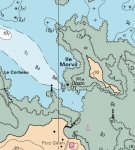
Ok I've got pictures of the Navionics track now. First, the whole trip, so you can see how the next photo fits in. Second, the detail of the rock/boat interface, near the red pin. The NE tip of Ile Grande is at the bottom of the photo. You can also see the red and green posts in this photo. I also put a blue pin (not shown in photos) in the approx location. I did not anchor at the brown anchor icon. Lastly, the lat/long of the blue pin.
View attachment 53243
View attachment 53244
View attachment 53245
I hope these are of some use.

Soon we'll know how Swedish grp fared against French granite.

Looking at those contours, I'd have immediately said they were too smooth and regularly spaced to be "real"; they look as if they've been generated using far too little data. It is worth noting that contours on charts are NOT data; the only depth data are soundings, rocks and coast. Contours on charts are intended to assist in the interpretation of the soundings, but they don't replace them. Where there is plenty of sounding data they will be pretty good, but in places where there isn't much data, they will be bad.
 
If you just want to know about the drying pads, skip the next 4 paras ...!

Yesterday Friday was a trying day! Actually it started on Thursday, when I removed a roll pin from the steering. This pin is what makes the lines to the rudder move when you turn the wheel. And it had started working out of its socket occasionally and binding against a nearby bracket. So I thought to remove it. That took most of Thursday afernoon. And I had no time to put in the new one. So when Friday dawned as the first day when there was unlikely to be any swell in the harbour, I had no steering but wanted to get over to the grounding pad. I could have asked the HM to help tow me across. Or rigged up the emergency steering. But in the end I just took a deep breath and used my bowthruster to manoeuvre around the marina to the pad. That and the drying out went fine. After inspection of the rock damage (see below), I worked on the steering pin again, still no luck, the pin was half in and half out, effectively jamming the steering.

The rock damage was too hard to see to really judge. It was very near max depth, another few inches and I'd have cleared the rock. Quite a bit of GRP material had been scraped off, in one small patch. Unlikely I can do a useful patching up job. And there might be more damage under the keel where I couldn't see. I phoned Dave Norman of this parish, he runs Marine & General, a full service boatyard in St Sampsons. He came down to see the damage, and I've decided to have my boat hauled oput properly on M&Gs travel lift. Dave even drove me to his yard so I could see the lie of the land for when I take the boat in there on Tuesday, and showed me round the impressive facilities there at his boatyard. Many thanks to Dave, and Alan.

Back to the boat and worked again on the steering pin. No progress. Then we re-floated, still no steering, so used bowthruster again, this time just get to nearest pontoon. More work on the steering pin. Tearing out my hair, figuratively. Then brilliant help from neighbours. Told me a different method of removing the pin: I'd been trying to pull it out with molegrips. They suggesting hammering it out backwards, and crucially suggested using a drill bit as a drift (is that the right word?), putting the flat end against the pin. Then what had been a trying day suddenly got better, the pin was hammered out. Next the new one was installed in the right hole, job done. Very grateful to Stuart and Mick for their help.

Kindness and generosity from several people helped me out yesterday. A good result but it was a trying day.

Just to wrap up this thread on subject, I used the southernmost of the 3 drying spots in Victoria Marina, the concrete pad. I preferred the flat concrete to the uneven surface of the sleepers on the other 2 pads. Couple of points to bear in mind:

First, do remember Doug's warning about swell in the harbour. We did do a couple of small bumps as we refloated but nothing to worry about. A couple of days earlier it would have been rather drastic.

And, on inspection at a previous low tide, I'd found rock clippings had been washed round the harbour wall onto the concrete at just the spot where my keel would go. I pushed these aside to avoid them creating a sharp pressure point on the GRP of my keel if it grounded on one of them. Otherwise the concrete was fine.
 
Last edited:
Thanks for posting the result, it is always nice to hear how people get on.

I have been mulling over the rock in the anchorage. I guess the sand could have been scoured away and what once was an even sandy bottom is now exposed rock in places. I bet the survey data is ancient. But even so you would imagine a prominent hazard, in such a well used place complete with nav marks, would be recognised and incorporated over the years.

One other possibility. I once came to a full stop against what I later found to be a forty gallon oil drum filled with concrete.
Do you think it is possible that you hit a mooring sinker? Or were you actually able to see rock?
 
There are some shadowy underwater forms in that area on Google Earth, but it's difficult to draw conclusions. Good luck with your repairs.
 
Last edited:
I once came to a full stop against what I later found to be a forty gallon oil drum filled with concrete.
Do you think it is possible that you hit a mooring sinker? Or were you actually able to see rock?

I did see rock. Possible that a post marker had once been on it I suppose, but nothing there on my visit.
 
Top