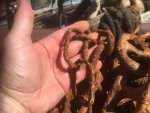
When did you last check your mooring?

That is a sad sight and should be quite alarming. The wear is not unusual I would suggest from my experience around here perhaps 2 years worth of boat on the swing mooring. In other words chains and shackles of that size 10mm needs to be checked at least once per year. Now if you go much heavier chain then there is simply more meat to wear through so it will last longer. Around here moorings a re licenced by state government department and they have decreed moorings must be inspected and certified by an approved contractor every 2 years. For may years I maintained my own swing mooring replacing chain often. The worst part was where the iron chain/shackle met SS hardware of the supplied buoy. the I then got hold of stainless steel chain about 12mm (out of a rotating lime kiln) which has lasted now many years. Along with SS shackles etc.
It still has to be inspected and that costs around the 125squid mark. Not to mention the 300 squid per year licence fee for the mooring. Grrrr ol'will
 
This was a couple of boats down from my fore and aft mooring a couple of years ago. The boat, unsurprisingly, broke free. 9564FA53-A054-4EAB-AABC-B3487460737A.jpeg
 
I check my moorings at least once a fortnight during the season (April-Oct) then a full check 6 weeks before the start of the season. Fortunately it is a drying mooring so not difficult to inspect, if it wasn't a drying mooring it would obviously be a different inspection regime, but also totally different ground tackle.
I have a fore and aft mooring, 'V' chain for both fore and aft linked to Anchorplait warps which are removed and washed over the Winter. I usually run a continuous replacement programme on the chains, replacing one length of chain each year so no length of chain is ever more than 4 years old.
 
When I had my own mooring to maintain it was always the top few feet of riser that corroded fastest due to more oxygen in the splash zone. The ground chain which sunk in the mud had hardly any corrosion after 10 years.
I found a zinc anode bolted to the chain reduced corrosion considerably. You can get zinc anodes cast onto a length of chain or just pick up a few discarded half used hull anodes from the boatyard skip and attach them to the riser.
I learnt the hard way that poor quality shackles can fail in as little as 3 months. My final solution was to run the riser up through the centre of a pole buoy with a plate on top to take the load. The swivel and shackles were all on top where they could easily be checked.
 
.

19mm chain is the minimum I would use for a riser chain, 22mm is even better, though you might need a bigger buoy.

How long it lasts depends on tidal conditions and the amount of silt in the water. here in the bay they last between 3 and 6 years - t cvaries a fair bit depending on theposition in the bay, probably due to tidal flow and silt load.

If possible inspect it every year and caliper the worst part of the chain. When it gets down to 10mm it is time to replace the riser. Shackles should automatically be replaced at the same time. The local fishermen cable tie the shackles rather than wiring them,


- W
 
Interesting thread, for different reasons.

I recall a well know member here being highly critical of the galvanised coating on their anchor chain and suggesting coating, or their specific coating, should last longer than 4 years. This comment is not isolated and others have made similar comments. The comments are usually, exclusively, made by liveaboards, long term cruisers and some back up their comments suggesting 4 years for basically every night at anchor - is simply not good enough.

I stand to be corrected but galvanising would typically be 100 micron thick. I believe a common specification is 70 microns and testing I have done finds coatings can be as thin as 50 micron and not often more than 110/120 microns.

This thread comments on mooring chain life being 5-6 years? (which would be similar to an unserviced mooring here in Sydney - where the sweep chain would be 15mm - 20mm (where 15mm would be 15,000 microns).

Galvanising is an alloy process and the alloys (of Fe and Zn) are harder, thus more abrasion resistant than G30 or G40 chain about 2 to 2.5 times as hard. However galvanising is also subject to other wear factors, mud being a common culprit.

To me 4 years for galvanising life is not a cause for complaint - even if I would like it to be longer.

Jonathan
 
Agree that 10mm is very small for a mooring riser. Obviously it will be strong enough when it's brand new but it will be a false economy as within a few months it's likely to have worn alarmingly thin.
I use 19mm galvanised chain, the last one lasted me 4 years and would have gone further but once you've gone to the trouble of lifting the whole thing it seems daft not to replace worn parts.
If you know who to talk to, you can pick up used gear from e.g. fish farms for a fraction of the new prices. Even if it has a little wear, there will be more meat on the chain than a cheap brand new one of the same cost. Obviously I wouldn't advocate secondhand shackles or swivels.
 
19mm chain will not fit through many bow rollers, necessitating a smaller bridle to be shackled to it. In our experience shackles are the weakest link, so we avoid them.
Most of our club boats in Portland harbour lie to 12mm risers, which is bought on board. All our risers have two egg links one on either end, a large and a smaller one, they are reeved through the ground chain eliminating the need for shackles.
Every club mooring is lifted and checked at the beginning of every season, down to the ground chain. The chain is laid out on our work boat foredeck. The large egg link attaching the riser to the ground chain, and the rest if the riser is examined by eye.
Any suspect links are measured with a vernier and if the thickness has dropped more than 20% of the original it is replaced.
Every five years the mooring is bought ashore to check the staple in the sinker holding the ground chain.
For those of us with heavier boats we use 16mm risers. these are still to big for most bow rollers, so a bridle has to be attached.
These come in 5 and 7 meter lengths, and have egg links on both ends so they can be reeved through the riser without the need for shackles.
 
It's all a compromise- you're going to have to have shackles somewhere, and downsizing the entire riser just to make it fit the bow roller IMHO risks premature wear on underwater components.

I use the biggest multiplait mooring rope that fits the roller, with chafe protection, and shackle that to the end of the (much larger) riser. One compromise I am happy to put up with is to have no swivel. That's three failure points removed, at the expense of having to drop and pick up the mooring every few weeks to get rid of twists.
 
It's all a compromise- you're going to have to have shackles somewhere, and downsizing the entire riser just to make it fit the bow roller IMHO risks premature wear on underwater components.

We do not have ANY shackles, except for the pickup buoy. I don't quite understand what you mean, downsizing the riser?
The riser is the riser, being 12mm or 16mm. We have them made up for us in varying lengths, all with an egg link on each end.
What we don't have is rope bridles, all our bridles are chain. Either 5 or 7 meters in length with egg links on both ends.
I use a 16mm riser with a 12mm chain bridle so it can go over the bow roller. As I have said, the bridle is reeved onto the end of the riser, no shackle.
My boat at 6 ton would happily lie to a 12mm riser, and next year if my 16mm riser fails, (thickness of any one link falls below 12.8mm) I will renew it with a 25meter by 12mm riser reeved to the ground chain, and will bring it directly on board.
The average life span of a 12mm riser is only two seasons
 
.

19mm chain is the minimum I would use for a riser chain, 22mm is even better, though you might need a bigger buoy.

How long it lasts depends on tidal conditions and the amount of silt in the water. here in the bay they last between 3 and 6 years - t cvaries a fair bit depending on theposition in the bay, probably due to tidal flow and silt load.

If possible inspect it every year and caliper the worst part of the chain. When it gets down to 10mm it is time to replace the riser. Shackles should automatically be replaced at the same time. The local fishermen cable tie the shackles rather than wiring them,


- W

By definition you are saying for the last year you are happy to let your boat lie to a 10mm riser.
 
I don't quite understand what you mean, downsizing the riser?

The average life span of a 12mm riser is only two seasons

That's what I mean by down-sizing the riser. I'm really surprised that you're happy to put up with small gear that only lasts a couple of seasons. Obviously it's your choice, and if you have everything brought to the surface every year anyway it's OK, but sounds like a lot of hassle and cost to me.

I don't really understand the aversion to shackles. There are bad shackles out there, but there are good ones too. Tested brand name shackles are perfectly good. The bigger your gear, the more margin for error. I've had mousing fail before, and now peen over the end of the pin and use two cable ties. I have never ever (touch wood) had a cable tie fail, whereas various types of wire have been less succesful. Again, size is key- I don't think I'd sleep happily using 12mm gear where everything is miniaturised, including the cable ties.

My first (19mm) riser lasted four years, and if I wanted to I could have end-for-ended it to get a few more years out of it. My (32mm) multiplait strop (I use a single line rather than a bridle) lasts two, but it's always the chafe protection that fails, not the rope itself. Annual costs work out very low indeed, and I don't feel the need to lift the mooring every year.

Maybe moorings are a bit like anchors... everybody likes to defend their own decision!
 
I really think some of the above posters should investigate polysteel risers. My previous mooring lasted me some 10 years and, when raised, was virtually as new in terms of chafe (or lack of it) and strength. My current risers are only 5 years old and I honestly expect them to see me out. Long eyes cow hitched to ground chain or sinker means no shackles anywhere in the riser, strop combination.
Prior to changing to 36mm polysteel I was replacing 12mm-15mm chain risers every few years.
 
I would very happily use a polysteel riser (my strop is polysteel, or possibly seasteel), but I'm surprised you haven't noticed any wear at the cow hitch. I would have used a galvanised thimble and a shackle.

If we want to reduce exposure to unnecessary shackles, eliminating the swivel has to be the first priority. It will depend on local conditions but I am currently doing without one and have had no problems.
 
I would very happily use a polysteel riser (my strop is polysteel, or possibly seasteel), but I'm surprised you haven't noticed any wear at the cow hitch. I would have used a galvanised thimble and a shackle.

Genuinely not. The riser is cow hitched to the ground chain, which I think is 38mm studlink, and held in place with cable ties and terylene cord bindings. The whole lot sits in shallow but gloopy mud which protects the ground chain. The cow hitch does not move.
 
Somewhere, in the dark recesses of my memory, I seem to recall that some areas where copperas is present have high rates of corrosion on mooring chains. For example, Copperas Bay, River Stour. These areas need extra vigilance.
 
We have a 40ft steel work boat with a 15 ton winch, and a team of volunteers who maintain and run her.
Most mooring holders are happy to come out and assist when their mooring is being done. Hard work, but not costly.

In earlier days we used to use shackles, ones below the water line were always welded.
We have about 80 moorings. Since I've been at the club, 16 years we have had about 5 failures.
The weakness always was owners shackling their own bridles badly, or rope bridles chaffed through.
Members can use a rope bridle if they wish, but now a reeved chain must be bought on board as a back up.
Portland Harbour I believe, is classed as open water and with a strong easterly it can get very rough.
I can get 2/3 years out of a 16mm riser, my last 12mm bridle lasted for 5 years, and was only down to 10.7mm when I changed it.
I can understand using thick chain if lifting and checking is a major task, but for us it isn't, and paying an average of £130 a year for annual checking and chain is okay by me for piece of mind.
I hope!
 
Top