What they don't tell you about production boats

Love the production boat bashing that is about, so what about the big Oyster that was severely damaged? Just saying....

The Oyster was shoddily built by a tiny subcontracting company working out of a rented shed in darkest Norfolk. Faced with a multi-million pound claim for damages, the subcontracting company declared voluntary liquidation. And, guess what, two of its directors then bought the company's assets for £7500 and are still in business under a different name.
 
How did you form the opinion that a Bavaria is "flimsy"? They're quite heavily built.


Not in comparison to the boat ip485 sails, and my vessel of the same make.

From direct experience.

There is, of course, a significant design philosophy difference as well as a price difference.

Please note, I am NOT knocking high volume production boats, especially Bavaria. They are excellent products.

First Mate and I had a very close look at the Bavaria 'Cruiser' range and were very impressed.
 
I don't think that it's fair to generalise this as "all production boats are like this". They aren't.

Talking Bavaria, I know that the newer boats are built the same way as this, but the older ones aren't. Mine was built in 2003 and the grid structure is laminated to the hull, aswell as being bonded.

I replaced my skin fittings last year, and the hull was way thicker than 10mm. Underneath the boat (where the engine intake is), the laminate was 28mm thick (I measured it).

So you can't tar every production boat with the same brush, but I do agree that the bonder looks less than ideal, both as a manufacturing method, and also the fact that is has no give in it.
 
Leaving aside the Bene bashing (other "budget" boats are available and equally bashable), the lesson I'm getting from this is that any grounding apart from running into mud at low speed needs to be investigated.

A good friend had a Dufour 385 and, after he died, we had the boat surveyed in readiness to sell it, and there was similar damage to what happened in this video. He certainly had no idea that it was like that, or he would have had it fixed and, AFAIK, the only "proper" grounding was getting too close to one of the Winner buoys coming out of Chichester Harbour, so sloping sand with no damage to the Coppercoat, rather than unforgiving rock.

OK, bolt-on keels are more vulnerable than fully encapsulated keels, which tend to be longer anyway, but they still need to be checked, as a small crack in a GRP keel may let water in to chew up iron ballast. It's safe to say that ANY boat built in the last 30+ years was built to a price, so none, give or take the odd expedition boat are designed to be any more than just strong enough. Of course, the definition of just strong enough may vary a bit.
 
I also wonder whether the extent of the groundings are often downplayed in these cases...

There was a bit of hysteria on here when the aforementioned Expedition Evans episodes aired and some concluded the boat was shoddily-built, weak, dangerous, etc. It didn't help that the owners seemed intent on the same conclusion.

I saw it somewhat differently... It seemed to me like their Bene took an almighty impact. And why would it not surprise anyone that a 'salvage' boat was sold without full disclosure to the extent of the accident/damage? It was salvaged - i.e. beyond economic repair - for a reason. It even took on water on the delivery trip.

I'm sure many of us have come across accidents - whether with cars/houses/boats - where either/both the circumstances or the damage was downplayed, whether to save face, reduce exposure to liability, or improve re-sale/salvage values. No reason to assume this was not the case in these examples, IMHO.
 
How did you form the opinion that a Bavaria is "flimsy"? They're quite heavily built.

Not in comparison to the boat ip485 sails, and my vessel of the same make.

From direct experience.

There is, of course, a significant design philosophy difference as well as a price difference.

Please note, I am NOT knocking high volume production boats, especially Bavaria. They are excellent products.

First Mate and I had a very close look at the Bavaria 'Cruiser' range and were very impressed.

The myth, usually propagated by owners, that some makes of boat are much stronger than others warrants some investigation.

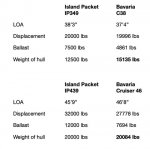
Similarly-sized boats generally have similar masts, rigging, engines and equipment. So, if we subtract the weight of the ballast from the overall displacement of the boat, we'll get the weight of the hull and equipment. Assuming the equipment is a similar weight, this gives us a measure of how "heavily built" the hull is.

Let's take a couple of Island Packets, and compare them with similarly-sized Bavaria Cruisers.

IP vs Bavaria.jpg
You'll see that the Bavarias are more heavily built - quite significantly in the case of the C38.
 
A buddy of mine bought a new X4.3 last year and we met up for lunch in Thorness bay one day last spring. I anchored and he rafted to me.

He commented how his boat was being thrown around by the little bit of swell there was, whereas my boat (Bavaria 49)was just sat still.

I asked him what his boat weighed. About 8 tons came the answer. Ah, that'll be it then, I said. This old bus weighs fourteen and a half tons.

Needless to say, he was quite surprised at the weight difference, seeing as they both had almost identical waterline lengths.
 
The myth, usually propagated by owners, that some makes of boat are much stronger than others warrants some investigation.

Similarly-sized boats generally have similar masts, rigging, engines and equipment. So, if we subtract the weight of the ballast from the overall displacement of the boat, we'll get the weight of the hull and equipment. Assuming the equipment is a similar weight, this gives us a measure of how "heavily built" the hull is.

Let's take a couple of Island Packets, and compare them with similarly-sized Bavaria Cruisers.

View attachment 108530
You'll see that the Bavarias are more heavily built - quite significantly in the case of the C38.

Interesting. I'd often wondered how much cored hulls really saved in weight on a cruising hull. I believe the Bavaria has a foam cored hull, Vs the IP's solid (non cored) hull.

I suspect Bavaria and others use the foam core to increase stiffness & insulation but then probably over engineer the laminate either side anyway to err on the side of caution. Of course a cored race boat would be much lighter, but in the cruising boat you at least get the stiffness and insulation benefits of having the core.
 
Interesting. I'd often wondered how much cored hulls really saved in weight on a cruising hull. I believe the Bavaria has a foam cored hull, Vs the IP's solid (non cored) hull.

I suspect Bavaria and others use the foam core to increase stiffness & insulation but then probably over engineer the laminate either side anyway to err on the side of caution. Of course a cored race boat would be much lighter, but in the cruising boat you at least get the stiffness and insulation benefits of having the core.
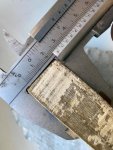
Foam core is only in the topsides above the waterline. Below the waterline it it solid glass and kevlar, and really thick in the right places.

In the cored part of the hull, the skins either side are about 10 or 12mm thick each.

Here are 2 photos. One is of a chunk of Bavaria cut out of the bottom of the hull in front of the rudder (to fit a stern thruster). You will note that it is 28mm thick and made of solid woven rovings. The second is a piece that was cut from the topside to install a hull portlight (in the foam sandwich part). Also notice the tickness.

Hopefully this will put to bed once and for all the daft notion that Bavarias are flimsy and that you can see through the topsides.bottom.jpgcore.jpg
 
Last edited:
Who was talking about comparative hull weights?

The older model IP's were designed by an Aerospace designer. The strength was EXACTLY where it needed to be, very strong around the keel, tapering up to the topsides and coachroof where weight becomes a disadvantage.

The structural bulkheads on my own vessel are in excess of 75mm thick.

I have just fitted radio speakers ajacent to the helm position - that was the thickness of the removed plug. A little thinner at the rear of the pilothouse, only about 50mm there. But that bit is just the inner lining of the pilot house, not a bulkhead.

We met a bloke with a Bavaria 34 in Yamouth IOW some years ago, when we had our IP 350.

First Mate and I did our training in a Bav 34 and were impressed with the boat in all respects.

He told us it was a new one and it was on a de snagging cruise, nothing major so far.

Later, over drinks in the Royal Solent YC it became clear Peters Opal had replaced the complete boat.

It fell into a hole in heavy weather and the heads and foward cabin doors jammed shut.

As it was almost new and he would not accept repair the vessel was replaced. It was found the bulkheads has shifted enough to cause this problem.

I would suggest the quality difference is reflected in the price.

Bavaria are fantastic value for money, sail well, are reliable and have an enthusiastic following.

All in all, great boats.

But the weight of materials used in construction is only part of the story.

Island Packets are not perfect by any stretch of the imagination. But they are bloody strong..............................
 
Foam core is only in the topsides above the waterline. Below the waterline it it solid glass and kevlar, and really thick in the right places.
I am pretty certain that some years ago an owner of a new Halberg Rassey had an extra skin fitting placed below the waterline of his 38. It was found to be a cored section & delaminated. I am sure the construction was cored. As I understand it the resulting legal case ended with HR paying considerable compensation. If I have that correct it would suggest that some craft do have cored detail below the waterline. Perhaps some HR owners know about the case.
 
Do any mobo,s have cored hulls or decks ? I'm just curious as I don't know.
Yes . A friend of mine had a Beneteau Princess 36 & when he decided to have a coppertec antifoul applied they found that the outer skin below the waterline in a large area was hanging down. the craft had 350 hours on the clock. Cost £ 200K & was sold for £75 after repairs. Fortunately the buyer did not ask for a survey. We could see the light through the hull sides in the cupboards where it was not lined
 
Yes . A friend of mine had a Beneteau Princess 36 & when he decided to have a coppertec antifoul applied they found that the outer skin below the waterline in a large area was hanging down. the craft had 350 hours on the clock. Cost £ 200K & was sold for £75 after repairs. Fortunately the buyer did not ask for a survey. We could see the light through the hull sides in the cupboards where it was not lined
A beneteau princess is like saying a ford audi.

It is good to be able to see light through the parts of the hull that don't need strength. If you can't it's unneccessary weight.

That's the problem with old style hand lay up. You'll always add a bit more just in case. Modern production boats will use computer design and resign infusion so have exactly the right amount where its needed.
In planing mobos or in a sailing boat where you want decent speed then unnecessary weight is nothing to be proud of.
 
Top