Fanny Haddock
N/A
I'll change the setting on my barometer from "Changeable" to "No one has a clue".


In '75 I went to Germany for a long weekend, returning in the first few days of June. It was cold when I left on the Friday and scorching when I returned on the Monday. I had thought that it included the last day or two of May, but maybe it was the week later. '75 did actually get higher temperatures than the famous summer of '76 but the latter started earlier in early May. Aerial pictures showed the countryside as a uniform brown, punctuated by vivid green duckweed on all the remaining water. The canal outside a pub in Surrey we visited with my in-laws was completely covered with duckweed. This fooled their Labrador into thinking it was solid ground, leading him to try to walk across it. I expect he wondered why we were laughing our heads off.Interesting memories. I was also abroad in 1959, but in North Germany for 3/12, they had no rain at all for many months, the drought was so severe that many hundreds of cattle had to be slaughtered due to failure of their water supply. It was amazingly hot, but very very low humidity so actually quite comfortable.
In 75 and 76 we were in Newmarket, one year, can’t remember which, it snowed on about 6th June, and then the temperature shot up and we had no rain until October!

The 1976 drought resulted in me being on a Church Council that had to decide to demolish a church. It was a Victorian church in London (Holy Trinity Sydenham), of no great architectural merit, and one end had been built on an infilled pond. It had been fine for the preceding 100 or so years, but the 1976 drought resulted in the clay filling of the pond shrinking. The wall above it developed a large and active crack, and the local authority condemned the building as unsafe. Repairs were going to cost a sum in the region of a quarter of a million pounds (getting on for £2million these days) and the church council decided that they couldn't justify the expenditure, and the church moved to the well-built church hall! There were the usual complaints from people who never darkened the door of the church, but it was demolished and the land used for housing.In '75 I went to Germany for a long weekend, returning in the first few days of June. It was cold when I left on the Friday and scorching when I returned on the Monday. I had thought that it included the last day or two of May, but maybe it was the week later. '75 did actually get higher temperatures than the famous summer of '76 but the latter started earlier in early May. Aerial pictures showed the countryside as a uniform brown, punctuated by vivid green duckweed on all the remaining water. The canal outside a pub in Surrey we visited with my in-laws was completely covered with duckweed. This fooled their Labrador into thinking it was solid ground, leading him to try to walk across it. I expect he wondered why we were laughing our heads off.
It's fairly common to see glass slides stuck across cracks in churches, to see if the crack is mobile or not. Mostly they aren't. Of course. most older churches have very shallow foundations and are particularly susceptible to ground movement.There was a vast industry developed after '76 selling underpinning to houses across the land. I dare say that some of them needed it, but not all. Our house had a fine crack up the centre thought to have come from a V1 that landed nearby. In '76 this opened up to about 1/3" in places. When the rain came it closed up again and was no worse when we sold the house a year or two later.

This site is a good overview.Actually I really was genuinely interested to know what was happening with the weather. Don't have a TV to explain it to me.
yes i use that one myself, i find it quite goodThis site is a good overview.
Click on the word 'Earth' at the bottom left for the options menu.
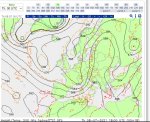
It shows the jet stream at around 250 hPa. Notice how the stream drops south, dragging polar air down and over the UK - or preventing warmer air from moving up.
The idea is that the glass breaks if there's any movement.There was one in our school chapel, a substantial modernist building from the '30s. I used to stare at the glass tell-tale for hours during sermons. It never moved.
Fascinating & beautiful. I've seen similar but not that particular version, it's enough to make me want to fix a second charging system & get another battery to run on a tablet. Need to study it more. I have explored it fully yet but I guess if it does water temperatures, we could make even more sense of what is going on & why.This site is a good overview.

Yeah, I know but miswrote while inadvertently sober.The idea is that the glass breaks if there's any movement.
Classic quote from Giles cartoon: "Too much blood in the alcohol stream". I think one of the Doctor films put someone's blood group down as "White Horse"!Yeah, I know but miswrote while inadvertently sober.
You are absolutely correct! The reason there is a jet stream at about the 40-60 deg latitude is basically due to the way the convection starts the weather. Just past the solstice, the sun is overhead at noon roughly at the tropics. Obviously the heating effect of the sun is greatest when the sun is vertically overhead. So, that heats the air at the surface, which becomes less dense and rises , meaning that atmospheric pressure at the surface reduces ( so there are areas of low pressure between the equator and the tropics) and with air further north being less warm, the wind commences to flow at the surface to the south. If the earth wasn't a sphere, that would be a straight northerly but, if you consider the West to east rotation, the circle of latitude a few degrees north is smaller circumference. This means that at the equator, a spot on the earth's surface is moving at about 950 mph. At 60 North the similar speed is 475 mph. (Coriolis effect)Might help on tv if the weather forcasts with maps show the jet Stream over the GB/UK as i understand that it has a greater influence than many of us understand, might mean us genning up on the Jet Stream thought to understand it, but it then might help us understand why the weather does not allways do as thought or predicted by the Weather Forcasters
I have noticed that the ITV weather forcast sometimes appear to show the Jet Stream over the GB/U K but never the BBC
Guess that we really appreciate our variable weather in this country really, it affords us unpredictability plus change, plus plus the very best growing seasons for Fruit, Veg, Flowers etc etc

That's very easy to understand in the weather context!Bill Bailey's comparison of Australian and British greetings;
Oz "how ya going?"
"Awesome!"
Brit "how are you?"
"not too bad, mustn't grumble"

Structural movement or a sign from above?!The idea is that the glass breaks if there's any movement.
" For now we see only a reflection as in a mirror; then we shall see face to face. Now I know in part; then I shall know fully, even as I am fully known. " 1 Corinthians 13:12!Structural movement or a sign from above?!