What makes the best electrical join?

What is the optimal method for joining untinned copper wires on a boat?

  • Chocolate box connector - untreated copper ends to wires

    Votes: 4 3.2%
  • Tin the ends, then use a chocolate box connector

    Votes: 2 1.6%
  • Crimp connectors - untreated copper ends

    Votes: 21 16.7%
  • Crimp connectors - tinned ends

    Votes: 12 9.5%
  • Waterproof junction box

    Votes: 3 2.4%
  • Soldered joints protected by heat shrink

    Votes: 77 61.1%
  • Chocolate/junction box set in epoxy

    Votes: 0 0.0%
  • Other - please specify

    Votes: 7 5.6%

  • Total voters
    126
There are several reasons why soldered joints (except as above) should be avoided in a marine environment. Where the solder ends, there is a stress point, leading to early fractures if there is any vibration. The use of solder, and the fluxes within it, tends to erode copper wire, leaving a point of weakness at the same stress point. Because solder is soft, tinning the ends of wires before crimp or screw termination will lead to eary failiures.

1) there is always a stress point, you have to ensure it is not subject to movement under vibration.
2) Modern fluxes used in electronics do not generally erode copper wire. But it's worth buying a decent brand of cored solder, it should have a 'no clean' flux meaning that cleaning off the flux is not required. Sometimes with tarnished parts, a more aggressive flux is required, in which case the joint should be cleaned afterward as per the instructions.
Perhaps something to watch for those using el cheapo soldering kits.
3) tinning multistrand before crimping is indeed generally bad practice, probably the worst of both worlds?
4) Tinning multistrand before screw termination. Mixed views on this, it can be better than trying to shove a fraying end into the hole, potentially getting loose strands etc etc. It's good I think for those really small wires like instrument wiring, bad for bigger wires, because the screws only force a small area into contact. The solder as you say is soft, so may deform in time loosening the connection. With small wires, the screw should flatten the soldered wire pretty firmly into place. I use this method for things like masthead instrument connections at the bulkhead and find it very reliable with the fine wires (which other wise are a nightmare). But I am carefull to clamp the incoming cable with a p-clip to ensure the joint is not stressed or moved during the season. You are right about the vibration, it must be dealt with!

I think I would change what you said to ' there are several reasons why relying on electrics should be avoided in a marine environment...'

But at the end of the day, it's partly about doing it well, whichever method you use. And then keeping it dry.

Cheers,
 
Slightly peripheral, but what I would like to be able to find, and can't, is a choc box busbar arrangement. The block of the bus bar goes to 0 or 12V, then you have all the instruments screwed in to the terminals.
 
Slightly peripheral, but what I would like to be able to find, and can't, is a choc box busbar arrangement. The block of the bus bar goes to 0 or 12V, then you have all the instruments screwed in to the terminals.

AFIK they don't exist.

You can get "commoning blocks" where all the terminals are joined together - usually a lump of brass, rather than plastic. Usually used for commoning earth connections, not safe for power as not insulated.

A bit specialist, but you can get all sorts of terminals that clip onto a metal rail, for use in distribution cabinets. You can get an "E" shaped bussbar to join all the top terminals together. Look in RS, etc.

Otherwise, it's down to making your own using chocolate block strips and heavy copper wire to common one side.

Hope this helps!
 
I have had to replace several failed crimped connectors on my boat where water had eventually got under the heatshrink and corroded the connectors.

I have some auto style crimped on connectors where a spade slides into a receptable. Those are just plain useless as water/condensation gets in and they corrode in no time at all even wrapped in heat shrink. The smallest amount of corrosion is enough to prevent a low resistance connection.

Even when corroded, the chocolate box connectors still hold a good electrical contact.

I keep a selection of chocolate box connectors on board for emergency repairs. Much easier to get a solid result than with crimping in a gale as in the photo where I am fixing the failed crimp for the alternator field wire.
 
Last edited:
I have had to replace several failed crimped connectors on my boat where water had eventually got under the heatshrink and corroded the connectors.

I have some auto style crimped on connectors where a spade slides into a receptable. Those are just plain useless as water/condensation gets in and they corrode in no time at all even wrapped in heat shrink. The smallest amount of corrosion is enough to prevent a low resistance connection.

Even when corroded, the chocolate box connectors still hold a good electrical contact.

I keep a selection of chocolate box connectors on board for emergency repairs. Much easier to get a solid result than with crimping in a gale as in the photo where I am fixing the failed crimp for the alternator field wire.

Sorry to hear you're having so much trouble. If stuff is unavoidably getting wet, I recommend filling connections with vaseline or silicone grease. A good squirt of GT85 is better than nothing at keeping water out of the gaps where corrosion starts.

Adhesive lined heat shrink is good in many circumstances, even underwater.
Where push on blade connectors give trouble, they can sometimes be replaced by a soldered on ring terminal if the spade is itself screwed to the alternator for instance. Use a plated spring washer and some grease or copperslip.
 
Some comments based on when I wired up my new boat. I ended up using about 12 km of 2.5mm plus power (welding cable) and instrument cable.

I used plain copper wire as I could not get local tinned copper and importing was was just to costly.

I used HellermannTyton insulated crimps of all types.

Used a HellermannTyton ratchet crimp tool.

Just before crimping I sealed the crimp with squirt silicon sealer and then made the crimp.

If i used a chocolate block connectors I either used a pin crimp or a leaf spring connector with plain twisted wire (normally small instrument wires).

For my main connection board I used DIN rail terminals blocks.

I tried to get several commoning blocks and they are available as mains earthing blocks but in the end I made my own using brass strip and M4 brass machine screws with cables terminated with 4 mm ring crimps. This does allow more then 1 cable per connection point.

most of the instrument cabled (wind, depth, speed ,video cameras and the like I used multi pin locking plugs/sockets. Any outside were mil spec like belling from RS.

Mast connections on the top of the mast in IP66 boxes with cable glands and at the bottom the connections are in a screw lid stainless box with swan neck so no plugs/sockets on deck. Only one is for a removable solar panel over hatch garage.
 
Google 'Marine wire termination by Compass Marine',for good info on crimping.
Having read that excellent account of how it should be done, and the cost of the crimper that the author uses ($1347) I can see why so many of us amateurs find soldering more reliable.
 
The real world

If the vibration and stress on the wiring were at a level where solder joints were at risk my fillings would have gone first.

I have never had a good solder joint fail but have had many chock block and crips fail.

Good luck with the iron
 
Lakie,

In tinned wire each individual strand is tinned so the strands remain separate, thus flexible.

Also agree.

I think the point is the wire must always remain flexible.

I use either crimp on spade connectors with female counter part on the joining cable, or those plastic connector blocks. I always waterproof after joining with 'rubberweld'.
 
Suprised no one has mentioned these yet:_

http://www.hilltop-products.co.uk/products/crimp-slices

Not cheap, available at good auto electrical places & the Dogs dangly bits for things like bilge pump & float switch connections.

You crimp as normal, using the correct tool, then shrink the cover.
The hot melt lining then seals the joint & provides mechanical support to it.

If you must use ordinary crimps, stuff it full of vaseline or silicone grease before you crimp, this fills the spaces in the wire & keeps moisture out.


IMHO at pot of vaseline or similar should be part of the toolkit on any boat, the number of connectors for winch controls, radars etc that I have seen that have rotted away, all for the want of some basic care.
 
Suprised no one has mentioned these yet:_

http://www.hilltop-products.co.uk/products/crimp-slices

Not cheap, available at good auto electrical places & the Dogs dangly bits for things like bilge pump & float switch connections.

You crimp as normal, using the correct tool, then shrink the cover.
The hot melt lining then seals the joint & provides mechanical support to it.

If you must use ordinary crimps, stuff it full of vaseline or silicone grease before you crimp, this fills the spaces in the wire & keeps moisture out.


IMHO at pot of vaseline or similar should be part of the toolkit on any boat, the number of connectors for winch controls, radars etc that I have seen that have rotted away, all for the want of some basic care.


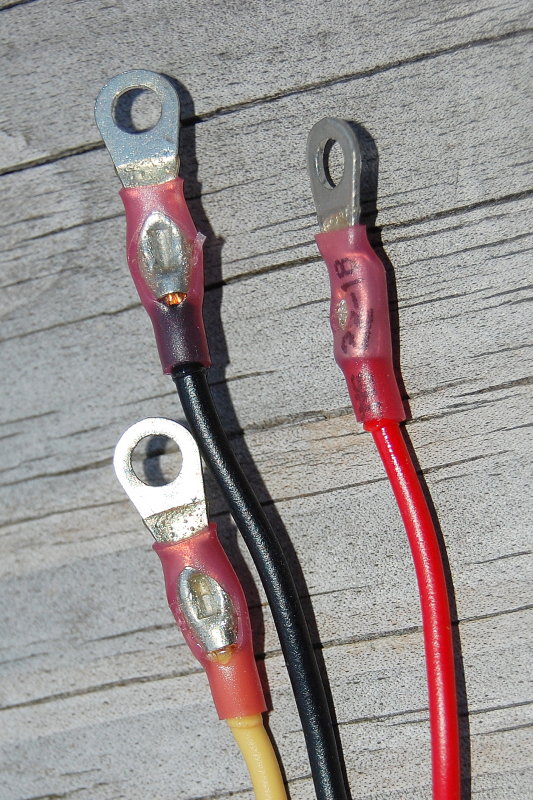
If you are using factory made adhesive line heat shrink connectors PLEASE do not waste your money on them if you plan to fill them with any sort of "grease" as you will ultimately waste your money.

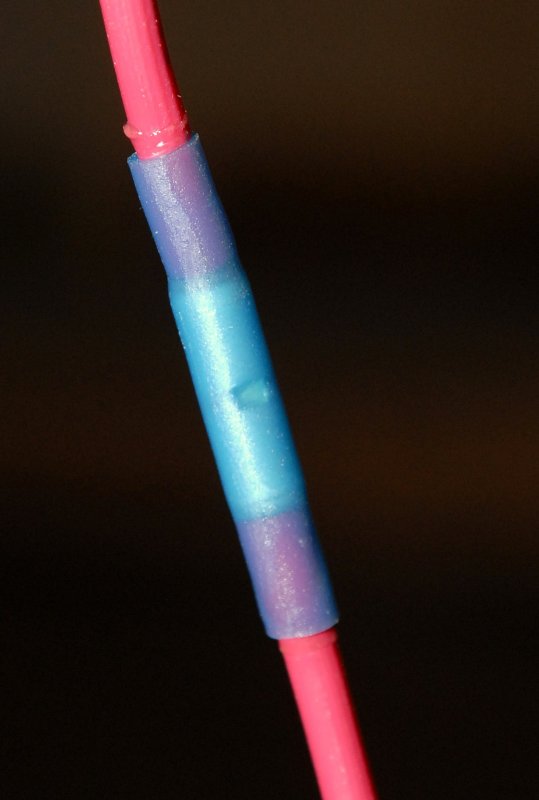
The adhesive in these crimp connectors makes them 100% waterproof. I have installed 1000's of them, it is all I use, and never once had a seal failure. Well drillers in the US use very similar products and then submerge the well pump wires in 100 + feet of water.

Vaseline, silicone dielectric, terminal grease or any other "grease" should NOT be used with factory made adhesive lined heat shrink. The whole point of the adhesive glue is that it bonds to the wires jacket. If anything you may want to wipe the wire jacket with denatured alcohol to remove any grease or contaminates so the glue bonds better. Inserting grease only guarantees the glue will NOT bond well to the wire jacket.

Using the wrong crimp tool with these fittings is also a waste of good hard earned money:
127309480.jpg


I purposely did not crimp this fitting and only heat shrunk it with the adhesive lining.
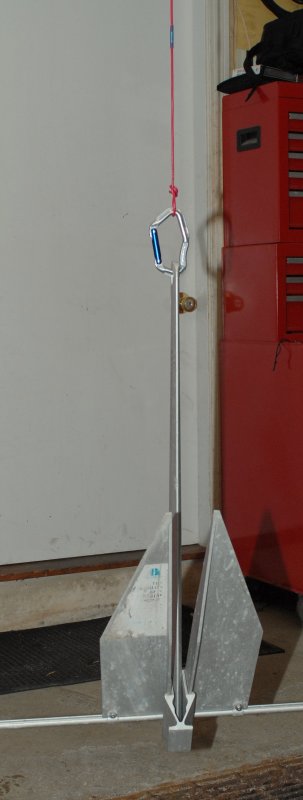
93392504.jpg


I then hung a Fortress FX-16 from it. the glue alone is quite strong.
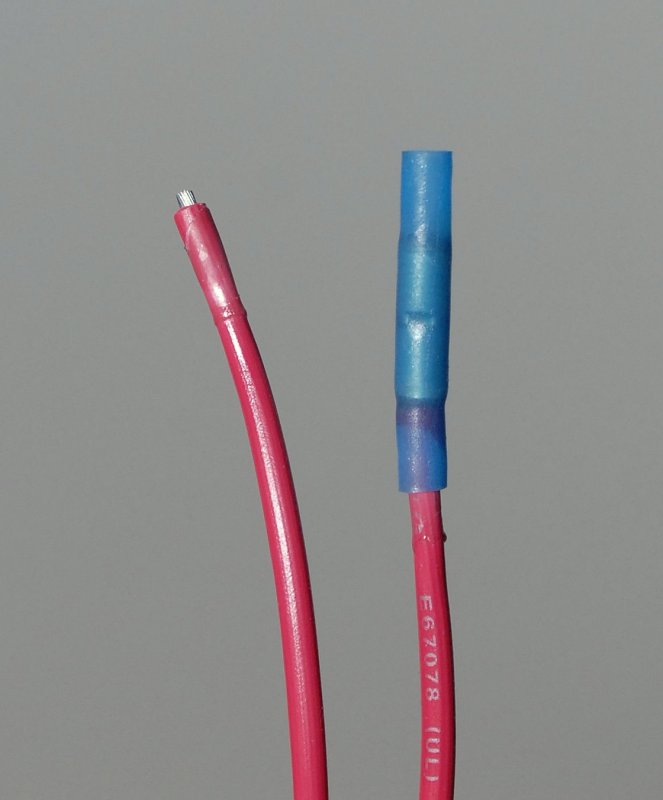
93393309.jpg


I hung a second anchor and wire jacket elongation caused the failure. As the jacket stretched it got thinner thus pulling away from the heat shrink glue.
93393310.jpg


These fittings do not need any grease to remain water tight as that is their whole purpose...
 
Last edited:
So,by using the 'hiltop' connectors, without spending any money on a crimping tool(<1347 US dollers),for £18.98 inc delivery,I can make 25 m/f connections.I work that out as 76p/connection.I never realised that being well connected could work out so cheap!
For that price, it pays not to use 'scotch locks' for doing a tow bar wiring addition to a towing vehicle.(not that I would use scotch locks anyway-waste of time/money/effort.Learnt that about 30 years ago).
Nice one 'Maine Sail'
No connection with hiltop, or any other electrical connection manufacturer.
Cheers
 
So,by using the 'hiltop' connectors, without spending any money on a crimping tool(<1347 US dollers),for £18.98 inc delivery,I can make 25 m/f connections.I work that out as 76p/connection.I never realised that being well connected could work out so cheap!
For that price, it pays not to use 'scotch locks' for doing a tow bar wiring addition to a towing vehicle.(not that I would use scotch locks anyway-waste of time/money/effort.Learnt that about 30 years ago).
Nice one 'Maine Sail'
No connection with hiltop, or any other electrical connection manufacturer.
Cheers

A good crimper for adhesive lined heat shrink connectors can be had for about $40.00 on this side of the pond. As I mentioned you DON'T need to spend $1300.00 for a crimper to make a decent crimp.;)

http://sailorssolutions.com/index.asp?page=ProductDetails&Item=WP042


BTW those hilltop connectors are very well priced. Even at wholesale I pay more than that on this side of the pond. Of course I have no clue about the quality of them but at those prices it makes them quite appealing. The yellow butts are comparable in price but the blue & red are better priced.
 
Last edited:
Maine Sail


Great post, love the photos, but before you take me to task, please read what I posted.

' If you must use ordinary crimps, stuff it full of vaseline'
 
BTW those hilltop connectors are very well priced. Even at wholesale I pay more than that on this side of the pond. Of course I have no clue about the quality of them but at those prices it makes them quite appealing. The yellow butts are comparable in price but the blue & red are better priced.
The problem is that none of the on-line sites I have seen state what metals are used in the connectors. Is there anyone out there who knows whether the Hilltop connectors are tinned copper or aluminium?
 
Top