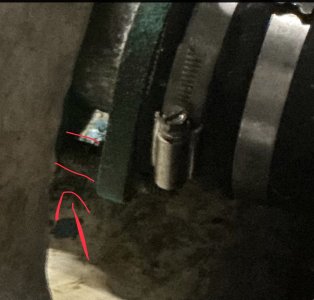
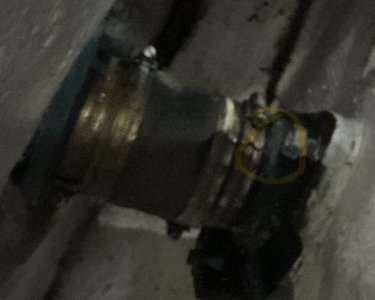
What make are these stern glands

Cant take offense when youre correct 🤣🤣🤣

It looks like a hybrid sort of arrangement….homemade? We are talking Sealine here
Looking closer at the 2nd pic, it looks a bit like a PSS seal, but fitted the other way around to normal. Also looks like the might be another flange where it all meets the back of the boat, covered in sealant ? In which case, nut sure what the bronze flange is supposed to be doing.
 
Looking closer at the 2nd pic, it looks a bit like a PSS seal, but fitted the other way around to normal. Also looks like the might be another flange where it all meets the back of the boat, covered in sealant ? In which case, nut sure what the bronze flange is supposed to be doing.
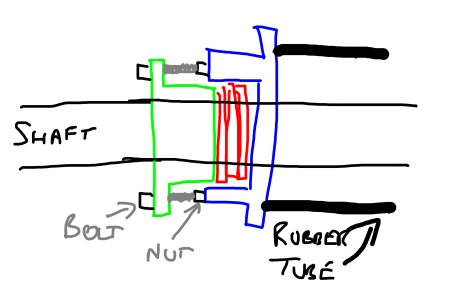
Looks like part of a ā€œstandardā€ stuffing section is ā€œfloatingā€ on the shaft and stopping water coming past the shaft with packing so my assumption is tightening the 2 bolts would work as it’ll compress the stuffing.

An early iteration of a PSS style? (Although they has a collar fixed to the shaft and O rings to achieve the seal)

Feels like there was an issue so they jerry rigged it by adding the flexible hose section. Could be wrong…could be by design
 
Looks like part of a ā€œstandardā€ stuffing section is ā€œfloatingā€ on the shaft and stopping water coming past the shaft with packing so my assumption is tightening the 2 bolts would work as it’ll compress the stuffing.
But the two bolts don't go anywhere. Zoom in on the 2nd pic.
 
There is no dripping from the gland when in port , but evidence of spraying one side.they are also water cooled . To make you smile when I did a rydlem flush it all disappeared out of these glands.
 
Ok. This is a standard factory sealine stern gland arrangement.
The stern gland packing is in a floating stuffing box. The stuffing box sits at the end of the rubber tube, which is a design that allows the stuffing box to self centre on the shaft without controlling or guiding the shaft.All of that is taken care of by the shortened cutless bearing on the outer of the Stern tube section.
AS I mentioned above there will be differing opinions on the acceptable/correct amount of dripping from the gland.
If there is a gap between the gland body and the follower, then there is the ability to compress the packing further, ccausing it to expand aginst the shaft thus increasing the sealing.
However that can be overdone which has various effects. It can cause friction against the shaft which uses horsepower.
It will prevent the dripping which helps lubricate between the shaft surface and the packing. It causes heat which hardens the packing causing more leaks and it can cause unnecessary wear on the shaft. in an extreme case it can try to turn and rip the rubber tube.
If the boat has not been run for a while the shaft may be tight and not capable of being turned by hand even a little (by grabbing the coupling behind the gearbox)
If you run the engine in gear for a bit and then after shutdown can move the shaft by hand, it's important to not overly increase that friction when tightening the gland packing.
(You should never get close to that, but I've seen it happen)
I like a loose gland seal which is well lubricated and low friction, so I like to see a drip every 30s or so when moored. After a couple of weeks of inactivity it usually slows to almost nothing. I'm happy to accept some water by the glands and the bilge pump runs for 5 seconds roughly once every other day (maybe 1litre).
I was happy with my gland packing, and adjusted it roughly once every 3 years.
When doing other work, and removing the shafts, I decided that the packing was circa 15 years old so I would freshen everything while it was all in bits. The packing that came out was in fabulous condition, and could have been left in place. I changed it anyways.
 
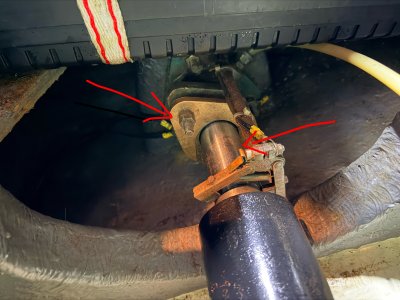
I think thats a bolt going into (guess) threaded back plate. You can sort of make out the other

View attachment 205852
Better photos needed seacock
Ah yes, i see what you mean. Apologies if my earlier comments caused any confusion. I'll head off to Specsavers first thing Monday.

Worth noting that the lock nuts are next to your arrow, they'll need slackening before turning the bolts.
 
That is indicative that it needs adjusting as in post#27 This type of seal used to be common but nowadays mostly replaced with dripless seals either face seals such as PSS or lip seals in a housing like the Tides Marine one pictured earlier. That is probably the best arrangement and now widely used on your type of boat. No desperate need to change if you are happy with the small amount of seawater entering the boat.
 
IMG_1425.jpeg
Is this where to adjust a bad photo but there are two nuts ,one is lock nut , so I undo lock nut hold spanner on bolt head on the other side then just nip nut up then put lock nut up tight.
 
Those bolts. Tightening pulls the collar inwards which compresses the stern packing. Do half a turn on both and see how you go

There will be a locking nut somewhere which might need backing off 1st


You_Doodle_2026-01-31T19_44_01Z.jpeg
 
For the hard of understanding. Repacking a traditional gland.
Lots of YouTube videos on this job , regards pre cutting the rings of packing and the angle of cut for best seal and ease of fitting.
It always helps if previous lazy git owners have not just forced new packing on top of existing old packing which results in gland being mostly virtually rock hard packing doing nothing to provide a seal and only the newest ring of packing doing anything.
When doing this job forcibly dig out the crusty bits at the bottom of cavity.
A nice metallic sound from your removal device hitting metal indicates the old stuff is out.
If doing the job in the water , water coming in will help flush out any remaining fragements.
 
Top