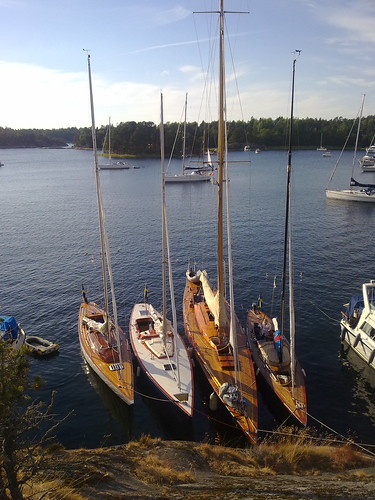
What is the purpose of spreaders?

Nostrodamus

Well-Known Member
Joined
7 Mar 2011
Messages
3,659
www.cygnus3.com
I know, I have to stop thinking so much or get out a bit more but from my list of "why" questions comes...
Why do aluminium mast boats have spreaders?
You don't see them on wooden masts, you tend to see less on carbon fibre masts but on aluminium masts the come in various numbers, shapes and angles.
What is their purpose besides sometimes getting in the way of or wearing the sail?
I would have thought it was to put the mast under compression but seeing some that are swept backwards or forwards I am not so sure.
Anyone out there who can show me the light?
 
They increase the angle between the mast and the shroud. This reduces the shroud tension and the compression force in the mast for the same sideways force when compared with a straight shroud. They also break up the length of the mast into a number of bays between points of restraint. This greatly increases the mast's resistance to buckling under compression load.


Edit:- And they give the birds a nice perch for ****ping on the deck!
 
Last edited:
Thank you for the reply which helps me understand. In the same vein I presume a keel steeped mast will need less compression forces than a deck stepped one which will also have an effect on spreaders?
I suppose the ideal for a racing boat would be to do away with spreaders all together?
 
I don't think you see any less spreaders on a carbon rig! Wooden, yes possibly, most will be a single set, but this is more to do with the desired shape of the mast which back in the day would tend to be arrow straight.

Spreaders give you a lot of control on the pre-bend of the rig, and if they are swept, and also stop the rig falling off to one side and take some of the load off the backstay. Without spreaders, the top of the mast would be above the bottom, but the middle would fall off to leeward. The mast would be more likely to invert with the kite up too.

Certainly in dinghy racing, spreader setup is critical. My Fireball has fully adjustable spreaders (go longer for heavy crews, shorter for light to keep the gust response the same) and sweep more for increased per-bend. I know yachts don't tend to have adjustable spreaders but as with anything like this dinghies are a good way to show what is going on with the various forces!

Incidentally the 49er has totally fixed spreaders, but a lot more wire to control the rig. And the shrouds and capshrouds are totally independent...the caps go from the top spreaders straight to the chainplates without passing through the bottom ones at all.
 
Thank you for the reply which helps me understand. In the same vein I presume a keel steeped mast will need less compression forces than a deck stepped one which will also have an effect on spreaders?
I suppose the ideal for a racing boat would be to do away with spreaders all together?

The other advantage of spreaders is that they control sidways bend at the point of the spreader.

A keel stepped setup is stronger than deck stepped, because you have an extra point of control of the mast. In a racing boat, you can use this to specify a lighter mast section. The downside of a keel stepped mast is that you have a hole in the deck. Hence many cruising boats (HRs etc) having deck stepped masts.

Of course, the one thing you can't do with spreaders is hoist a gaff past them. So for a gaff main, the spreaders have to be above the throat. So as the mast is unsupported for most of its length (as well as the additional forces exerted by the gaff), you need a big, heavy, chunky section.
 
I suppose the ideal for a racing boat would be to do away with spreaders all together?

Like the earlier poster said, carbon masts need them as much as Aluminuim masts. Racers certainly need them. They're penalised under IRC which encourages racers to try to get away with fewer, but then again they want lighter, bendier masts which encourages them to have more.

Not sure why wooden masts have fewer - maybe they're typically shorter or maybe it's because wooden masts tend to be on older boats built when multiple spreaders were less prevelant.
 
If a mast is made from carbon to save weight it will tend to be whippy - think fishing rods - so it will need spreaders to stop it bending like a pretzel. OTOH carbon masts can be made stiff enough to be completely unsupported. Mine is 15 metres long and completely unstayed. The down side is that it is as heavy as an equivalent aluminium mast and stays.
 
Thank you for the reply which helps me understand. In the same vein I presume a keel steeped mast will need less compression forces than a deck stepped one which will also have an effect on spreaders?
I suppose the ideal for a racing boat would be to do away with spreaders all together?

We don't need any compression in the mast. The stays go into tension to resist the sideways forces and the compression arises to resist the downward components of these tensions. For the same rig a deck stepped mast will have the same compression as a keel stepped one (except for a little bit more mast wieght). By reducing the free length between restraints the spreaders increase the compression capacity of a given section allowing smaller mast sections to be used. They also reduce the bending moments in the mast again allowing a smaller section to be used. Yes you could do away with them altogether and have an unstayed rig but the mast section would have to be much bigger and heavier to resist the large bending moments even though it will be carrying no compression.
 
Last edited:
Try simple terms. Put a 12" ruler vertical. Press down on the top - it buckles. Press hard enough and it will buckle and snap. Now imagine stopping the middle part from moving sideways. It will then take a much greater vertical load.

With sails on a mast and wind in the sails there is a vertical load and a bending force. If too much the mast will fail in compression and buckle. Put shrouds on the mast under an amount of tension - when the mast bends it will increase the tension on the windward side by trying to deflect sideways. Put a spreader between a tightly strung shroud on the windward side and the mast and it will be compressed as soon as the mast trys to bend effectively stopping the mast bending.

The combination of shrouds under tension and spreaders (effectively stopping the mast bending sideways too much) enables the mast to resist far greater loads.

r
 
Yes to spreaders on wooden masts - if they are bermudan rigged. No different from an aluminium mast.

You do not get spreaders on many gaff rigged boats because you would not be able to get the sail raised. These masts tend to be much shorter (often termed "pole") masts and are supported differently - sometimes with "channels" outside the deck edge to widen the shroud base. Even then, taller masts may well have a fixed topmast (above the top of the gaff jaws) and have spreaders to allow the shrouds to support the topmast.
 
We don't need any compression in the mast. The stays go into tension to resist the sideways forces and the compression arises to resist the downward components of these tensions.

Sorry but that's not strictly correct.

Shrouds can't support compressive loads. The only way that the moment a lateral force on the mast generates can be resisted is by the couple/moment generated by the compressive load in the mast and the tensile loads in the shrouds. Take moments about the mast heel and you'll see what I mean. As the lateral load increases the first thing that happens is the tensile load in the leeward shroud reduces, and the tension in the windward shrouds increases to compensate. As sail loads increase still further the leeward shrouds go slack and then tension in the windward shrouds increases still further and mast compression starts to increase.

You can do away with the shrouds altogether but then you need to have a much bigger mast section, as the walls must support the bending moment by themselves. The leeward side will be in compression and the windward side in tension.
 
My old mast was aprox 150-175mm width and single spreaders.
The new mast is 80mm width and has 2 sets of spreaders so I guess the spreaders are instrumental in preventing sideways bending of the mast.
The new mast has not been stepped yet but I notice the spreaders are very slightly swept back somewhere in the region of 5-10degree, what is the advantage, if any of the back sweep?
C_W
 
Sorry but that's not strictly correct.
Ok preload in the shrouds complicates the issue but I was trying to keep things simple. Yes the couple between shroud tension and mast compression resists the overturning moment but the compression only arises in reaction to the vertical component of shroud tension.


You can do away with the shrouds altogether but then you need to have a much bigger mast section, as the walls must support the bending moment by themselves. The leeward side will be in compression and the windward side in tension.
I thought I said that.
 
Ok preload in the shrouds complicates the issue but I was trying to keep things simple. Yes the couple between shroud tension and mast compression resists the overturning moment but the compression only arises in reaction to the vertical component of shroud tension.


I thought I said that.

You did. :)

I agree with what most of what you've said about mast compression, but after the leeward shrouds go slack the additional overturning moment is resisted by increasing compression in the mast and corresponding increase in tension in windward shroud. If you reduce shroud tension then this crossover point occurs earlier.
Not trying to be contrary, just trying to help people understand what's going on in their rig.
:D
 
My old mast was aprox 150-175mm width and single spreaders.
The new mast is 80mm width and has 2 sets of spreaders so I guess the spreaders are instrumental in preventing sideways bending of the mast.
The new mast has not been stepped yet but I notice the spreaders are very slightly swept back somewhere in the region of 5-10degree, what is the advantage, if any of the back sweep?
C_W

I believe it's to allow the chain-plates to be further aft, presumably because that's where the hull is wider. The shrouds must not pull the spreaders fore or aft obviously or they'll put a massive strain on the spreader's fastening to the mast - the spreader's strength is all in compression.
 
I believe it's to allow the chain-plates to be further aft, presumably because that's where the hull is wider. The shrouds must not pull the spreaders fore or aft obviously or they'll put a massive strain on the spreader's fastening to the mast - the spreader's strength is all in compression.

Spreaders are swept back for a number of reasons, none of which are of benefit to the cruising man.

On racing boats they are used to achieve greater headstay tension, which means the backstay can be used to induce bend. The flip side to this is that you can't let the mainsail out very far, not a major for racing boats and spinnaker does most of the work. It is also easier to tack overlapping headsails as one can do away with fwd lowers (if they feel brave)

On cruising boats it has developed because bavaria and co. realised that if they followed the racers they could also do away with fwd lowers and have all the shrouds terminate at one point on the deck, reducing the amount of support necessary on older boats. Which means to tune these boats you create pre bend and then tension lowers against this. for fore and aft support. Some modern boats also have babystays but these cant be tensioned properly because there is no deck support there. This is a little awkward but doesn't become a problem till you get in mast furler options which can't have prebend. So you end up with a pumping mast or so over engineered fore and aft that it affects performance.

The extreme of this is the legend boats which use the BR rig with 90 degree spreaders and no backstay. This rig was designed for a canada cup windwand leeward race. And allows for fat head mainsails and lots of roach. But you can't go downwind.

For me a cruising boat should always have in-line spreaders and for and aft lowers.
 
Spreaders are swept back for a number of reasons, none of which are of benefit to the cruising man.

Except that they can counter the pull of a forestay on a fractional rig without the need for runners. Carried to a greater degree they can allow one to do without a backstay at the cost of a much narrower sheeting angle for the main.
 
Top