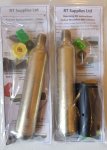
What exactly is needed when servicing a life jacket?

wipe_out

Well-Known Member
Joined
23 Feb 2013
Messages
1,399
Location
Bournemouth
Visit site
Maybe a daft question but do you replace the gas cylinder and the auto trigger gizmo (not sure what its called) every year?
if not how often do you replace these items and what do you do annually?

If it's relevant we have basic Crewsaver automatic life jackets that a a few years old now..
 
Auto-trigger gizmos tend to have an expiry date, length of time depends if it's a dissolvable type, or hydrostatic pressure type. Most will have expiry date printed on, and if long overdue, probably worth replacement for peace of mind.

Canister can be weighed and compared to the weight stamped on the side (presuming it weighs at least the stamped number it will still be good. This ensures gas hasn't escaped....or any sign of corrosion it might be best to replace.

Then mouth inflate the jacket, and leave overnight to ensure no leaks in the bladders or valve.

Check light etc. if there is one.

Then re-pack.
 
Last edited:
Auto-trigger gizmos tend to have an expiry date, length of time depends if it's a dissolvable type, or hydrostatic pressure type. Most will have expiry date printed on, and if long overdue, probably worth replacement for peace of mind.

Canister can be weighed and compared to the weight stamped on the side (presuming it weighs at least the stamped number it will still be good. This ensures gas hasn't escaped....or any sign of corrosion it might be best to replace.

Then mouth inflate the jacket, and leave overnight to ensure no leaks in the bladders or valve.

Check light etc. if there is one.

Then re-pack.

+1. Just like what he said.
 
Auto-trigger gizmos tend to have an expiry date, length of time depends if it's a dissolvable type, or hydrostatic pressure type. Most will have expiry date printed on, and if long overdue, probably worth replacement for peace of mind.

Canister can be weighed and compared to the weight stamped on the side (presuming it weighs at least the stamped number it will still be good. This ensures gas hasn't escaped....or any sign of corrosion it might be best to replace.

Then mouth inflate the jacket, and leave overnight to ensure no leaks in the bladders or valve.

Check light etc. if there is one.

Then re-pack.

The Auto-trigger gizmos On my life jackets have a green indicator if its still in working order and red when out of order.

I would not mouth inflate the jacket as this will introduce moisture into the life jacket bladder which would cause the bladder to deteriorate.

I use an oilless compressor ( diaphragm type) or used my SCUBA tank.
 
Last edited:
Wipeout-I see you are in Bournemouth so I guess Poole is your closest source of nautical info however if you are worried I recall Baltic used to offer a servicing option (maybe crewsaver do likewise?) . We just check and weigh cylinder and keep to to the replacement dates stamped on the auto inflate unit. I would suggest you take the LJ into Force 4 in Poole ad they weill no doubt advise as to correct parts to replace the auto trigger gizzo which just unscrews on ours. There have in past been articles in PBO on lifejacketing servicing if you can find one somehow BTW. As siad do mouth inflat to test if they stay blown up but in reality any lilo type pump will blow in dry air if you dont happpen to have a handy SCUBA compressor on board your vessel.

We have just replaced ours after 15 years -went to helpful company on IOW cowes who have website where you can spec out requirements etc .
 
I’ve been mouth inflating ours for the past 10 years with no sign of any deterioration. Equally, my BCD must be 15 years old and my wife’s is getting on for 25 years old. Neither of them showing any signs of deteriorating bladders after repeated inflation and deflation complete with sea water.... Might have be consideration once upon a time when there was rotatable fabric or rubber involved in the bladder but these days it’s all plastic and we’ve been repeatedly told how that’ll still be floating about in the sea in thousands of years time.
 
Ordinary servicing, checking the cylinder, etc, is easy enough, but repacking can be tricky. One of my Crewsaver Ergofit jackets decided to inflate itself a couple of years ago. I'm a fairly practical guy, but there was absolutely no way I could easily repack the thing! In the end, I had to have it professionally serviced and repacked. Be wary of lifejackets which burst their zips when they inflate!
 
Ordinary servicing, checking the cylinder, etc, is easy enough, but repacking can be tricky. One of my Crewsaver Ergofit jackets decided to inflate itself a couple of years ago. I'm a fairly practical guy, but there was absolutely no way I could easily repack the thing! In the end, I had to have it professionally serviced and repacked. Be wary of lifejackets which burst their zips when they inflate!

I have just replaced my 5 year old Crewsaver with a KRU. The velcro on the crewsaver wore out and kept coming undone, and repacking after a service was a nightmare as it was packed so tightly. The KRU has zips and seems much easier to repack. Neither jacket was used in earnest and only opened once a year for servicing.
 
Funnily enough, I replaced the capsules on 2 LJ today.
I inflate them , by mouth, and weigh the cylinders, every season but the capsules were marked "Replace 2013"!
After fitting the replacements I dropped the old capsules into a sink of water. Both poped and I'm sure that they would have inflated the Ljok.
I would guess that storage conditions are probably more important than age but not as easy to quantify.
 
Corrosion on a cylinder can be a problem if it is not kept dry. I think some corrosion and discoloration is OK. I like to smear a grease over the cylinder to discourage rust. (petroleum jelly) . I would use a pump it at all possible for test inflation. ol'will
 
Top