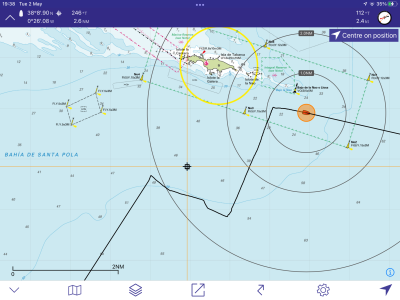
what does "tacking through 75-800" mean

The B&G kit I have cleverly shows the tack laylines adjusted for tide, and as CS says Solent sailors almost always having to beat close to the wind on the way out or their way home.

B&G call it "sail steer". Still getting the hang of it because in home waters it's just a toy as tacks are more often needed to avoid ships, Bramble, Lepe, shallows etc rather than working out best VMG.
I have that too, on Garmin gear. But it develops itks advice on the tide you are currently in. Given the variation in tide strength you get in a fairly short distance, it’s rubbish. Ok for an offshore race, but in home waters we might be tacking at 2m and 5m depth. It cannot do that accurately.
 
I suppose one could always factor in whether it is worth using some fuel & how many revs to give the engine. With a Brunton Autoprop one can have it on a fast tickover & add a couple of knots to one's sailing speed upwind ( or any angle for that matter) which makes a big difference to where one decides to go. That is about the only good thing about the Brunton, but it makes having one all worthwhile when one would just like to get home.
 
For Solent based sailors, we’re so often in wind aligned with the tide, one way or another, that COG means little for your windward performance, unless there’s a lee bow to be had. The effect of tide on the wind means often that the seat of your pants, and knowing the TWA your boat does best at is all you can go by. You may well have a really impressive vmg to the mark/waypoint, but then, you would, with 3.5kn of tide under you. Easy to be deceived that you’re acing it.
Maybe I should have qualified it as VMG to wind, which is what these instruments have displayed since they arrived in the '70s. With this, one's best VMG will still always be one's best course, and is will often be the most accurate way of judging one's performance. I do have VMG to waypoint as an option on a different instrument but seldom use it.
 
VMG is again in the here and now. It’s not looking ahead, nor telling you if a small trade off in speed for height is going to get you a lee bow.
Although an alert sailor will be looking ahead for possible changes in wind, tide, or sea state, the duty of the helmsman is to make the best progress possibly at that point in time. In this respect, the more information the better, from speed log, wind gauges, sail shape, tell-tales, Windex and the feel of the boat and wind. How much is practicable at any one time is a matter of choice, but you can't have too much information or feedback.
 
I can only say, Angus, that my favourite memorable sails normally involve spinnakers, light to moderate winds, and a G&T. However, if we exclude the favourite, most of them would be hard thrashes to windward.
 
To see how close winded modern race yachts can be, have a look at this.
Look at the film of Law Connect sailing particularly from about 1 hour 18 minutes onwards. The yacht is at a bit less than 40 degrees to true wind with the mainsail centred and a big overlapping sail (code zero?) flown from the bowsprit.
 
75-80°. I wish.
IMG_0761.PNG
This was pinching my way around the east cardinal earlier this year. The thing about having a VMG indication is that it sometimes feels horrible to sail to it when you know you can go much faster through the water if you come off a bit.
 
75-80°. I wish.
View attachment 169657
This was pinching my way around the east cardinal earlier this year. The thing about having a VMG indication is that it sometimes feels horrible to sail to it when you know you can go much faster through the water if you come off a bit.
When your destination is upwind and you’re not expecting any major wind changes, it’s almost never quicker to pinch instead of sailing your best upwind angles.
 
When your destination is upwind and you’re not expecting any major wind changes, it’s almost never quicker to pinch instead of sailing your best upwind angles.

That's kind of implicit in any reasonable definition of 'pinching' and 'best upwind angle'.
 
When your destination is upwind and you’re not expecting any major wind changes, it’s almost never quicker to pinch instead of sailing your best upwind angles.
It doesn't have to be a matter of pinching, which is almost always wrong but as in #70 if you try to get the best VMG by following the meter you end up sailing closer than feels natural. I reckon that I can sail to windward pretty well, judging by how I get on against other boats and when racing, but if I want to get the maximum VMG on my boat it feels like I'm pinching. In order to achieve this I have to watch the wind instrument, the speed, the VMG meter, and if I have time even the sails. A lot of concentration is required to get the best results and I seldom do it for a few minutes or when teaching someone. It is really only practicable in smooth water because the slightest knock from a wave risks pushing you upwind and a critical loss of speed. What I try to do is learn from these sessions and use the information to inform my sailing.

PS, we had a discussion about pinching a year or two back, with some of us asserting that there were a few rare occasions when pinching to reach a mark or a bend, or to gain lee-bowing can just work.
 
That's kind of implicit in any reasonable definition of 'pinching' and 'best upwind angle'.
There are those who insist that when beating at roughly 40 degrees to the tide. pinching above their best close hauled course just to get the tide to hit the other side of their keel is beneficial.
They are wrong.
 
It doesn't have to be a matter of pinching, which is almost always wrong but as in #70 if you try to get the best VMG by following the meter you end up sailing closer than feels natural. I reckon that I can sail to windward pretty well, judging by how I get on against other boats and when racing, but if I want to get the maximum VMG on my boat it feels like I'm pinching. In order to achieve this I have to watch the wind instrument, the speed, the VMG meter, and if I have time even the sails. A lot of concentration is required to get the best results and I seldom do it for a few minutes or when teaching someone. It is really only practicable in smooth water because the slightest knock from a wave risks pushing you upwind and a critical loss of speed. What I try to do is learn from these sessions and use the information to inform my sailing.

PS, we had a discussion about pinching a year or two back, with some of us asserting that there were a few rare occasions when pinching to reach a mark or a bend, or to gain lee-bowing can just work.
I’m quite pleased you note that this is not easy. Can I quote this post to my crew when they next complain that I have the easy job!?
 
We have a basic Bavaria, never racing, very basic skills (me), and we can do around 5kts at 35 apparent in around 10-12kts.. But the track and the log dont lie. Our drift while 'pinching' is noticeable, and it is quite easy to get pushed off by a few degrees and loose speed. Around 42-45 feels like better progress, is easier to maintain, and with a better VMG. The true tacking angles, from the plotter, are then around 90. As @flaming says, pinching and chasing the numbers isnt always best.
 
Sailing a bilge keeler, I have quite mixed feelings about how my boat goes to windward.
Sometimes it seems to do pretty well against bigger, racier boats, other times not so much.
I think sea state matters a lot. And we like more breeze than you might expect, reef early, roll up a bit of genoa, the boat becomes more balanced and responsive.
Getting rid of the fixed prop made a big improvement in lighter airs, but also in breeze.

The main thing is to be on the right tack though, on a coastal passage, the wind is always (?) going to shift over time and vary from place to place. It's not like a 10 minute beat in a dinghy race.
 
Top