
14K478
Well-Known Member
Just as dead. Foetid down below and growing a black beard of mould while the engine and electrical stuff corrodes.But probably not rotten or rotting as the fresh rainwater seeps into their opening joints.

Just as dead. Foetid down below and growing a black beard of mould while the engine and electrical stuff corrodes.But probably not rotten or rotting as the fresh rainwater seeps into their opening joints.

Nothing a Karcher and a few bottles of Bilgex wouldn't cure though as opposed to a couple of firelighters and gallon of petrol.Just as dead. Foetid down below and growing a black beard of mould while the engine and electrical stuff corrodes.

Which takes us to a repeat of the several past threads on is it worth the money in view of the ongoing expenditure. Which is why there is a preponderance of cheap but barely maintained old yachts apart from the occasional gems that arise when the last careful owner that lavished his time and attention on his yacht has either shuffled off this mortal coil and his descendants don't know what to do with it or want it or he has fallen on hard times or ill health.For me the Hunter Impala is the ideal boat in that ball park, but everybody's expectations from a boat are different.
If you are new to boat ownership, I should also say that the cost of a £10k boat itself is minor if not negligible compared to the upkeep and mooring costs. So I would not see it as a "£10k boat" but think about budgeting for a whole project.
Thanks, I'm working on a rough budget of putting aside £200 a month for maintenance (not including mooring or lifting costs).If you are new to boat ownership, I should also say that the cost of a £10k boat itself is minor if not negligible compared to the upkeep and mooring costs. So I would not see it as a "£10k boat" but think about budgeting for a whole project.
That is very very wise!Thanks, I'm working on a rough budget of putting aside £200 a month for maintenance (not including mooring or lifting costs).
Things like the Konsort are massively better than the Centaur, not modern but a generation or two newer than the Centaur and still inexpensive in current market.Yep, so there isn't a modern equivalent of a Centaur.

Things like the Konsort are massively better than the Centaur, not modern but a generation or two newer than the Centaur and still inexpensive in current market.
Or the Hunter Horizon 27 suggested earlier. Will sail much better also.
You're right, I have limited experience in the category I'm looking at - almost all of my sailing has been in the 36-40ish range charter/school boat. I have been on a few smaller boats but it's hard to separate "that's different" from a stable preference without really prolonged experience, especially when not taking charge.Another 2 cent from me - if you don't know exactly which boat you want, you might not have spent enough time on other people's boats to know what is important for you. Just a small example of the parameters you need to consider: a lot of the boats that are suggested have large overlapping genoas. The Impala I suggested carries big genoas too, but it can also be cruised perfectly well with a jib. I would never want to be stuck with a large furling genoa as I don't like tacking them and the way they sail.
Now people might respond and call this "niche", illogical,l or silly but it's an entirely personal choice, that has developed over the years. The boat you choose should fit such personal choices you will inevitably have.
Are you a solitary sailor or do you have a partner?Doing up a not too rundown boat means you can modify to a certain extent how you want it and discover any problems this is a good opportunity for you and your mate to bondYou're right, I have limited experience in the category I'm looking at - almost all of my sailing has been in the 36-40ish range charter/school boat. I have been on a few smaller boats but it's hard to separate "that's different" from a stable preference without really prolonged experience, especially when not taking charge.

My wife and two youngish children are interested in holidays afloat but probably not sailing as often as I'd like to - so probably a mix!Are you a solitary sailor or do you have a partner?Doing up a not too rundown boat means you can modify to a certain extent how you want it and discover any problems this is a good opportunity for you and your mate to bond

I’m sorry, but I think this is going too far and getting a bit silly. You, “Potentilla” with his post 20, above, and “Baggywrinkle” with his post 24, above, have triggered what I hope will be a polite and I hope a useful little rant:
I can understand people who have only had plastic boats feeling a bit inadequate in the company of people who have wooden boats, but they really don’t need to.
For the first century and a half of our sport almost all boats were wooden and most of the always numerous smaller boats were always maintained by their owners, who had no woodworking skills.
All the old sailing handbooks - Worth, Cooke, Hiscock, etc - have a chapter on maintenance. Just a chapter. No big deal. By definition, anyone could do it and anyone still can.
Let me illustrate this:
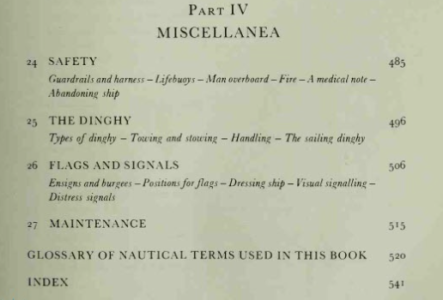
Here is the second page of the index of Claud Worth’s “Yacht Cruising” - first published in 1911 and the “bible” for all those who messed around in small boats until Eric Hiscock wrote his own book.
View attachment 209039
and here is the same thing for Eric Hiscock’s “Cruising under Sail:
View attachment 209040
It’s in “Miscellanea”!
No big deal.
You never see anyone ever saying that only aviation technicians should own OVNIs, or only builders should own ferro boats, or only welders should own steel boats.
When plastic boats were first fighting for market share, in the sixties, they were “mass produced” by bigger organisations than the small family run boat builders who made most wooden boats and they used the power of the corporate world to advertise and to persuade the pundits that plastic was “maintenance free”. We all know that is nonsense and yet all the owners of plastic boats who have no experience of wooden boats will gather round to dissuade people from trying something of which they have no experience and about which they are unqualified to comment.
For most of my sailing career of almost sixty years, it has suited people like me to go along with this twaddle because it scared people off wooden boats so that people like me could buy them cheap, but it is now getting to the point in Britain which it has reached in the USA where wooden boats are somehow abnormal.
 .... possibly 5/12 of the work?
Another 2 cent from me - if you don't know exactly which boat you want, you might not have spent enough time on other people's boats to know what is important for you. Just a small example of the parameters you need to consider: a lot of the boats that are suggested have large overlapping genoas. The Impala I suggested carries big genoas too, but it can also be cruised perfectly well with a jib. I would never want to be stuck with a large furling genoa as I don't like tacking them and the way they sail.
Now people might respond and call this "niche", illogical,l or silly but it's an entirely personal choice, that has developed over the years. The boat you choose should fit such personal choices you will inevitably have.
... have you taken your family to warmer climes and chartered newer, bigger boats? ... If so then you may well need to get something nearer the low 30+ foot range with a pleasant interior. I made the mistake of chartering in the med for a few years before buying and that certainly set the expectation with my family .... now they don't just want separate cabins, they want ensuite heads tooYou're right, I have limited experience in the category I'm looking at - almost all of my sailing has been in the 36-40ish range charter/school boat. I have been on a few smaller boats but it's hard to separate "that's different" from a stable preference without really prolonged experience, especially when not taking charge.

Now is you opportunity then,a bilge keeper will afford opportunities to do some sailing then take the ground were the kids can scamper about gradually find in interest in the boat without forcing the situation ………and other weekends when you can go off on a bash towindward…it’s essential to take your family along they will value time afloat in later yearsMy wife and two youngish children are interested in holidays afloat but probably not sailing as often as I'd like to - so probably a mix!
If that's your experience I very much doubt you will be satisfied with a Centaur or anything like it.You're right, I have limited experience in the category I'm looking at - almost all of my sailing has been in the 36-40ish range charter/school boat. I have been on a few smaller boats but it's hard to separate "that's different" from a stable preference without really prolonged experience, especially when not taking charge.
I have just had another look at the Sigma 36 and it doesn't look like it has roller reefing headsails which may be a problem for you. If I am right then it would confirm my suspicion that it has essentially been a racing boat and the interior will have suffered and the sails at 9 years old will be tired but for a cruising boat you would be able to live with them.My wife and two youngish children are interested in holidays afloat but probably not sailing as often as I'd like to - so probably a mix!
I guess I will find out! But I'm looking for a different kind of experience, that's part of the point. And I have enjoyed the little time I have had aboard smaller older boatsIf that's your experience I very much doubt you will be satisfied with a Centaur or anything like it.
You have to add into the equation his diffident wife and two small childrenThe sailing performance of the Centaur is quite good for a 1960’s bilge keeler.
She will bravely attempt to go to windward in a Force 3 and will stop trying in a Force 5.
The Holman, on the other hand, really sails.
