Westerly Jouster advice sought

From your latest pic I would agree the strip along the centre of the roof now does look original.
A piece of hardwood as you have horizontally under the mast is totally inadequate to take the loads involved.
The first few degrees of tilt is the scary part until you have the weight of the mast.
Two holding the mast you increase your confidence? A 3rd forward of the boat with a line.
 
Might I add, lengthening the holding lines going out the front helps, it's all basic leverage. And why not strap together a simple A-frame at the back tied to the pushpit to catch it if/when it falls?

I saw a "challenged" individual actually lose their mast of a similar size, putting it up I think it was, where is actually fell right forward while still in the tabernacle and it all survived and the boat's still sailing with it.

I'm not recommending trying but just encouraging you to have a go at it. Ditto, I've seen it down with a wife out front holding the ropes to take the initial weight, so it does not require a lot of strength.

Have you watch the videos of the pro way to do it using a boom like arm off the front of the mast (gin pole)?

I'd say a Catalina 22 is pretty similar.

 
Last edited:
As an aside, I also know a guy with a bigger, stronger boat, a Contessa, who cracked his right at that point by falling off a wave heavily. He was, however, in the middle of the Atlantic at the time.

He reinforced it with a wooden beam and kevlar-ed it in for the next time he crossed it!

Although compression from the mast does seem the most likely, may be your boat has had an adventurous past? I'd put a single piece of wood right across the width, shortening the alloy uprights to support it. I suppose bent and laminated/glued strips would be best but perhaps overkill. On other Westerlys, I have seen the company just use vertically layered plywood but also seen it fall to pieces.

Which wood to use?

Is there anything going on at the foot of the uprights, on the sole of the cabin?
 
If you have a reliable out board you could motor to either Ballyronan or to the Six mile water at Antrim where there are cranes which would facilitate the removal of your mast.
 
Hi

I owned the lifting keel Jouster called Selina-B in the late 80s. Great boat. I had this same issue. In my case it was a breakdown of the glue in the laminated beam supporting the mast. I simply slackened the rigging, used a couple of Akro props, and removed and relaminated the beam before refitting.

Sounds easy and it is if you break each job down. With the mast out it would be easier.

Hope this helps
 
From your latest pic I would agree the strip along the centre of the roof now does look original.
A piece of hardwood as you have horizontally under the mast is totally inadequate to take the loads involved.
Mine had a strip of wood, sheathed in GRP, across the opening, but it was at the top of the bulkhead of which I posted a picture and which have taken the load. I am sure that the OPs boat has been substantial hacked about since Westerly made it. It needs either something much stronger than that piece of wood there or - and this is what I would do - a recreation of the original bulkhead shape.
 
I'd be looking at and taking notes from how Hurley 22 owners dealt with it. Are there any cracks in the top (horizontal) layer?

Many stick a post directly under the mast to support it but it looks like you can't do that with the original bulkheads, so an alternative, is to do it like this with or without the bulkhead still in place.

If you want to own it long time, I'd be checking under the tabernacle to make sure there's no cracks to leak or if there's any sealant.

1969-Hurley-22.jpg
 
Last edited:
Thanks all for your variety of advice and encouragement; I'll try to respond as many as possible in this one post. I agree that the mast is not that heavy as I have carried it about myself in the past. Its the >50:1 leverage ratio created by the pivot point at the tabernacle which is the scary bit - until I have done it the first time. I have made a dimensioned sketch of the tabernacle to model the geometry of the rotation, but haven't done that yet.
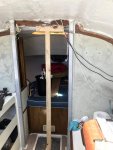
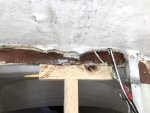
Meanwhile I have been focussed on preventing any worsening of the damage, and now have a support in place, which buys me time to think and get other bits and pieces together. See pictures - with the aid of a pair of wedges I was able to close up the crack in the beam. Lovely day here today. I was tempted to put the sails back on and go out for a while......
It occurred to me that the fore & aft strip glassed onto my coachroof might be intended to stiffen rather than repair. Theres no core - its just a 1/4 inch or so of resin and glass, and still rather springy under my weight. I have to concur that what I have found re my "door posts and lintel" does not look very professional, and may well be retrofit - but done long time ago as the textured surface on the sole is neatly cut around the posts. As far as I can tell the box sections stop at floor level and do not go through it to meet a rib in the hull moulding, and the hull there sounds hollow. That said they are wellbolted to the fibreglass internal structure and each ahs in integral fin to which the current bulhead panels attach. There is no sign of them habing shift - its just the beam that has given way. I am inclined to laminate a new one once I can strip out and get an accurate profile for the underside of the coachroof.
Re the sealing of the tabernacle - I was advised to remove and inspect. Unfortunately, like every other bolt on a westerly, the nuts are glassed over (just like those on the u-bolts & chainplates that hold the mast up. And the ones that hold the hull and coachroof together. I'll defer judgement on that one...... However no signs of any water ingress, and we had very strong wind in past week and lots of rain all winter. Boat stayed dry beyond a few minor leaks from known weak spots such as companionway hatch & such. Incidentally when I first bought her (2013) I put a lot of care into getting sealant up behind the rubbing strake, whilst she was in a barn and well dried out. Sailing on Lough Neagh is not at all like being at sea, but I have not yet had any leaks there.
I am currently weighing-up whether to make an A-frame or a gin-pole (like the contessa film) to aid in the lowering. However neither of those guarantee thst the mast will pivot as desired, but they do make it more controllable. Re motoring elsewher to a crane. My outboard is oldish but OK but I have never run it for the ca 2 hours continuous needed to get to ANtrim, or more to 6-mile water, and then back again. Not the time to be needing to call for help !
Things will probably go quiet for a while now, unless I come up with a new question, but I will report back upon the outcome, eventually.
Many Thanks
Nick (Yacht Symmetry)
 

Attachments

  • IMG_3506.jpg
    IMG_3506.jpg
    845.7 KB · Views: 16
  • IMG_3507.jpg
    IMG_3507.jpg
    486 KB · Views: 15
As far as I can tell the box sections stop at floor level and do not go through it to meet a rib in the hull moulding, and the hull there sounds hollow.
A lot of small Westerlys have hollow sections under the cabin sole that are again, themselves, springy. I've seen one that's been cut open for some reason and it was a fairly large void the shape of the root of the skeg in its case. A great place for importing some goods from Columbia, or potentially for filling with to pack foam for more floatation. Don't know yours specifically.

Less, it looks like a simple stringer to strengthen a flexy top.

Could afford yourself more access to the fore, with similar strength, if you cut out an arched bulkhead and attached it to the uprights. Or even 45° props. If you can take them out, you might even be able to weld it all up?
 
As far as I can tell the box sections stop at floor level and do not go through it to meet a rib in the hull moulding, and the hull there sounds hollow. That said they are wellbolted to the fibreglass internal structure and each ahs in integral fin to which the current bulhead panels attach. There is no sign of them habing shift - its just the beam that has given way.

On mine neither the bulkhead nor the posts extended below cabin floor level. The idea must have been for the bulkhead to transfer the load to the hull and the posts to stiffen the bulkhead.

A lot of small Westerlys have hollow sections under the cabin sole that are again, themselves, springy.

No such on the Jouster, perhaps because of the hull shape. There is a removable section in the middle of the cabin sole which gives you access, reaching under the sole, right up the edges of the lockers/bunks, which are internal mouldings.

Could afford yourself more access to the fore, with similar strength, if you cut out an arched bulkhead and attached it to the uprights.

As I posted above, I'd go for arched too, to get as much stiffness as possible while retaining headroom.
 
I like the full naval/marine door look with an arch at the bottom to. Suppose, if glassed in, it would add a little stiffness too.

If you get some slosh in the main cabin, it means you have a little dry space in the fore.
 
I like the full naval/marine door look with an arch at the bottom to. Suppose, if glassed in, it would add a little stiffness too.

Can't do that in a Jouster because the keel bolts through the hull and a plate which extends into the forecabin. Like this (note that I had strengthened the keel attachment with stainless floors under the transverse bulges, and that involved cutting away the old cabin sole.)

yQdYZtU.png
 
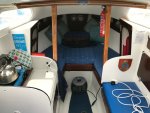
My Jouster shares your white interior (along with interesting texture from the headlining glue...) but it also has a ply vertical section, like in JumbleDuck's photo. I wonder if this provides some support to the cross member? Or at least to the roof.
 
My Jouster shares your white interior (along with interesting texture from the headlining glue...) but it also has a ply vertical section, like in JumbleDuck's photo. I wonder if this provides some support to the cross member? Or at least to the roof.
The bulkhead is bonded to the hull all the way round from the locker base on one side to the locker base on the other. Without it you would need an awful big cross member to take the load, and much stronger columns as well.
 
Slight aside, I was impressed, in another thread, how just 4 x 18mm sheets of ply, standing vertically, were able to support the entire weight of a Centaur and it's keels.

However, on my own Westerly, a lot of the original ply that was exposed to water has completely delaminated. The bulkheads are all solid though. No disrespect to the boats or the owners, but is the quality of the ply on the later Giles Westerlys as good? All talk I hear is "fing's ain't as good as they used to be".

The bonding stopped any water that was get into cabin from seeping into the ply. I've been in old Westerlys that have been abandoned for years, on and off the water, and despite being 6" in sludge, the ply bulkheads were still good.

Someone with half a brain could actually do the engineering calculations to *know* what is required, but overengineering is generally easier.


I think if that was my boat, the question I'd be asking myself, is how did I want to remodelling the interior to suit my use, as in one big open space, or sticking with two cabins.

I think that Westerly pretty much pioneered the domesticising of small boat and part of it was about creating two cabins so the kids could be hidden away/from the adults and the little lady be given a stove and a WC for the sake of her modesty. But now most of them are just used for solo or couple sailing, so it's not such an attraction. The feeling of space to challenge the claustrophobia and ability to move around and get to things often is more appealing. Or to have lots of and good wet storage.

Those bulkheads could be structural in a vertical plane (mast compression), but not on the horizontal plane (falling off a wave), so do you actually need them? Think of the difference between the inside of a W22 and a Nomad, or a W25 and a Windrush.

Again, look at the variety of bulkhead and reinforcers on Hurley 22s, a comparable but, both, much tougher and smaller interior. One typical one, I think they used on the later H22Rs was a sort of keyhole bulkhead, on others two upright pillars, (also handy to grab onto). Unless you go to a junk or cat rig, having a keel/sole stepped mast or support where a Bermuda would want sucks for access on a small boat.

But with that plate and nuts there, you've got a good opportunity to build the equivalent of a roll cage in a Landrover!

I've also seem seriously sailed H22s use precisely that ... a large diameter metal pipe "roll cage" holding it all up, also keeping out of the way because it was strong enough to go around the edges. Probably advantageous because you could use a land based manufacturer, who did not know how much marine based manufacturers charged for everything.
 
Top