welding wire for windlass

Just to clarify some figures

AWG 2 is 33·6mm² and has a resistance of 0·5Ω /1000m. For a total cable run of 15m (50') that will give a volts drop of 0·63V

AWG 1 is 42·4mm², has a resistance of 0·4Ω / 1000m which will give a volts drop of 0·5 volts

AWG 0 is 52·5mm², is 0·31Ω /1000m giving a volts drop of 0·4 volts
 
I got the 11.325 from this site http://shop.genuinedealz.com/Store/Tab.aspx?tabid=2 see below.
I agree bigger is better, 2/0 is good and 4/0 is best as Maine Sail stated.

Well, a bit misleading as it assumes the voltage will be 12v. Planned install will be for the windlass to be switchable between engine and house banks, 185aH and 450aH. Haven´t looked at the cca yet but shooting from the hip if the voltage goes down to 12v then something is wrong.

Quick google...

The only data I can find easily is that a trojan t105 can go for 115 minutes at 75a discharge before the cell voltage goes down to 1.75v per cell which would equate to 10.5v if it was a 12v battery. I really hope they ( x 4) will be able to keep above 12v if run for 2 or 3 minutes. Only 1 way to know for sure & it involves somehow applying nearly a tonne load to the windlass. That ain´t going to happen. Ever I hope :)
 
I've always found soldered connections far superior to crimped ones in a marine environment. Even when the original wire is almost corroded away, the soldered joint will still be good but a crimped one will be a mass of green.
 
Just to clarify some figures

AWG 2 is 33·6mm² and has a resistance of 0·5Ω /1000m. For a total cable run of 15m (50') that will give a volts drop of 0·63V

AWG 1 is 42·4mm², has a resistance of 0·4Ω / 1000m which will give a volts drop of 0·5 volts

AWG 0 is 52·5mm², is 0·31Ω /1000m giving a volts drop of 0·4 volts

Thanks Vic. As ever boats are a constantly learning experience. Wonder I I got to 0.39v for awg2.
Out of interest, is the voltage drop a percentage of the voltage or would it be the same for, say, 20v as it would be for 15v ?
 
Wonder I I got to 0.39v for awg2.

Found it.

From marine electric and electronics bible

voltage drop at load = 0.0164 * I * L / S

I = Load in amps
L= total cable length in metres
S=Crossectional area in square mm.
Assuming worst case (100a breaker)
0.0164*100*15 / 33.6 = 0.731. Dunno what figures I put in before, the wrong ones obviously. :(
 
Last edited:
Having spent more time than I care to remember soldering heavy (ish) lugs onto cable ends I can not remember any failures due to wicking or anything else.

Mmmmm, well, there was the starter motor that went up in flames and melted the cable and soldered joint!. Not sure if that counts as a joint or cable failure though.

I am beginning to understand why Refuler spat his dummy out ! !

73s de

Johnth
 
Out of interest, is the voltage drop a percentage of the voltage or would it be the same for, say, 20v as it would be for 15v ?

My figures for volts have been calculated from the current and the resistance ... ohms law and all that stuff.... so for the same current they would be the same absolute values regardless of the volts.

But of course a 24 volt 1000 watt motor would only take half as many amps so the volts drop would only be half as much.

3% drop is the figure often quoted as an acceptable maximum drop. So for 12 volts thats 0.36 volts. From my calcs above you can see that even AWG 0 is none too big using that yard stick.

If you go through the same exercise for a 1000 watt 24volt windlass

the current is 1000/24 = 42 amps

you then find that AWG 4 (21.2 mm²) at 0.8 Ω/1000m gives 0.5 volts drop which is only 2% of 24 volts
and that AWG 6 (13.3mm²) at 1.5 Ω/1000m gives 0.95 volts drop which is approx 4% of 24.

AWG 5 would satisfy the 3% "rule".

Must point out though that all thses calcs are of volts drop on long cable runs. Once you get to short cable runs what you must also look at is the safe current capacity of the cable.
 
Having spent more time than I care to remember soldering heavy (ish) lugs onto cable ends I can not remember any failures due to wicking or anything else.

Mmmmm, well, there was the starter motor that went up in flames and melted the cable and soldered joint!. Not sure if that counts as a joint or cable failure though.

I am beginning to understand why Refuler spat his dummy out ! !

73s de

Johnth


Just because you haven't experienced it, doesn't mean it doesn't happen. This cable is 4 years old. The corrosion started at a lug on the engine. At no time could the end have been dipped in seawater:
 
Just a little further info about the above photo:

The 30 foot length 2-0 welding cable was the house bank earth on the engine (750 amp hr). The voltage drop between the 100 amp alternator and the house bank was .5V. I had to cut away the insulation to find this damage.
 
Just a little further info about the above photo:

The 30 foot length 2-0 welding cable was the house bank earth on the engine (750 amp hr). The voltage drop between the 100 amp alternator and the house bank was .5V. I had to cut away the insulation to find this damage.

Well a little time with Mr Google hasn´t found any other incidents involiving problems with welding cable and sailors love to winge , and asking round Trini people seem happy with it here, maybe something strange happened specific to your boat.

Can't quite work out the pic - to me it looks like 2 different cables butted together - is it one cable? How come the colour difference of the cover?
 
There are a lot of boats without tinned cable and some are quite old. Many builders in the past used non-tinned wire and many items come with non-tinned wire such as lights. As long as the connection is protected from moisture with adhesive heatshrink they seem to last. But I have seen many poorly done connections without heatshrink and they exhibited corrosion sometimes several feet away from the connection point. There is no doubt that tinned wire is better. My boat has been rewired and every wire is tinned marine wire and every connection is sealed with adhesive heat shrink, including the battery cables.
 
Can't quite work out the pic - to me it looks like 2 different cables butted together - is it one cable? How come the colour difference of the cover?
To me it looks like insulation on the left and a soldered on terminal on the right. Wire looks to have failed at the end of where the solder has penetrated.

Copper salts suggest to me some contact, even if not total immersion, with salt water!
 
To me it looks like insulation on the left and a soldered on terminal on the right. Wire looks to have failed at the end of where the solder has penetrated.

Copper salts suggest to me some contact, even if not total immersion, with salt water!

Hi VicS .... youre quiet correct ..... copper lug on the right, solder wicked up at least 2" and the damage started in ernest at the end of the solder. I have no idea whether they used rosin flux or not.

As for salt water. This is in an engine space, and it can get humid. I rather suspect that the salt in the environment settled on cable end, allowing the damp to wick up the cable. By the way I cut back the insulation for 5 feet until I found bright copper again. Damp does penetrate cables a long way.

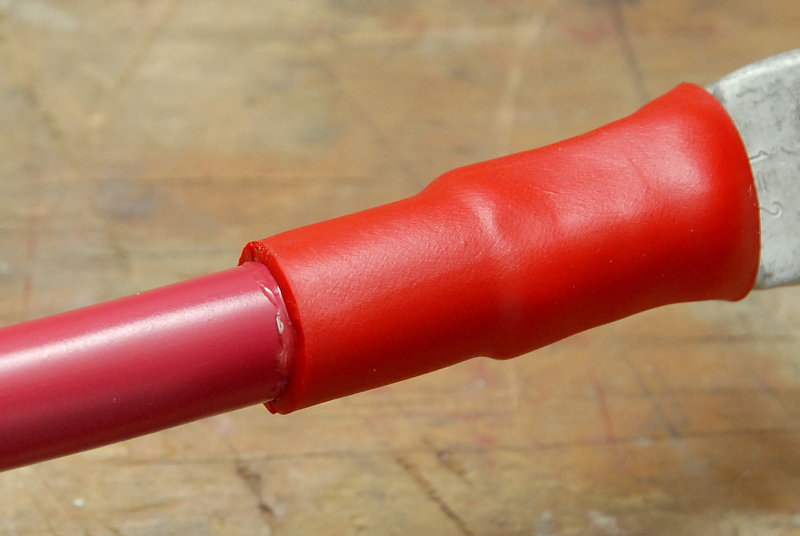
As for heat shrink with glue ...... marvelous stuff, much better than the cheap unglued variety ..... But the only way it will make a waterproof seal is if it is passed over a fair lug and sinngle cable insulation: The glue will almost certainly not penetrate around the wire strands .... or seal if there are any irregularities at the ends, like two cables exiting.
 
Yes Tradewindsailor, I agree. Just because I have not seen a problem like this does not mean it has not or can not happen.

Having said that, I have seen very many soldered joints and made more than I can remember with complete success.

What the circumstances are for your failure may need investigation however, my experience is that a soldered joint is perfectly sound.

73s de

Johnth
 
Well a little time with Mr Google hasn´t found any other incidents involiving problems with welding cable and sailors love to winge , and asking round Trini people seem happy with it here, maybe something strange happened specific to your boat.

Can't quite work out the pic - to me it looks like 2 different cables butted together - is it one cable? How come the colour difference of the cover?

No butt ..... one cable end (see reply to VicS above).

Plain copper cables in the marine environment will corrode, it just depends on how fast ... unless of course you can stop the moisture getting in.....

You're free to believe whoever you want, it's your choice. I'm just giving you the benefit of my experience. Just remember that most boat fires are caused by poor equipment or poor judgement. Add to that, there are all the boats that get into trouble due to equipment failure ........

This photo is not an isolated example, but it's a good one for this thread.
 
Yes Tradewindsailor, I agree. Just because I have not seen a problem like this does not mean it has not or can not happen.

Having said that, I have seen very many soldered joints and made more than I can remember with complete success.

What the circumstances are for your failure may need investigation however, my experience is that a soldered joint is perfectly sound.

73s de

Johnth

Hi Johnth

I've found this sort of corrosion in many cables in many boats. It certainly seems prevalent in the tropics.

You noted before that you had a case where the starter-motor caught fire and the solder melted. The cable could have fallen out of the lug and shorted. This is why most authorities require a mechanical connection, whether or not you choose to use solder or not.
 
That picture looks to me like the classic result of not cleaning off certain types of active flux. Specualtion of course, but be aware.
It you use active fluxes for soldering, RTFM and don't let it up inside the insulation.
Some fluxes wil wick a long way up a finely stranded cable.
But sometimes they are necessary for a good joint, particularly on a cable that has been on the boat for a while.
Use a 'no clean flux' if possible, and clean it anyway.
Then try to keep the water out.
And if your windlass gets feeble, check out the voltage drop!
Crimped wires can fail too.
Whatever you have, the heavy cables need occassional inspection and checking, as has been pointed out the will put out a lot of heat before tripping any fuse or breaker.

PS Raywire silver plated wire is far superior to 'marine' tinned stuff. Some of the 'dolphin friendly' ROHS compliant lead free tinned cable isn't very good near water imho.
 
The starter motor in the case I mentioned had become faulty due to the ingress of a foreign object.

Looks like we will just have to agree to disagree on this subject.

73s de

Johnth
 
The starter motor in the case I mentioned had become faulty due to the ingress of a foreign object.

Looks like we will just have to agree to disagree on this subject.

73s de

Johnth

Hi John ... I think you miss understand what I meant: if the fire cause the solder to melt, and if the joint was not also crimped, the cable could have dropped out and caused a short.

All the best ....
 
Hi John ... I think you miss understand what I meant: if the fire cause the solder to melt, and if the joint was not also crimped, the cable could have dropped out and caused a short.

All the best ....


This is why the US ABYC standards recommend a mechanical connection, crimp, then, and only then, solder if you must. Sadly they still allow a solder only connection for battery cables, provided the length of the solder joint is 1.5 times the length of the diameter of the wire, which is where the two failures I have seen were, battery cables.

That photo is a prime example of why the US ABYC does not like solder. That is an amateur job at best and a very, very poor example of a solder joint, but one we see all to often by DIY's & "pros" alike who think they know what they are doing. A heat sink should have been used to prevent that solder creep and a non-acid rosin core solder. Looks like a plumber soldered that one..:D

I have seen two instances in my life of melted solder allowing a live dangling wire. Batteries have HUGE amounts of current and way more than necessary to melt PVC jacketing and solder. we also have a guy in this threa whom that happened to so it is not totally unheard of.

As for welding cable I would be more concerned about the jacket quality, temp rating and wire stranding. With adhesive lined heat shrink and quality closed/sealed lugs no moisture will get in.

In the US we use Stakon's for connecting well pumps to the well pump wire. These Stakon's are nothing more than large adhesive lined heat shrink butt connectors.

My well pump is 20 years old using adhesive lined heat shrink 200+/- feet below the water (my well is true artesian for a good part of the year). If the bare copper wires of my well pump can remain dry 200 feet below water for 20 years I think the battery lugs on my boat, above water, will be fine.

That said, I still use tinned marine grade battery cable and do my own crimps and adhesive lined heat shrink.

Adhesive Lined Heat Shrink
109677137.jpg
 
Last edited:
Top