Webasto Air Top - smells when running

KevinT1

Well-Known Member
Joined
23 Nov 2011
Messages
592
Location
Home Noss Mayo, Boat Yealm
Visit site
We have a Webasto Airtop HL32 fitted to Catre - installed in the engine compartment when built by Hallberg Rassy. When I bought Catre 5 years ago the Webasto struggled to fire and I stripped it down and rebuilt using all new gaskets plus the burner ( all genuine Webasto parts ).

I've suspected for the last few months that it has been giving off a smell when operating. I don't think is coming from the heated air distributed around the boat - and this has now been proven after fitting an additional outlet into the heads. The heads are pretty much sealed off from the rest of the boat when the door is shut and although the heater outlet was pumping out hot air there wasn't the smell that I have noticed elsewhere.

I'm concerned that this could be exhaust gas - but cannot identify any leaks in the exhaust pipe, and as such are not using the heater at all now.

I've got both a Neureus CO sensor and a seperate one - neither are alarming, and I know that I've got a very sensitive sense of smell ( my wife cannot smell it ) but stupid question - do diesel exhaust fumes smell ? and would they always contain Carbon Monoxide.

The only air movement I can detect is coming out of the end plates of the heater - it's cold and I assume from the pressure side of the clean air

Any suggestions on where it might be leaking and / or how to check for leaks on the exhaust side - I'm considering removing the exhaust pipe from the webasto end, blocking the outboard end and pressurising with the dinghy inflator pump then seeing if the pressure falls

thx, Kevin
 
Are you sure its not exhaust gases exiting correctly on outside of boat and then somehow finding their way back into cabin? I very occasionally get a whiff of it from the eber in my campervan when wind is in the 'wrong' direction.
 
Diesel heater exhaust gas smells like burnt diesel - same as your engine. If you want a sample, just stick your nose near the heater exhaust outside your boat (not too close though, it'll be hot). Then you can compare the cabin air smell.

If it is indeed exhaust, you'll also soon start discovering a very fine layer of soot on everything white inside the boat - that's a strong hint! :)

Where are the air intakes? Does the heated air intake come from outside or inside the boat? If from inside, it may be picking up exhaust fumes from a leak in the exhaust pipe. If from outside, the only possibilities are either a failed gasket in the heater, a hole in the body (corrosion? - very unlikely) or some of the exhaust air is being blown back into wherever the air goes back in.

Buy a pack of incense sticks from the local hippie store, light one and wave it around near the Webasto exhaust pipe to see if the smoke is disturbed by any outflows there. If so, refitting the pipe with a bit of Firegum will probably sort it.
 
Perhaps move your detector nearer to the heater and pipes just to test.
Remember that the finned heating chamber has officially got a shelf life, apparently they can develop fine cracks ( though I have never come across this even with ancient heaters!
Worth noting that on 90% of the heaters that I dismantle ( many less than 5 years old) the furnace gasket has broken! it may still seal as they only fall apart when the bits are separate.
 
It is fairly likely that the exhaust is leaking at that age, especially if it doesn't have a gas tight marine silencer. Another issue with HL & AT 32s is the seperate exhaust seal (part # 131130) which often does not get replaced on DIY service as it is not part of the cheaper gaket set which most people buy instead of the full service kit (when they can find one that is)

Edit to add, the CO output from a properly set up diesel heater is very low so unlikely to set off a CO alarm unless there was quite a bad leak and a very poorly adjusted burn rate.
 
Last edited:
Thanks all for the advice

I bought a new Kidde CO detector that has a LCD readout and tried that yesterday, it didn't register even though the smell was being given off, so probably as David 2452 suggests

I can see some small amounts of soot on the exhaust clamp directly under the heater so maybe that is where it is leaking from

Checking back on the parts used - 1 can't cross reference to the exhaust seal (part # 131130) as that Supplier no longer lists those parts and the invoice quotes their part numbers

My plan now is to remove the exhaust pipe from the Webasto and carry out a simple pressure test to see if there is a leak downstream. If that is Ok then I'll probably buy a complete kit ( Butler now sell them ) and strip / rebuild the unit. Does that sound sensible ??

thx, Kevin
 
Thanks all for the advice

I bought a new Kidde CO detector that has a LCD readout and tried that yesterday, it didn't register even though the smell was being given off, so probably as David 2452 suggests

I can see some small amounts of soot on the exhaust clamp directly under the heater so maybe that is where it is leaking from

Checking back on the parts used - 1 can't cross reference to the exhaust seal (part # 131130) as that Supplier no longer lists those parts and the invoice quotes their part numbers

My plan now is to remove the exhaust pipe from the Webasto and carry out a simple pressure test to see if there is a leak downstream. If that is Ok then I'll probably buy a complete kit ( Butler now sell them ) and strip / rebuild the unit. Does that sound sensible ??

thx, Kevin

Sounds like a sensible path, though Butler are not the cheapest for exhausts (and many other parts despite the hype) .
 
Ok - so down to the boat over the weekend and checked the integrity of the exhaust by disconnecting it from the Webasto end, blocking off the outside / exit with ducktape and blowing down it ( i tried other methods of pressurising it using a balloon but couldn't get an airtight seal )

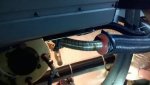
Result is that I could feel air coming back out of the end of the exhaust pipe as it enters the larger ducting - in the picture this is the area around the red plastic sealant

2017-02-19 11.31.00.jpg

Question - as the boat was built in 1998 and I am assuming it is original Webasto - is there anything "serviceable" in there. If so how is it constructed and what would the red plastic sealant be / can I replace it

The larger ( approx 2.5" ) ducting extends all of the way to the external skin fitting. I've looked on line and cannot see any exhaust similar - so if I have to replace what would you suggest ?

thx

Kevin
 
Ok - so down to the boat over the weekend and checked the integrity of the exhaust by disconnecting it from the Webasto end, blocking off the outside / exit with ducktape and blowing down it ( i tried other methods of pressurising it using a balloon but couldn't get an airtight seal )

Result is that I could feel air coming back out of the end of the exhaust pipe as it enters the larger ducting - in the picture this is the area around the red plastic sealant

View attachment 63040

Question - as the boat was built in 1998 and I am assuming it is original Webasto - is there anything "serviceable" in there. If so how is it constructed and what would the red plastic sealant be / can I replace it

The larger ( approx 2.5" ) ducting extends all of the way to the external skin fitting. I've looked on line and cannot see any exhaust similar - so if I have to replace what would you suggest ?

thx

Kevin

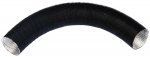
The Duct is simply a heat shield, I hate it when people do that as it makes it impossible to easily inspect the exhaust condition during service, the sealent would be just to tidy the job up a bit. I would replace with a marine silencer and exhaust with standard lagging if it were me. That's assuming you find the exhaust tube under the duct to be defective. The outer stuff is just 25mm PEK duct by the way.
M03-021.jpg
 
Last edited:
Top