Weather websites - planning ahead

We mainly use windy.com and predictwind. Someone will correct me if I'm wrong, buy windy takes the synoptic chart info and applies it to the topography. From what I remember it was originally created by a paragliding enthusiast? So local topographical effects would be really important to them.

Interestingly, this is similar to how the Pardey's did their weather forecasting in the Mediterranean - look at the synoptic chart and a topographical chart showing all the mountain ranges around the Med and figure it out.

We've definitely found windy to be more accurate along the North Spain coast, where there's high mountains along the coast.

I think the important thing with all the new forecast sites is to not let the great graphics lure you into thinking it's more accurate than it is.


www.sailingkittiwake.com

www.youtube.com/sailingkittiwake
 
We mainly use windy.com and predictwind. Someone will correct me if I'm wrong, buy windy takes the synoptic chart info and applies it to the topography. From what I remember it was originally created by a paragliding enthusiast? So local topographical effects would be really important to them.

Interestingly, this is similar to how the Pardey's did their weather forecasting in the Mediterranean - look at the synoptic chart and a topographical chart showing all the mountain ranges around the Med and figure it out.

We've definitely found windy to be more accurate along the North Spain coast, where there's high mountains along the coast.

I think the important thing with all the new forecast sites is to not let the great graphics lure you into thinking it's more accurate than it is.


www.sailingkittiwake.com

www.youtube.com/sailingkittiwake


All numerical weather prediction models run by national weather services use only observational data from land stations, ships, buoys, radio-sondes, aircraft and satellites. There is no “synoptic” chart input.

The https://www.windy.com/?13.625,1.318,4 that I know is just another presentation of the US GFS. Given that this is a global display, I assume that it is a somewhat degraded version of the US GRIB files provided via Saildocs, zyGrib and various apps. It looks a useful teaching tool but for operational use those services will be more useful. The ability to save the forecast for the area that you want is most useful.

Use of synoptic charts is great if you have the knowledge and skill. Given the quality of forecast models today, I would put using synoptic charts as a useful add-on rather than a tool in its own right. That is how I use them. Having worked as a forecaster and sailed in the Med, I think that using synoptic charts is very much an add-on - more so than around the UK.

For sailing decisions which, to me, are mainly about planning for the next few days, the GFS is as good as it can possibly be given current data availability and computer power. The gives weather, effectively on a scale of about 50 miles in size.. for westher detail of a few miles, numerical models are really of limited use because of the short lifetimes involved. Be prepared to use your own experience, knowledge and common sense. Maybe read http://weather.mailasail.com/Franks-Weather/Reeds-Weather-Handbook where I preach what I do.
 
Last edited:
All numerical weather prediction models run by national weather services use only observational data from land stations, ships, buoys, radio-sondes and satellites. There is no “synoptic” chart input.

The https://www.windy.com/?13.625,1.318,4 that I know is just another presentation of the US GFS. Given that this is a global display, I assume that it is a somewhat degraded version of the US GRIB files provided via Saildocs, zyGrib and various apps. It looks a useful teaching tool but for operational use those services will be more useful. The ability to save the forecast for the area that you want is most useful.

Use of synoptic charts is great if you have the knowledge and skill. Given the quality of forecast models today, I would put using synoptic charts as a useful add-on rather than a tool in its own right. That is how I use them. Having worked as a forecaster and sailed in the Med, I think that using synoptic charts is very much an add-on - more so than around the UK.

For sailing decisions which, to me, are mainly about planning for the next few days, the GFS is as good as it can possibly be given current data availability and computer power. The gives weather, effectively on a scale of about 50 miles in size.. for westher detail of a few miles, numerical models are really of limited use because of the short lifetimes involved. Be prepared to use your own experience, knowledge and common sense. Maybe read http://weather.mailasail.com/Franks-Weather/Reeds-Weather-Handbook where I preach what I do.

Really great knowledge-based explanation as usual Frank.

I am however intrigued by your earlier comment that serial intra-model consistency is often a better measure of forecast accuracy than inter-model comparisons: e.g. GFS vs ECMWF. This as it happens is what I tend to do, but without a shred of supporting evidence I must admit.

I get the fact that the different models are being fed similar but different data sets, but am curious as to why static differences between say ECMWF and GFS is a smaller signal as to future uncertainty than serial inconsistency within a given model. Is there an intuitive non-technical explanation for this?

One more question if I may, one which many sailors wonder about. The UK Met's shipping and inshore forecasts are low granularity affairs. So how much benefit would you assign to say checking the Met's Cowes, Portland and Salcombe daily forecasts if planning to sail that route in a day or so?
 
Last edited:
Really great knowledge-based explanation as usual Frank.

I am however intrigued by your earlier comment that serial intra-model consistency is often a better measure of forecast accuracy than inter-model comparisons: e.g. GFS vs ECMWF. This as it happens is what I tend to do, but without a shred of supporting evidence I must admit.

I get the fact that the different models are being fed similar but different data sets, but am curious as to why static differences between say ECMWF and GFS is a smaller signal as to future uncertainty than serial inconsistency within a given model. Is there an intuitive non-technical explanation for this?

One more question if I may, one which many sailors wonder about. The UK Met's shipping and inshore forecasts are low granularity affairs. So how much benefit would you assign to say checking the Met's Cowes, Portland and Salcombe daily forecasts if planning to sail that route in a day or so?


From your last para, I suspect that you misunderstood my comment about condidtency. Or I was not clear.

The major Met services run ensemble forecasts - http://www.metoffice.gov.uk/research/weather/ensemble-forecasting. The reason being that there is no unique analysis for a given set of weather data. Therefore, they run their models with many analyses all of which fit the data. Every outcome is equally likely. The answers may all be fairly similar in which case they have high confidence in the forecast. On other occasions, the results differ widely and confidence is low. They do not assume that the best answer will be that which seems to be the most common. If most results seemed to cluster around a similar solution, the outcome could still be an apparent outsider. See my initial statement.

By comparing, say, ECMWF, GFS, JMA, UK you are only using a small ensemble. The PredictWind two member ensemble is meaningless. It is not unknown for two of the big boys to have a similar outcome and the other two a different one.

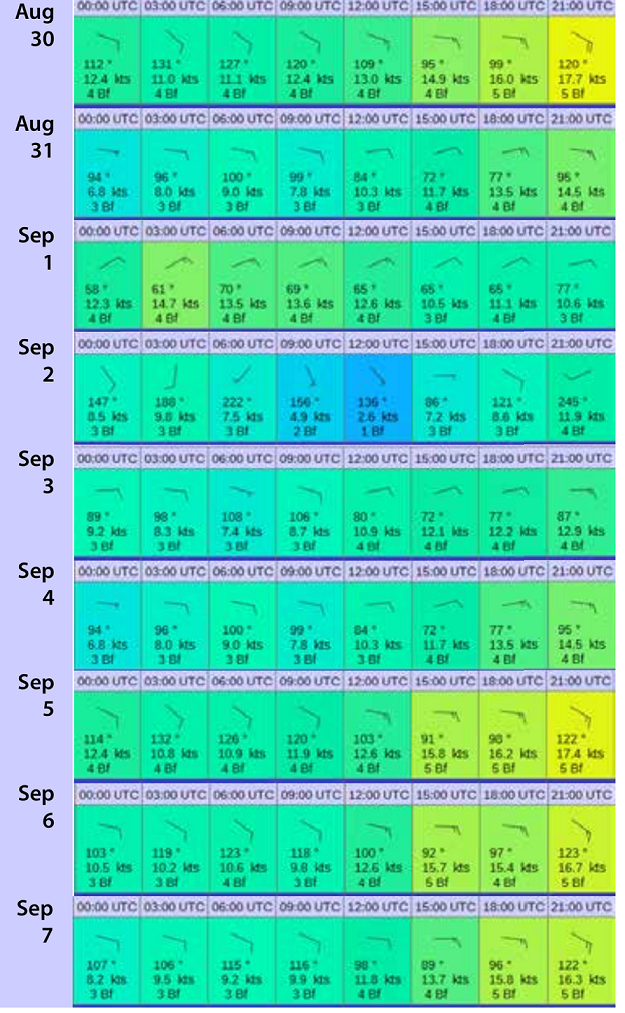
For us, watching successive 12 or 24 hours apart forecasts for the next few days, we are seeing the same evolving weather situation being computed at different stages with different data inputs. I give an example on my site -

ninedaystppdart.png


This was for a point near Channel LV. Forecasts on the days shown were all for Sept 7. We were pretty sure by the 2nd that we would be OK on the 7th. Being antique, we prefer to avoid F7+ and do not like motoring. Also, gentlemen do not beat.

Currently, we are in Roscoff waiting to go east. Forecasts have had some more than usual uncertainty but we are looking to move on tomorrow.

Re your last para question; those UK forecasts are for one and two days respectively so cannot be used for forward planning. However, when intending making a passage, I always watch the last few GMDSS forecasts to check, similarly, for consistency. Is the forecast changing? Are later data causing the forecast to change in an unwelcome way? On, say a Channel crossing, I do take a look at UK,French and, if appropriate, Jersey Met.

There are old sailors and bold sailors but not many old bold sailors. I am not bold.
 
From your last para, I suspect that you misunderstood my comment about condidtency. Or I was not clear.

Nope, the misunderstanding was entirely on my part as my thinking was based around a couple of misconceptions.

Thanks for the explanation; it makes absolute sense that two big models could cluster around a wrong answer if similar elements in their algorithms treat specific data sets the same way. It also makes sense to look for dynamic stability while keeping an eye on the bigger picture.

That last bit is what I like Windy for, but formally logging consistency is something I will now set up. To be more precise, I'll ask a whipper snapper to do the computer bit as not my strong point :ambivalence:

Thanks again and great website BTW.
 
Nope, the misunderstanding was entirely on my part as my thinking was based around a couple of misconceptions.

Thanks for the explanation; it makes absolute sense that two big models could cluster around a wrong answer if similar elements in their algorithms treat specific data sets the same way. It also makes sense to look for dynamic stability while keeping an eye on the bigger picture.

That last bit is what I like Windy for, but formally logging consistency is something I will now set up. To be more precise, I'll ask a whipper snapper to do the computer bit as not my strong point :ambivalence:

Thanks again and great website BTW.

Thanks. You need a whipper snapper? I confess to 84 and moderately computer literate!

Good lusk and fair winds. If not fair w9nds, the foul weather well forecast is the next best!
 
Frank thanks for detailed explanation. For simple souls like me I just want to click on a website and find the forecast wind in easy to read format for the next few days. As such I find Grib files easy to use.

Currently in Ile d'Yeu in Bay of Biscay and looking for future weather going south and along N spain coast. What links would you recommend please. Ideally should not be too data hungry as may be using mobile phone without internet if at anchor. When in Marinas (where internet is then available) the French system displayed in marina offices on large TVs is great.
 
Frank thanks for detailed explanation. For simple souls like me I just want to click on a website and find the forecast wind in easy to read format for the next few days. As such I find Grib files easy to use.

Currently in Ile d'Yeu in Bay of Biscay and looking for future weather going south and along N spain coast. What links would you recommend please. Ideally should not be too data hungry as may be using mobile phone without internet if at anchor. When in Marinas (where internet is then available) the French system displayed in marina offices on large TVs is great.

For planning purposes, why not use GRIB files? You seem happy with them.They can be as large or small as you choose. With a laptop, zyGrib is excellent. Choose whatever parameters you want. It tells you the file size. You are not using a browser with all the overheads including adverts. GRIBs were seized upon by sailors in the early 2000s because a great deal of information could be received in a small file. I used to get mine using dial-up cell phone or GPRS. I still find it convenient to request GRIBs using email. Saildocs was designed for email use over HF/SSB.


If you are interested in using email, I can post a simple guide, it is far less “techie” than it seems at first sight.


With a tablet there are various apps on my page http://weather.mailasail.com/Franks-Weather/Grib-Files-Apps. As with zyGrib you can determine size of file - if only by experiment.


With zyGrib you can right click on any point and get a time sequence - as I showed at #46. PocketGrib and other apps have a similar facility. Pocket`Grib can give forecasts up to 8 days ahead so you can get an 8 day sequence at 3, 6, 12 hour intervals;


For GMDSS coastal forecasts, use the links at http://weather.mailasail.com/Franks-Weather/Southwest-European-Marine-Weather-Forecast-Texts and similar pages for other areas. With low bandwidth use the Saildocs text retrieval. The forecast for Asturias, Cantabrigian and Pays Vasco is at, http://www.aemet.es/es/eltiempo/prediccion/maritima?opc1=0&opc2=martot&opc3=1&area=can1. That is not a heavy download. However if you send an email to query@saildocs.com with the message -

send http://www.aemet.es/es/eltiempo/prediccion/maritima?opc1=0&opc2=martot&opc3=1&area=can1

You will get the information in a file of about 2k. It will contain a deal of extraneous text as well. Just ignore and scroll to the forecasts.

That works for most of the forecast texts on my pages and, indeed, for many web pages generally. A notable and regrettable exception is Mete France. There used to be a Navimail service which was a clumsy text retrieval but that does not work now.
 
Tried zyGrib. Downloaded files but that's it just a load of files with nothing with a suffix . exe. What am I missing.

Downloaded Predict wind but get two forecasts side by side - both different. cannot see what each one represents.

As anyone can tell I can use laptops but not a computer expert. I just want to click on a link that gives me the sailing area I am in and the grib files.
 
Last edited:
Tried zyGrib. Downloaded files but that's it just a load of files with nothing with a suffix . exe. What am I missing.

Downloaded Predict wind but get two forecasts side by side - both different. cannot see what each one represents.

As anyone can tell I can use laptops but not a computer expert. I just want to click on a link that gives me the sailing area I am in and the grib files.

Is it a windows machine you are using?

The zygrib download should look like this ->
LLBiPDY.png


The extensions might be hidden on your, if so just double click on the zygrib file.
 
Tried zyGrib. Downloaded files but that's it just a load of files with nothing with a suffix . exe. What am I missing.

Downloaded Predict wind but get two forecasts side by side - both different. cannot see what each one represents.

As anyone can tell I can use laptops but not a computer expert. I just want to click on a link that gives me the sailing area I am in and the grib files.


Will this help http://weather.mailasail.com/Franks-Weather/Zygrib-Ftp-Grib-Service
 
Tried again and downloaded but double clicking on bits I got Qt5.dll file missing. nowhere was a zygrip.exe file.

Now downloaded it twice! Using Win 10.

WIerd, I just downloaded from here..
http://www.zygrib.org/#section_windows
"zyGrib_win-8.0.1.zip (24.1 Mo)"

Saved to desktop, unzipped to desktop, opened the folder and double clicked on zygrib.exe.
Worked straight away..

One thought - are you unzipping the donloaded folder first? If you just open the folder without unzipping then it won't work, if you right click on the folder there should be something like a "unzip to here" in the menu.

Good luck!

fNAOxpQ.png
 
Top