Watertight wire connections

Zing

Well-Known Member
Joined
7 Feb 2014
Messages
8,232
Visit site
I need to fix my bilge alarm system. The failures are wiring connections between the float switches and the wire running back to the controller. 4 connections have failed. Two are soldered joints inside adhesive lined heat shrink and two are in RayTech gel filled junction boxes, supposedly IP68 rated. In all cases water from bilge leaks has tracked along the wires and corroded the thin signal wires to the point of failure. What I have ought to be OK, but it isn’t, so I’d like a bullet proof, reliable solution. Any suggestions?
 
I need to fix my bilge alarm system. The failures are wiring connections between the float switches and the wire running back to the controller. 4 connections have failed. Two are soldered joints inside adhesive lined heat shrink and two are in RayTech gel filled junction boxes, supposedly IP68 rated. In all cases water from bilge leaks has tracked along the wires and corroded the thin signal wires to the point of failure. What I have ought to be OK, but it isn’t, so I’d like a bullet proof, reliable solution. Any suggestions?
Red Adhesive-Lined Heat Shrink Butt Splice Connector 0.5-1.5mm²

Available from other sources. Do not use the ones with solder in them, stick to the crimp ones. After crimping heat them up until they shrink and then the glue melts, you can see where it's melted inside, make sure it's fully melted.
 
Thanks for the suggestion. I checked my wires and unfortunately they are 0.2mm2, so outside the stated spec.
 
Despite the failure, soldering and glue-lined heatshrink is the best alternative. It is important for maximum waterproofing that the glue-lined heatshrink is the right size; it can only shrink so far.

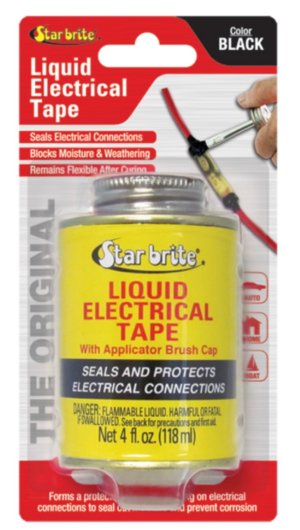
For extra protection, you can add two layers of heat shrink of different lengths so there is a double seal and/or apply liquid electrical tape (such as pictured below) to the soldered wires before adding the heatshrink.

IMG_8555.jpeg
 
Better adhesive tubing. They should last.

If there are crimp terminals, the seal needs to be OVER the crimp in severe locations, because the crimper breaks the seal. Also, eyes have an open end and require extra attention. Soldered connections can have rough spots that poke through the tubing; smooth them before sealing.

It is common practice for well pumps to be under water, including the connections. A good seal should work. But you need to check every point. Something got missed.
 
I have just the cheapies or pliers....both damage the plastic covering. But when I look up good crimping tools the choice is overwhelming....so I was hoping for a little guidance....but that’s ok
I use 'Klein Tools' crimpers and find them ok for 1mm to 6mm. Important to apply the heat from different directions on the heat shrink until as Paul says you can actually see the adhesive line bonding to the insulation. Have a look at the Klein 3005CR, Works for me.
 
I have just the cheapies or pliers....both damage the plastic covering. But when I look up good crimping tools the choice is overwhelming....so I was hoping for a little guidance....but that’s ok
You have to choose the correct tool for the type of crimp. This page shows various different types, as examples. The "light duty" ones for £7-£8 are junk, don't use them.

Cable Termination Tools | 12 Volt Planet
 
Last edited:
Not if you use the correct crimper.
Amen!

And the correct crimp terminal, matched to the die in the tool. Hint: they're not cheap, neither the tool, nor the terminals.

I use a Swedish Pressmaster crimp tool, and Molex tin-plated copper heat shrink terminals. These are glue-filled besides being heat shrink, and are impressively hermetic after finishing with a heat gun.

It's worth talking about the wire, as well -- tin-coated marine cabling is much less susceptible to the kind of problems the OP was talking about.
 
The correct tool.
I understand that very well. I have a pair of ratcheting crimpers for insulated terminals. But if the pressure is high enough to truly merge the terminal and wire into one piece, the insulation can be compromised. In principle the adhesive then fills the voids during the shrinking process. But best practice for well pumps, for example, is to use a non-insulated crimp and heat shrink over that with extra thick heat shrink.


It is also possible the heat shrink he used was sub-par. Thicker is better.

0.2 mm sq is really tiny. 1mm sq is more reasonable for durability. It's not just about the current. Perhaps two layers of heat shrink, overlapping a the end, will give better support.

The OP said he was having problems. I was suggesting a problem he could have, and a solution. We also need to be realistic about the tools available. For example, many good crimpers are not rated as small as 0.2 mm sq. The common cut-off for non-specialty crimpers in the US is 0.3mm sq. (22 AWG).
 
I understand that very well. I have a pair of ratcheting crimpers for insulated terminals.
Those are not correct for heat shrink terminals. See post #12
But if the pressure is high enough to truly merge the terminal and wire into one piece, the insulation can be compromised. In principle the adhesive then fills the voids during the shrinking process. But best practice for well pumps, for example, is to use a non-insulated crimp and heat shrink over that with extra thick heat shrink.


It is also possible the heat shrink he used was sub-par. Thicker is better.

0.2 mm sq is really tiny. 1mm sq is more reasonable for durability. It's not just about the current. Perhaps two layers of heat shrink, overlapping a the end, will give better support.

The OP said he was having problems. I was suggesting a problem he could have, and a solution. We also need to be realistic about the tools available. For example, many good crimpers are not rated as small as 0.2 mm sq. The common cut-off for non-specialty crimpers in the US is 0.3mm sq. (22 AWG).
When i suggested crimping i was not aware that the wires were only 0.2mm sq. I made another suggestion in post #14, more suitable for such tiny wires.
 
You have to choose the correct tool for the type of crimp. This page shows various different types, as examples. The "light duty" ones for £7-£8 are junk, don't use them.

Cable Termination Tools | 12 Volt Planet
I have one of these @Bouba - in the kit with the interchangeable dies, the second die in the pic is the right one for these heat shrink crimps. Does a very neat job indeed, although I think it's better at a certain angle (if you look closely and try a few, you'll see what I mean).

The same crimes is available from a number of different suppliers, including Draper, I think with different criming die options, and a large selection of dies too:

 
Top