Waterproof sealant for calorifier leak

colind3782

Well-Known Member
Joined
18 Jan 2011
Messages
4,510
Location
Shropshire/Empuriabrava
Visit site
On getting to the boat after six months away I found that one of the pressure valves on the calorifier is leaking quite badly into the bilge. Replacing the calorifier is not an option in the short term so I need to plug the leak somehow. I know there are sealants that will adhere to wet surfaces and that seems to be the best option for now. Any recommendations and am I likely to find it in Spain?

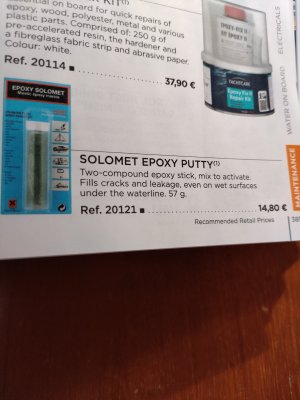
Update. Found this in the Uship catalogue. Would it do the trick?
 

Attachments
  • IMG_20250401_102503_MP.jpg
    IMG_20250401_102503_MP.jpg
    1.1 MB · Views: 51
Last edited:
On getting to the boat after six months away I found that one of the pressure valves on the calorifier is leaking quite badly into the bilge. Replacing the calorifier is not an option in the short term so I need to plug the leak somehow. I know there are sealants that will adhere to wet surfaces and that seems to be the best option for now. Any recommendations and am I likely to find it in Spain?

Update. Found this in the Uship catalogue. Would it do the trick?
No experience of that epoxy putty but why not just change the pressure valve? I assume it is one like this BBSAFETY1 ATI pressure relief valve for boat calorifier 6 Bar
 
Interesting. I've not seen a completely internal pressure relief valve on a calorifier. Would be helpful to see a picture of where the calorifier is leaking.
I'll get a picture up asap.

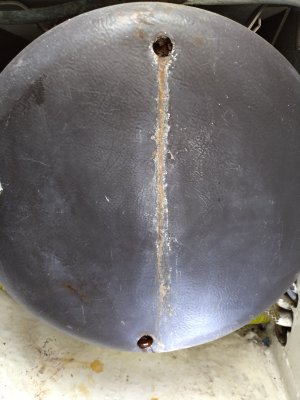
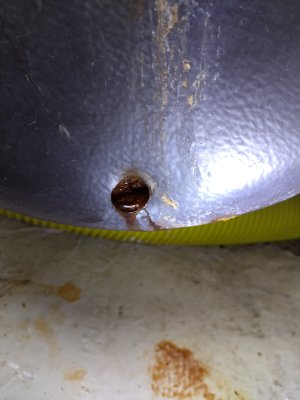
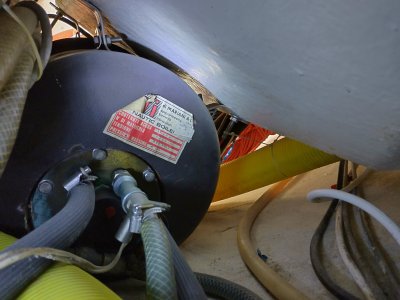
Here's a couple of pics of the end of the calorifier where it's leaking. I'm assuming that the holes are pressure valves but, in any case, they are corroded to hell but it is nearly 40 years old! I've plugged them with epoxy putty and, hopefully, that will stop the leaks until I can replace the unit which will involve major surgery due to access.
 

Attachments

  • IMG_20250402_090014_MP.jpg
    IMG_20250402_090014_MP.jpg
    1.3 MB · Views: 43
  • IMG_20250402_090006_MP.jpg
    IMG_20250402_090006_MP.jpg
    942.7 KB · Views: 48
Last edited:
Its an electric stored water heater rather than a calorifier, Italian to boot. I would bet that the leaks are from iron plugs that have corroded away.
There must be an expansion vessel somewhere, could be internal, if that is duff or lost pressure the pressure build up in the heater could be the cause of the leaks. Is the safety valve still working or seized up?
 
Its an electric stored water heater rather than a calorifier, Italian to boot. I would bet that the leaks are from iron plugs that have corroded away.
There must be an expansion vessel somewhere, could be internal, if that is duff or lost pressure the pressure build up in the heater could be the cause of the leaks. Is the safety valve still working or seized up?
Not sure what the difference is but there are hoses from the engine to heat the water too. The valve, as pointed out by Paul, looks fairly pristine. In any event, there is a lot of corrosion around the cylinder so I have ordered a new one which should be here in a couple of days. €491 for a 20L unit which I thought was reasonable. When it arrives, I'll have a look to see what fittings and hoses are needed then schedule the job, probably for my next trip.
 
Not sure what the difference is but there are hoses from the engine to heat the water too. The valve, as pointed out by Paul, looks fairly pristine. In any event, there is a lot of corrosion around the cylinder so I have ordered a new one which should be here in a couple of days. €491 for a 20L unit which I thought was reasonable. When it arrives, I'll have a look to see what fittings and hoses are needed then schedule the job, probably for my next trip.
If the water is heated by the engine it's a calorifier. Post #11 is nonsense.
 
Not sure what the difference is but there are hoses from the engine to heat the water too. The valve, as pointed out by Paul, looks fairly pristine. In any event, there is a lot of corrosion around the cylinder so I have ordered a new one which should be here in a couple of days. €491 for a 20L unit which I thought was reasonable. When it arrives, I'll have a look to see what fittings and hoses are needed then schedule the job, probably for my next trip.

Following leaks, I replaced our calorifier a couple of months ago. New one (Quick from Italy) needed 1/2" BSP female couplings whereas old one had male. Fittings not stocked locally so had to obtain from UK.
 
Last edited:
Following leaks, I replaced our calorifier a couple of months ago. New one (Quick from Italy) needed 1/2" BSP female couplings whereas old one had male. Fittings not stocked locally so had to obtain from UK.
Any particular supplier recommended Graham? I need 2 x 1/2" BSP with a 15mm hosetail and 2 with 20mm hosetails. Plenty available on a quick Google though.
 
Any particular supplier recommended Graham? I need 2 x 1/2" BSP with a 15mm hosetail and 2 with 20mm hosetails. Plenty available on a quick Google though.

I got them from BES, posted to Portugal but they were 1/2" BSP female with HepO2 tails, not hose tails. Delivery + duty + VAT just about trebled the price:mad:
 
New calorifier fitted after it took five hours of hard work to get the old one out! All works fine with normal hot and cold flow to the wash basin in the heads and deck shower. However, the flow to the galley sink is very reduced and the pump "pulses" rather than running continuously. I can't see any leaks or kinks and the freshwater tanks are full as I thought the tanks might be low and the pump drawing air. I'm at a loss now. Any ideas?
 
New calorifier fitted after it took five hours of hard work to get the old one out! All works fine with normal hot and cold flow to the wash basin in the heads and deck shower. However, the flow to the galley sink is very reduced and the pump "pulses" rather than running continuously. I can't see any leaks or kinks and the freshwater tanks are full as I thought the tanks might be low and the pump drawing air. I'm at a loss now. Any ideas?

It sounds like the pressure thingy (normally next to or attached to the pump is knackered. It should be half full of air with a membrane in the middle to stop the air dissolving in the water. You might be able to pump it up with a bike pump attached to a the fitting for doing that. Pump it up to about 1.5 bar.

If that doesn't do the trick, then you need to change the pressure reservoir.

I have one you could use, but it is a bit on the big size for what I imagine is the size of your boat. It is 600L for a house with the water supply pump from 48m down in the well.
 
Top