Water mist fire extinguisher

You extinguish a chip pan fire by puting the lid on, no? Unless the pan flips, chip pan fires (and other frying) is a non-event in the kitchen.

Which is why you limit the amount of oil and don't fry underway.
First find your chip pan lid buried at the back of the cupboard. I was always taught that a wet tea towel was faster.
 
.... AFFF foam extinguishers certainly are higher rated size for size....
compared to dry water mist

The BSS and RYA both call for a minimum total extinguisher rating of 13A 89B for boats of length 27 to 36 ft. Achieving this solely with water mist would require 11 x 1 litre extinguishers, 7 x 3 litre or 5 x 6 litre.

AFF foam would require 5 x 1 litre, 2 x 3 litre or 1 x 6 litre.

The need for more water mist extinguishers is due to their markedly lower Class B ratings i.e. their ability to deal with flaming liquids, which is precisely what the study I referenced in post 14 illustrated.

I'm not trying to score any points here or enter into the typical "why what I've got is the best" argument which some of our threads degenerate into, I haven't made my choice yet. I'm just drawing attention to a consideration which may have some importance given the restricted space in a boat.
 
That's a fair point. I think that water mist may be able to alleviate some space but having an AFFF knocking around would still be useful... but my first port of call would be the water mist particularly for the smaller fires. (I.e it basically just started).
 
The need for more water mist extinguishers is due to their markedly lower Class B ratings i.e. their ability to deal with flaming liquids, which is precisely what the study I referenced in post 14 illustrated.
Jim step back from the question a minute and ask yourself what is the primary fire risk on your boat? If it is flammable liquids, petrol perhaps, then go for AFFF if not then it is not the solution you are looking for.

My risk assessment is that on my boat a flammable gas or electrical short is going to be the primary source of ignition that then develops into a Class A fueled fire. My experience with foam is that it is rubbish at putting out that type of fire. I've mitigated the risk as much as possible, all gas is kept out of the cabin, fuel is diesel and electrics are well insulated. From time to time I crew on one boat that bans aerosols below decks as they explode if exposed to heat! Risk mitigation or what and because of that I no longer use them at sea.

Another thing to consider is the amount of time from a safe haven you are. If just a few hours then fine, if not you need to live in a fire damaged vessel for, shall we say upto three weeks if you were doing an Atlantic crossing.
 
compared to dry water mist

The BSS and RYA both call for a minimum total extinguisher rating of 13A 89B for boats of length 27 to 36 ft. Achieving this solely with water mist would require 11 x 1 litre extinguishers, 7 x 3 litre or 5 x 6 litre.

AFF foam would require 5 x 1 litre, 2 x 3 litre or 1 x 6 litre.

The need for more water mist extinguishers is due to their markedly lower Class B ratings i.e. their ability to deal with flaming liquids, which is precisely what the study I referenced in post 14 illustrated.

I'm not trying to score any points here or enter into the typical "why what I've got is the best" argument which some of our threads degenerate into, I haven't made my choice yet. I'm just drawing attention to a consideration which may have some importance given the restricted space in a boat.

Your point about poor performance of water mist on liquids is worthwhile. Although it is much better than a jet stream, it's not good.

The advantage, I supose, for whole room systems is that it is not toxic. This is kind of a big deal in operating theaters.
 
Jim step back from the question a minute and ask yourself what is the primary fire risk on your boat? If it is flammable liquids, petrol perhaps, then go for AFFF if not then it is not the solution you are looking for.

My risk assessment is that on my boat a flammable gas or electrical short is going to be the primary source of ignition that then develops into a Class A fueled fire. My experience with foam is that it is rubbish at putting out that type of fire. I've mitigated the risk as much as possible, all gas is kept out of the cabin, fuel is diesel and electrics are well insulated. From time to time I crew on one boat that bans aerosols below decks as they explode if exposed to heat! Risk mitigation or what and because of that I no longer use them at sea.

Another thing to consider is the amount of time from a safe haven you are. If just a few hours then fine, if not you need to live in a fire damaged vessel for, shall we say upto three weeks if you were doing an Atlantic crossing.

Good points. In my mind, thing like water mist or fire blankets are in addition to basic requirements.

I've had one small fire on a boat I owned (PO hid some bad wiring under a carpet liner!) and several in the neighborhood. ALL of them started out as electrical, transitioning into fabric, wood, and fiberglass. None involved fuel until the boat was fully evolved. So while I agree that flammable liquid capability is vital for engine-related fires, for diesel-fueled sailboats, electrical fires are far more common, with the materials involved being fabric, wood and fiberglass during the incipient period (which is the only period where you have a realistic chance).

There are times when a good old bucket of water may be best !
 
The chip pan lid will be out and ready. A wet towel, on hot grease, is not smart.
It is the standard way of teaching the extinguishing of chip pan fires in the UK. It really does work. We have not had a chip pan in the house since I was a child, chips were never cooked with the lid on as they went soft, hence my comment about the lid being at the back of he cupboard.
 
Good points. In my mind, thing like water mist or fire blankets are in addition to basic requirements.

I've had one small fire on a boat I owned (PO hid some bad wiring under a carpet liner!) and several in the neighborhood. ALL of them started out as electrical, transitioning into fabric, wood, and fiberglass. None involved fuel until the boat was fully evolved. So while I agree that flammable liquid capability is vital for engine-related fires, for diesel-fueled sailboats, electrical fires are far more common, with the materials involved being fabric, wood and fiberglass during the incipient period (which is the only period where you have a realistic chance).

There are times when a good old bucket of water may be best !
Thanks thinwater.

I solve the problem the other way round, fire extinguishers are to hand buckets follow as you have bought some time.

My late father in law was a fireman, my late father a marine engineer, we talked a lot about the risks.
 
It is the standard way of teaching the extinguishing of chip pan fires in the UK. It really does work. We have not had a chip pan in the house since I was a child, chips were never cooked with the lid on as they went soft, hence my comment about the lid being at the back of he cupboard.
I understand, it just seems easier to have the lid at hand. I always do. Neater too.
 
It is the standard way of teaching the extinguishing of chip pan fires in the UK. It really does work. We have not had a chip pan in the house since I was a child, chips were never cooked with the lid on as they went soft, hence my comment about the lid being at the back of he cupboard.

That's right, tea towel should be wrung-out so it's wet but not dripping water. If the towel isn't damp it will quickly burn through, and make a bigger fire!
 
Its probably stored at the back of the cooker.

So no consensus across the forum, other than there is no perfect extinguisher, so carry lots of different ones and big ones at that, oh and a bucket.
 
So why not just use the lid? It's faster and you don't screw up the towel.

Because in most UK galleys a tee towel will be easier to hand and can be wetter from the galley tap very easy.

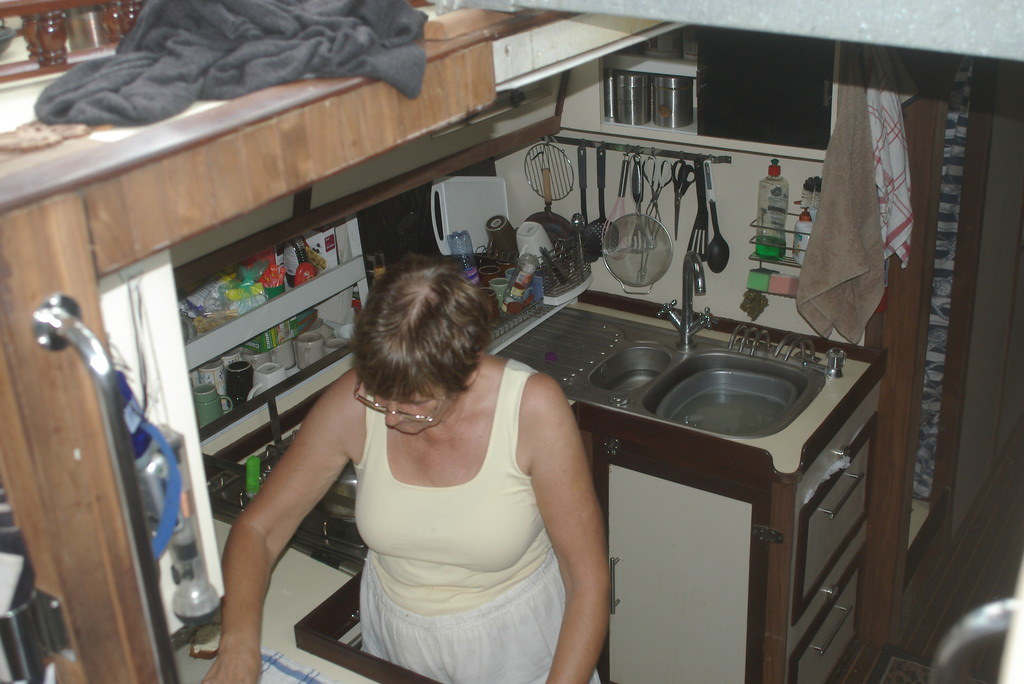
I have a fire blanket inside a cupboard door next to the cooker and the tee towel hanging up just above the galley sink

35246502634_336f25f0db_b.jpg


Cooker just behind SWMBO
 
In the domestic environment, current advice from the UK Fire service is;
  1. Turn off the heat source if it's safe to do so.
  2. Remove everyone from the property.
  3. Call the fire service.
Using a damp tea-towel (advocated in the 1970s' infomercial) is no longer recommended. The reason given is that if it's too wet it will make it worse and if it's too dry it won't work at all.

A lid may or may not work depending on how well it fits; I don't remember that advice being given in the past. But a lid on it's own will not protect your arm as you use it. I'd also suggest there is a likelihood of knocking or at least shaking the pan which may spill burning oil.

But clearly, waiting for the professionals out at sea isn't going to be a practical solution and most of us will choose to have and use equipment to tackle fires ourselves.

My choice is to have fire blankets and dry water mist extinguishers because they are simple and likely to be effective. The dry water mist extinguishers are suitable for every type of fire I'm likely to face aboard. I will not need to spend time getting the correct extinguisher because any of the ones I have are suitable. Dry water mist also appears to be very good at suppressing smoke.

The other choice I make is to buy oven chips or go to the chip shop . Cooking with large quantities of oil isn't something we do.
 
In the domestic environment, current advice from the UK Fire service is;
  1. Turn off the heat source if it's safe to do so.
  2. Remove everyone from the property.
  3. Call the fire service.
Using a damp tea-towel (advocated in the 1970s' infomercial) is no longer recommended. The reason given is that if it's too wet it will make it worse and if it's too dry it won't work at all.

A lid may or may not work depending on how well it fits; I don't remember that advice being given in the past. But a lid on it's own will not protect your arm as you use it. I'd also suggest there is a likelihood of knocking or at least shaking the pan which may spill burning oil.

But clearly, waiting for the professionals out at sea isn't going to be a practical solution and most of us will choose to have and use equipment to tackle fires ourselves.

My choice is to have fire blankets and dry water mist extinguishers because they are simple and likely to be effective. The dry water mist extinguishers are suitable for every type of fire I'm likely to face aboard. I will not need to spend time getting the correct extinguisher because any of the ones I have are suitable. Dry water mist also appears to be very good at suppressing smoke.

The other choice I make is to buy oven chips or go to the chip shop . Cooking with large quantities of oil isn't something we do.

I struggled to find a fire blanket here in the US so brought a couple when I was back in the UK a few years ago.

Fire stations are numerous here compared to the UK. But I still have a hose and branch ready - I also have a hydrant in my front yard so are lucky.

Extinguishers both ends of the house.

Maybe I’m paranoid but it’d one thing that really scares me.

PW
 
Your point about poor performance of water mist on liquids is worthwhile. Although it is much better than a jet stream, it's not good.

The advantage, I supose, for whole room systems is that it is not toxic. This is kind of a big deal in operating theaters.

This has been posted before but is worth watching if you haven't seen it.
 
So the tea towel advise is from the 70s. A lid that is beside the stove is OBVIOUSLY faster--your just being stuborn old farts, defending a weak position (I do the same, at times! :LOL:

I've used a lid many times. It's pointless to quible over non-existant problems, like knockding the pan over. And for heavens sake, why would you use a lid that didn't fit? That's a silly objection.

I'm sorry, but I know you folks don't approach seamanship this way.:LOL:

Hard to find a fire blanket? No, not at all, just not in boat stores. Amazon, any safety supply house, Walmart. Wool army-type blankets are also fire-rated. I actually tested a WWII blanket I had. Won't burn, no way (yes, I used the official UL test methodology).

---

I'm just having fun folks. I bored by being stuck inside. PLEASE don't take this ribbing seriously. Please. Just laugh. And tease back.
 
Oven chips have made the chip pan about as relevant as the mangle, the meat safe, the washboard etc. Who has a chip pan? what about those dreadful aluminium mincing machines that clamp to your Formica table?
 
So the tea towel advise is from the 70s. A lid that is beside the stove is OBVIOUSLY faster--your just being stuborn old farts, defending a weak position (I do the same, at times! :LOL:

I've used a lid many times. It's pointless to quible over non-existant problems, like knockding the pan over. And for heavens sake, why would you use a lid that didn't fit? That's a silly objection.

I'm sorry, but I know you folks don't approach seamanship this way.:LOL:

Hard to find a fire blanket? No, not at all, just not in boat stores. Amazon, any safety supply house, Walmart. Wool army-type blankets are also fire-rated. I actually tested a WWII blanket I had. Won't burn, no way (yes, I used the official UL test methodology).

---

I'm just having fun folks. I bored by being stuck inside. PLEASE don't take this ribbing seriously. Please. Just laugh. And tease back.

Nope I searched all over here, hence buying whilst in the UK.

I don’t use boat stores as don’t have a boat...

PW
 
Top