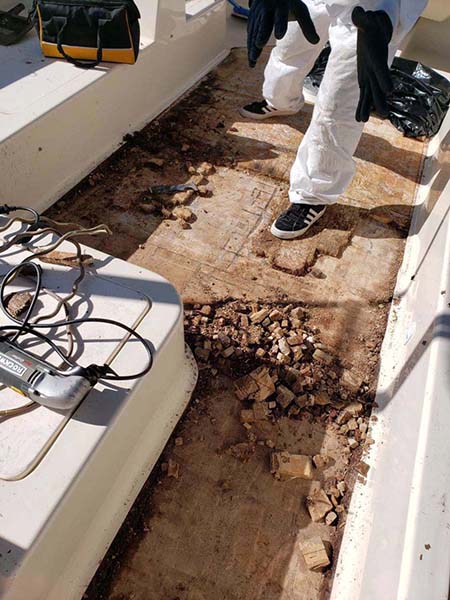
Water ingress balsa core seems soft

The simple answer is it cant. Anyone who has ever seen or done a balsa cored deck being laid up onto the deck moulding which is done upside down at the factory will know that the balsa comes in flexible sheets with a thin layer of fibreglass scrim glued to one side to hold it together. These sheets are laid in bonding paste.
The surface of the balsa is then flooded with resin which soaks readily into the end grain & fills the gaps between the blocks. The inner layer of glass is then laid down. What you end up with is a lot of small cubic cells of resin between the balsa.
If water has got in & its gone rotten it is going to take a long time to dry out even if you add lots of holes on the inner side. How can antifreeze make it dry out?, then you have the problem of what does the antifreeze do to whatever resin you choose to inject. Will it affect the bond or the curing? Unless the damage is extremely localised there is only one way to replace a core & that is the right way. Injecting goop is just a way of draining cash from gullible mugs.
 
I've done a bit of a desk top study on the injectadeck system and it seems it's snake oil.
I have a 48 yr old Sunray 21 with areas of rotten balsa and was, as always, hoping to find a solution that would be relatively easy as the boat isn't worth a huge amount and I didn't really want to spend a fortune and many hours cutting out the old balsa but I can't seem to find the magic fix.
 
I can't seem to find the magic fix.
That's because it doesn't exist.
Afaik, the only way to fix a a deck with rotten balsa is as per below pic, which ain't a pretty sight.
Maintenance of timber decks is a pita, but balsa cored GRP can be even worse... :eek:
OjT5zQrR_o.jpg
 
The article I read the owner worked from above cutting panels out of the deck,getting rid of rubbish and bonding in new core and then replacing deck section sanding off and a paint job on the whole deck,up side is your working down but you need good weather tight protection
 
Precisely what was being done in the pic I previously posted, where the upper GRP layer (i.e. the original deck surface) was already cut and removed.
 
Ive seen a new product for sale that’s supposed to fix this problem
Home - InjectaDeck

No connection with the product. I have no experience of using it. I would be interested to know if it works though.
As I understand it leaves the wet balsa in the core, which is not ideal. Something that liquifies wood would be great...
 
As I understand it leaves the wet balsa in the core, which is not ideal. Something that liquifies wood would be great...
Schweizer's Reagent? I note that when it evaporates it just leaves a deposit of copper hydroxide behind, which presumably would have a biocidal effect. I guess you could bore two holes, pump the reagent in at one hole and out of another.

It used to be one of the set piece chemical reactions you got when you bought a chemistry set!
 
Sounds brilliant, any practical argumeng against it, e.g. does it leave GRP fine/would it finish the job within a realistic timeframe (few days max)?
 
wouldn't it dissolve all wood in the cavity?
Only if you can arrange for it to reach all parts of the cavity, which might be tricky. You'd also have to devise some way if checking progress - while it dissolves cellulose, it doesn't do it quickly, and the cellulose can be precipitated by diluting the solution. It's how rayon and similar fibres used to be made.

I suspect it could be made to work, but it wouldn't be simple. You'd also need protection from ammonia fumes.
 
So I'm going to try the bottom up technique. I'm going to head down tomorrow afternoon and start to expose the areas of concern, hopefully not too much, let it fully dry out and re core and repair from inside.
It's a small yacht with easily removed headlining, already out, so, while I know it'll be messy I hope it'll be right way for me. I'm not confident in my ability to go too down and make it look good.
I'll try and post some pictures of how I get on.
 
Top