
Water in saildrive?

cmedsailor

Well-Known Member
Joined
10 Sep 2007
Messages
1,830
Location
East Med...
Visit site
Six months ago when my boat was out of the water the volvo mechanic replaced the seals of the volvo sail drive as well as the little nut at the bottom of the saildrive because the oil was milky (water inside the oil). I checked the oil again today (after around 50 hours of using the engine) and looks a bit milky again. Not like last time but definately not clear like new. Could it be any residues left from last time? Last time we simply emptied the oil from the bottom, replaced the seals and add oil again. We didn’t flush or something the saildrive. Are we supposed to flush it with something (diesel maybe?), Before you ask, no I never caught a line around the prop.
 
No flushing is required. Are you sure the slight milkiness is not dissolved air. You need to let the saildrive settle for 30 minutes or so after last use. This will allow the air to float to the top but the oil beneath the layer of bubbles will still look like "mocha" if there is water present.

If you drained all the oil from the bottom, I don't think that there could be enough water still in the pool of oil which lies below the drain plug boss to colour the new oil content. However, the only way to fully drain the saildrive is to pull out the output shaft casting and disengage the two O-rings.

Is this nut at the bottom of the saildrive actually the drain plug? It's not usually a nut so you could mean something else, although mine are not Volvo.

Richard
 
Six months ago when my boat was out of the water the volvo mechanic replaced the seals of the volvo sail drive as well as the little nut at the bottom of the saildrive because the oil was milky (water inside the oil). I checked the oil again today (after around 50 hours of using the engine) and looks a bit milky again. Not like last time but definately not clear like new. Could it be any residues left from last time? Last time we simply emptied the oil from the bottom, replaced the seals and add oil again. We didn’t flush or something the saildrive. Are we supposed to flush it with something (diesel maybe?), Before you ask, no I never caught a line around the prop.

If there was a lot of water in the oil previously it might have been worth while flushing with a filling of cheap engine oil,.................... but not with diesel or kerosene.

I dont think any free water would have remained if it was allowed to drain properly but a little wet ( emulsified) oil might have remained.

The O rings on the bearing housing should have been renewed as well as the seals. The O ring seal on the drain plug should always be renewed when even the drain plug is removed.

The question now is what is the best plan of action

If its not too bad inspect the oil regularly but be prepared to change all the seals and O rings again if it gets worse.
Or
Drain and refill with fresh oi then watch closely
Or
Renew the seals again etc anyway

If the drain plug has a hexagon head I'd be a little suspicious that it may not be the proper drain plug ... if so the O ring might not be making a proper seal

The picture in the manual appears to show a slotted head screw ... but it is only a picture
1601554678834.png
 
The nut at the bottom I am referring to is the drain plug shown in the picture that VicS posted. This was replaced last time. Not only the o-ring. The oil now is slightly milky and more green colour than the clear yellowish colour of 15W40 engine oil. I checked it this morning while hot and indeed you could see the air Richard has mentioned. These have now disappear but the oil (still in a glass) is still greenish colour and not clear. In any case I will check again a sample out from the sail drive when is cold.
 
........ I checked the oil again today (after around 50 hours of using the engine) and looks a bit milky again. Not like last time but definately not clear like new.

Sorry to read this. It surely would not have happened if you’d bought another Beneteau ?

I agree with Richard’s comment. After use, the oil in my Yanmar saildrive takes several hours to settle and become nice and clear. Worth waiting a while and checking again.

Difficult to know if there could have been any residual water in the leg immediately after the seal-change, possible but unlikely.

Given that you’ve once already had the seal changed on a nearly new boat, perhaps simply changing the seal did not fix the root cause of the problem ?

Worth a quick chat with the Volvo service technician that did the work?
 
The nut at the bottom I am referring to is the drain plug shown in the picture that VicS posted. This was replaced last time. Not only the o-ring. The oil now is slightly milky and more green colour than the clear yellowish colour of 15W40 engine oil. I checked it this morning while hot and indeed you could see the air Richard has mentioned. These have now disappear but the oil (still in a glass) is still greenish colour and not clear. In any case I will check again a sample out from the sail drive when is cold.
If it's just the drain plug and it has a new O-ring then it should be OK.

The simplest thing to do would be to drain out the oil, or suck out as much as you can if the boat is in the water, and replace it with new oil. Run the drive for a few minutes and then take a sample and keep it. Hopefully, this should be clear and you can now use your sample as a reference to check future samples against.

If the cloudiness keeps re-appearing, then a change of all seals and O-rings at your next haul-out is the only solution.

Richard
 
Maybe you should read my posting some months back , as for flushing it you can use as I did 70% diesel %30 cheap oil or buy flashing oil .
And if its out of the water I would remove the bearing hub and drain out that way which will get all the old stuff out the drain plug will still leave a little in there.
The other advantage of removing the hub you be able to see if the shaft is scored , its possible the engine has replaced the seals and not delt with a score shaft.
Way of dealing with this see my other posting but basically to sleeve it.
 
In any case I will check again a sample out from the sail drive when is cold.

Any progress?


If the cloudiness keeps re-appearing, then a change of all seals and O-rings at your next haul-out is the only solution.

Richard

Just a thought........I’ve been reading back through my own boat maintenance logbook as I’ve just posted on the other thread running about saildrives.

In 2009 Yanmar admitted by way of issuing a Global Technical Bulletin that too much oil in the box can cause excessive pressure and can result in sea water being sucked in through the bottom seal.

Hence it may be worth checking oil level?
 
Just a thought........I’ve been reading back through my own boat maintenance logbook as I’ve just posted on the other thread running about saildrives.

In 2009 Yanmar admitted by way of issuing a Global Technical Bulletin that too much oil in the box can cause excessive pressure and can result in sea water being sucked in through the bottom seal.

Hence it may be worth checking oil level?
Indeed. See my post #47 in the other thread, although the same has been stated, by me and others, many times over the last decade.

Richard
 
Six months ago when my boat was out of the water the volvo mechanic replaced the seals of the volvo sail drive as well as the little nut at the bottom of the saildrive because the oil was milky (water inside the oil). I checked the oil again today (after around 50 hours of using the engine) and looks a bit milky again. Not like last time but definately not clear like new. Could it be any residues left from last time? Last time we simply emptied the oil from the bottom, replaced the seals and add oil again. We didn’t flush or something the saildrive. Are we supposed to flush it with something (diesel maybe?), Before you ask, no I never caught a line around the prop.
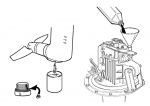
Assuming the leg oil was drained for, say, an hour, when the oil nut was dropped, all contaminant must have been removed.

You might just remove the dipstick and wipe oil onto a white plate or similar to see if there is anything in it. A few air bubbles can spoil the picture otherwise and are of course harmless. Only if real streaks are seen would I take further action.

Since the two seals have just been replaced, the chances of contaminant are almost zero.

But there is is the outside possibility that when the horizontal drive shaft was removed to fit the seals, if the shaft was grooved by previous wear and the new seals were just slotted back, contamination might have resumed. You would expect a serious engineer to look for this and take corrective action (slip over rings) if required. You might have words to see if this inspection took place.

Otherwise keep an eye on the oil. Contamination will of course lead to corrosion in an expensive piece of gear if the oil is not clear.

PWG
 
Any progress?


Just a thought........I’ve been reading back through my own boat maintenance logbook as I’ve just posted on the other thread running about saildrives.

In 2009 Yanmar admitted by way of issuing a Global Technical Bulletin that too much oil in the box can cause excessive pressure and can result in sea water being sucked in through the bottom seal.

Hence it may be worth checking oil level?
The local dealer will look at the issue since the boat is still in warranty period.
Interesting what you said about the oil level. I always keep it at maximum. But nit above that.
 
The nut at the bottom I am referring to is the drain plug shown in the picture that VicS posted. This was replaced last time. Not only the o-ring. The oil now is slightly milky and more green colour than the clear yellowish colour of 15W40 engine oil. I checked it this morning while hot and indeed you could see the air Richard has mentioned. These have now disappear but the oil (still in a glass) is still greenish colour and not clear. In any case I will check again a sample out from the sail drive when is cold.
The original oil drop closure (VP) was a slotted nut as shown in the above illustration. The sealing ring is a pretty tight fit over the thread. I tighten mine with a broad bladed screwdriver assisted by a spanner for extra torque. I have never heard of this closure rattling free / loose.

I hope I am misreading your posting - the oil for the VP S leg is not the same as for the engine (as above) it is semi-synthetic 75/90 G5 rating or 100% synthetic (Volvo product)

PWG
 
The original oil drop closure (VP) was a slotted nut as shown in the above illustration. The sealing ring is a pretty tight fit over the thread. I tighten mine with a broad bladed screwdriver assisted by a spanner for extra torque. I have never heard of this closure rattling free / loose.
I hope I am misreading your posting - the oil for the VP S leg is not the same as for the engine (as above) it is semi-synthetic 75/90 G5 rating or 100% synthetic (Volvo product)

PWG
IIRC at some point a while ago VP changed the spec for oil in the sail drive leg.
Not had time to download/open this, but here you are.
Volvo Penta Saildrive oil capacity chart

Here is a direct link to the to the VP Sail dive and outdrive oil chart http://fybmarine.co.uk/PDF/Saildrive-oil-quantity-type.pdf
 
Left my LM 30 with a supposedly reputable boat yard up the Beaulieu River when oil was emulsified. They only fitted one extra oil seal so there were 3 altogether. Needless to say it failed fairly quickly.
Another time crossing the Channel to Guernsey, tangled with some netting half way across and oil mixed with with water when we got to St Peter Port.. I fitted new seals and sleeve, which was scored, after flushing through with thin oil twice before all the water was removed so in my experience, flushing is essential.
 
An update:
The laboratory analysis showed no water and the result was "wear appears satisfactory. No significant contamination". In addition the appearance showed "debris present".
Anybody knows how much oil can I remove from the sail drive by extracting it trough that suction tube next to the dipstick?
 
Last edited:
That sounds like a bit of a contradiction?

"No water, wear appears satisfactory....debris present"?

I imagine that a typical 12v oil extractor (I've no experience of using a manual Pela) as used by many of us to change engine oil should be capable of pulling sufficient vacuum to remove all of the oil, especially if it's been warmed. That said, I've never tried it as I drain my saildrive by gravity as soon as the boat is lifted. Good luck (y)
 
Top