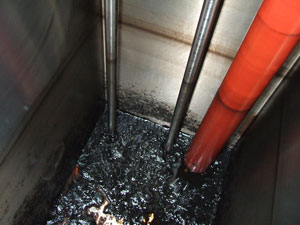
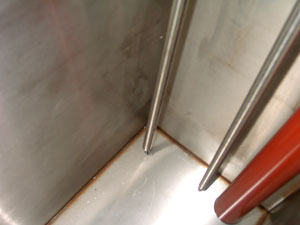
Water in deisel tank and black primary filter.

steve yates

Well-Known Member
Joined
16 Oct 2014
Messages
4,105
Location
Benfleet, Essex/Keswick, Cumbria
Visit site
So my new longbow has a yanmar hp30 engine, more or less brand new, less than 100 hrs use, but boat been ashore for last 3 years.

It started up, but soon stopped. Owner had left the deisel tank full, with bug additive added to protect it.

Quandry pumped up some fuel from the bottom of the tank and it was water and brown sludge. Took about 25 litres out before it started to look like red deisel again.

On checking the fuel filters, the primary was black with gunge, and the inside of it's casing, I mean really black, but the secondary was relatively cleanish.

Changed both, the date on the primary filter was oct 2006, so been in there for 10 years, obviously not changed when the new engine was installed.

We bled fuel through till it was running clean before changing the filters. The engine started up after a few attempts, and then ran fine for about the 10 mins we allowed it.

Quandry will pump out another load for me when the tank has had time to settle, and add 20l or so of new deisel.


What is the general opinion on the best way forward with this? I will check the filters again next week when I go up for the lift in, and bring some spares. If they are ok, do I run with it, checking the filters regularly and changing them?

Or do I pump out all the deisel, and refill with fresh, it's a 130l tank.

I'm a bit reluctant to do this, not from cost, as obviously a damaged engine will cost far more, but from fear of what is lying in the tank bottom that emptying out and refilling will stir up, and possibly send into the engine. (disposing of 130l of deisel in ardrishaig may also pose a problem!)

Anyone been there and got the t shirt?

Thx, Steve
 
Quandry pumped up some fuel from the bottom of the tank and it was water and brown sludge. Took about 25 litres out before it started to look like red deisel again.

As it was sludge at the bottom, you'll need to clean the tank! I've just done the same about 3 months ago - no idea when it was last cleaned. I emptied the tank into clear jerry cans (160 litres worth), dumping the last 30 discoloured litres or so. Cleaned the tank out with soap and a power washer, dried it and then polished the remaining fuel before refilling the tank. I had very little sludge as I always keep the tank full to avoid condensation forming.
 
I suspect that you are going to have problems with the fuel tank until you empty it,clean it thoroughly and filter the fuel that was in it, binning any that remains contaminated.
 
You can make yourself a basic fuel polisher very easily and use it to transfer the diesel into cans. Then dose up 5 or 10 litres of good diesel and run the engine to circulate that and clean out the system. You'll need to get a good few filters.

Incidentally, I wouldn't get hung up on the date on the filter - they don't expire so you don't know when it was fitted. I bought a dozen at once and (hopefully) I won't use the last for some time now, by which time it might appear old
 
Well I left mine with twin tanks about 200 litres each for 12 months.
Engine wouldnt even start due to fuel starvation.
Both tanks lined with black diesel bug deposits and the fuel lines clogged up.
I suspect that as the fuel lines run at the lowest point of my system that is where the bug was at its worst with a nice watery environment.
Im staying out this season and once I have finally cleaned and dried out the tanks helped by warmer weather I will refill them in the autumn liberally loaded with bug preventer.
As for the old diesel its not even going in my central heating tank!
I have replaced the 8mm pipe with 10 mm to help any future clogging and added a 2 gallon plastic outboard tank to the system which I can switch in between my two inline filters.
 
Pump out all the diesel/sludge and get the tank pristine. Disconnect the fuel lines and clean them out too. Steam clean or compressed air. Replace all the filters. If the tank doesn't have a hatch add/make one.
Tank1.jpg
Tank2.jpg

Where has the water come from? A leaking filler cap would be my guess.
 
Where has the water come from? A leaking filler cap would be my guess.

As I recall, the Longbow's fuel filler is on the cockpit floor, so I guess if the cockpit drains were blocked with leaves then rain could flood the cockpit and leak into the tank.
 
What is the general opinion on the best way forward with this? I will check the filters again next week when I go up for the lift in, and bring some spares. If they are ok, do I run with it, checking the filters regularly and changing them?

As already suggested, the optimum solution is to clean the tank, which effectively means removing it, as there's no inspection hatch. Second-best solution is to try to polish the fuel thoroughly to get the muck out of the tank. If you're tempted to take the boat to sea without doing one of these, you may well find that your engine will stop at the most inconvenient (and possibly hazardous) moment. I've experienced it, and it isn't fun.
 
I do not think polishing will work here, the tank has a flat bottom, the muck is mainly rust particles, the fuel below the draw off point is still the dirtiest stuff, and the particles are heavy enough to stay in there even with agitation, it is not floaty fuel bug jelly. This tank seems particularly inaccessible with no visible access panel. The solution is a new tank but I think the old one may have to be cut up in situ to get it out? A job for winter? A replacement Tek Tank of a bigger area and longer shape to allow a proper access panel is what I would favour.
I reckon that if the tank is kept as close to full as possible and the primary filter is checked frequently and changed often it will be okay? Even with the volume of muck that was in it last week the secondary filter still looked clean and the engine ran until it was sucking water, there are lots of boats with dirt in the bottom of the fuel tank, the difference here is that we know about it. Now that all the water is out the engine should not stop. When I let the fuel settle and lift the hand pump inlet an inch off the tank bottom, roughly the height of the fuel cock, the fuel then comes out quite clean. Perhaps I am being too optimistic here?
JKs boatyard shed has a drip feed stove which burns anything so he would provide containers for the dirty fuel but even if you did get all the fuel out the muck will still be in there.
BTW I suspect the tank capacity may be less than 130l. but I have made you a dipstick.
 
I reckon that if the tank is kept as close to full as possible and the primary filter is checked frequently and changed often it will be okay?

I've found a vacuum gauge between the primary filter and lift pump very handy. It gives you time to change the primary filter before it clogs up so much the engine stops. Much better than allowing the engine to chose its moment. SteveYates should be able to get a basic 2" vacuum gauge on Amazon etc. for only a few pounds
 
I've found a vacuum gauge between the primary filter and lift pump very handy. It gives you time to change the primary filter before it clogs up so much the engine stops. Much better than allowing the engine to chose its moment. SteveYates should be able to get a basic 2" vacuum gauge on Amazon etc. for only a few pounds

Agree that vacuum gauges are useful indicators of impending clogging, but it still means changing the filter with the engine stopped whilst in a seaway. Not the ideal place to do it.
 
Not the ideal place to do it.

Better than losing the engine in the narrow rocky channel into the marina.

If you know the filter is getting a bit clogged you can often chose to anchor somewhere with less swell and change it.

It also helps to keep 20l of fresh fuel in a can so you can run for a short while in an emergency with the fuel hose in the can.
 
Update, Steve
The tank is 600mm. sq. by 400mm. deep so the capacity of 130 litres must be about right. The bottom is slightly dished but the fuel 'out' pipe emerges from the bottom and then comes forward, I would be very disappointed if the intake point was not well above the floor of the tank. I did not notice a fuel return pipe? It looks as if it may be possible to remove the tank via the aft locker if it was cleared and the exhaust pipe was moved out of the way, the filler pipe might be a problem. There must be about 70 litres of fuel in the tank and I can extract that if I can find another couple of 25 litre containers to put it in, it should not need to be dumped as the particles settle to the bottom and it will be clean except for the last 20 litres or so. But what then? the only access is through the filler which is only about 32mm. dia. Even if I stir the remnant before pumping out the heavy particles will still lie on the bottom.
The doomsayers are sure that the engine will stop when you are in a narrow channel , what will stop it? the little rust particles that manage to float off the bottom and get in to the line will be stopped by the primary filter, enough of them doing this will eventually clog the filter but I hope there are not enough in there to do that now. If it runs from here to Portavadie or Largs why would it stop in the entrance, you are vulnerable for about a minute or two and then you are in? odds are against it. If the tank contained water or bug jelly which clogs filters quickly the risk would be a lot greater but the remaining fuel seems okay.
What about trying this - launch the boat and go for a motor, look for disturbed water, if there is no wind use your own wash to stir the tank up, keep the engine going for an hour, while we step the mast or when berthed. Then check the primary filter to see how much of a problem you have. If it is okay berth for the night and top up the tank, allow the disturbed fuel to settle overnight.
If I am wrong and the filter is clogged up, take out 50 or so litres of clean fuel, agitate the remainder with an airline or similar while pumping it out, flush again with some of the clean stuff. Put the remainder back and top up, check the filter again after a few hours running in rough water. (I have two 25 litre diesel containers.)
A replacement diesel tank will be about £100-150 with access plate and fittings but lower capacity , a custom made one to maximize capacity will be around £200, you could move the filler to a better place( see Tek-Tanks website) alternatively a Lucas type water separator/filter is about £30, a Racor (which I highly recommend as it is so easy to service) is three times that price. Interesting that the diesel now costs almost as much as the tank.
Meantime I have coated the filler cap threads and washer with grease and screwed it down tight, a new washer should be on your list of bits to buy.
You do not need biocide just now but it will do no harm long term, I prefer Soltron which is more of a preventative than a cure, neither would have made any difference to a tank with 40 litres of rusty water in the bottom of it.
 
It also helps to keep 20l of fresh fuel in a can so you can run for a short while in an emergency with the fuel hose in the can.
I did that as an emergency "get me home" measure.
The fuel disappears remarkably quickly from the can, since the engine draws off more than it needs and returns the surplus to the main tank!:eek:
 
Update, Steve
The tank is 600mm. sq. by 400mm. deep so the capacity of 130 litres must be about right. The bottom is slightly dished but the fuel 'out' pipe emerges from the bottom and then comes forward, I would be very disappointed if the intake point was not well above the floor of the tank.
After I cleaned out my tank, I shortened the "fuel out" pipe by about 15mm so that if the tank got more crud it would be less likely to be drawn in. In so doing I reduced the "usable fuel capacity", but I reckoned it was a sensible move.
 
There's no safe option other than cleaning the tank and I'd replace all the fuel lines as well. It's peanuts compared to a wreaked set of injectors and high pressure pump; and nothing compared to wrecking the boat when the engine stops when you need it most.
 
Regarding all these attempts to scare, any boat with a ten year old fuel tank will have some 'crud' in the bottom, I know I have cleaned out tanks in the past so for years I must have been going about with dirt in them, but then that is what filters are for. This tank has had all the reachable 'crud' removed and is probably cleaner now than it has been for ten years or more. The difference is that by sampling the fuel on the bottom we know there are black rust specks there, the fact that Westerly got away with installing a steel tank in an inaccessible position with no access to inspect or clean it is far from perfect but they must have thought it was okay. If the secondary filter had been dirty I would have more concern for the engine the fact that it was clean gives me a lot of confidence in the system.
 
Top