Water filter?

mikefleetwood

Well-Known Member
Joined
19 Dec 2005
Messages
3,778
Location
In my shed
Visit site
There was a thread a little while ago polling people's choice of drinking water onboard.

Musketeer has about 180l of "fresh" water (now fitted with gauges so I can see if I'm about to run out!), and I don't want to have to find somewhere to store bottled water. At the moment, the water is only used for hand-wash and to fill the kettle - so boiled before any consumption. At some point we want to be able to make overnight stays, so we will need clean/safe water for drinking, cooking and teeth-cleaning.

I'm looking for recommendations for an inline filter that I can fit after the water pump/accumulator so all fresh water passes through it. I want to make sure any crud that's been sloshing about in the bottom of the tanks for the last 40 years isn't going to poison us. There is a small strainer before the water pump, so that should remove any glass fibre bits from drilling holes for the gauge senders.

Thanks.
 
There was a thread a little while ago polling people's choice of drinking water onboard.

Musketeer has about 180l of "fresh" water (now fitted with gauges so I can see if I'm about to run out!), and I don't want to have to find somewhere to store bottled water. At the moment, the water is only used for hand-wash and to fill the kettle - so boiled before any consumption. At some point we want to be able to make overnight stays, so we will need clean/safe water for drinking, cooking and teeth-cleaning.

I'm looking for recommendations for an inline filter that I can fit after the water pump/accumulator so all fresh water passes through it. I want to make sure any crud that's been sloshing about in the bottom of the tanks for the last 40 years isn't going to poison us. There is a small strainer before the water pump, so that should remove any glass fibre bits from drilling holes for the gauge senders.

Thanks.
I have posted about this many times.
The cheapest way to get high capacity reliable filtration and taste free water is to install a pair of 10" clear filter housings. The first housing has a 1 micron filter. The 2nd has a carbon block filter. The clear housings allow you to assess filter condition without disassembly. Filters are cheap online. The 1 micron filter protects the carbon block filter from contamination and extends it life.
 
I have posted about this many times.
The cheapest way to get high capacity reliable filtration and taste free water is to install a pair of 10" clear filter housings. The first housing has a 1 micron filter. The 2nd has a carbon block filter. The clear housings allow you to assess filter condition without disassembly. Filters are cheap online. The 1 micron filter protects the carbon block filter from contamination and extends it life.
Do you mean this sort of thing: 3-stage water filter - I know it's 3-stage, but it was the first one that appeared in Amazon?

Thanks
 
Do you mean this sort of thing: 3-stage water filter - I know it's 3-stage, but it was the first one that appeared in Amazon?

Thanks
Yes, a two stage version of that would be fine. Once you are beyond the initial purchase price, the annual cost of filters is far lower than any tiny marine filter
 
OK, supplemental question:

If I fit 2-stage 5 micron filtering (as above), sediment followed by activated carbon, do I need add any treatment to the water in the tank? The filters don't claim any anti-microbial properties so do I need to put any purification tablets or other chemical into the tanks when I fill up?

Thanks again.
 
... I want to make sure any crud that's been sloshing about in the bottom of the tanks for the last 40 years isn't going to poison us.....

Thanks.
The FIRST step in any filtration or sanitation scheme is to clean the tank. There is no substitute. You wouldn't eat off dirty dishes, no matter haw many times they had been bleached. Clean the tank. No matter the shape or access, it can be done. Chemical plants face this all the time.

In addition to post-tank filters, don't forget to filter the incoming water (~ 1-10 micron) to remove hose and pipe crud. Not that harmful, but it provides food and substrate for bugs. Also, a strainer on the vent; bugs crawl in and die in your tank. Can be in-line or over the end. It's in the sanitary and RV code, but many boat builders skip this, can't say why.
 
You can get filters to fit those holders that strip out all the bugs, etc.
I would spend time cleaning the tank and removing any bits. If the OP is UK based im not sure that we have an RV code but I've never felt the need to put filters on the hose when filling in the UK and Northern Europe. Just run the hose for a few minutes cleaning the deck round the filler.
 
OK, supplemental question:

If I fit 2-stage 5 micron filtering (as above), sediment followed by activated carbon, do I need add any treatment to the water in the tank? The filters don't claim any anti-microbial properties so do I need to put any purification tablets or other chemical into the tanks when I fill up?

Thanks again.
I would dose the tank with thin bleach for 24 hours. This is standard chlorination practice on commercial potable water tanks.
Once you have your filter set up and running, keep an eye on the 1 micron filter. Use 1 micron not 5 micron. This will collect every bit of dirt out of the tank. If the filter is getting particularly dirty, consider cleaning the tank out at the end of the season. The 1 micron filter will act as a barometer to you tank condition.
 
I would dose the tank with thin bleach for 24 hours. This is standard chlorination practice on commercial potable water tanks.
Once you have your filter set up and running, keep an eye on the 1 micron filter. Use 1 micron not 5 micron. This will collect every bit of dirt out of the tank. If the filter is getting particularly dirty, consider cleaning the tank out at the end of the season. The 1 micron filter will act as a barometer to you tank condition.
Just out of interest after youve dosed the tank with thin bleach for 24hrs do you have to empty it or does the bleach become less harmful after that time?
 
Just out of interest after youve dosed the tank with thin bleach for 24hrs do you have to empty it or does the bleach become less harmful after that time?
Empty it all out. Refill, then empty again. Refill to use. Other wise, it tastes of bleach. Thr carbon filter will take it out but best to start from a tank that is sterilised and as clear of chlorine as possible
 
Empty it all out. Refill, then empty again. Refill to use. Other wise, it tastes of bleach. Thr carbon filter will take it out but best to start from a tank that is sterilised and as clear of chlorine as possible
I read somewhere not to filter out the chlorine using carbon filters as it helps keep the water from going off in the tanks.

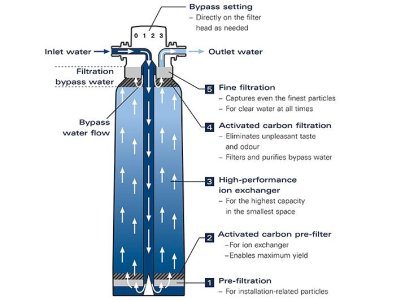
I filter using a twin pack 10u then 1u into the tanks then fitted a Grohe Blue filter tap at the sink for drinking water. The 10u gets dirty first so it must be catching a lot of crud.

blue-filter-2015-en_4_3.jpg
 
I read somewhere not to filter out the chlorine using carbon filters as it helps keep the water from going off in the tanks.

I filter using a twin pack 10u then 1u into the tanks then fitted a Grohe Blue filter tap at the sink for drinking water. The 10u gets dirty first so it must be catching a lot of crud.

View attachment 199238
It depends on your throughput of water. If you are leaving it in there for 3 years, leave the chlorine in. This is the condition of water in your liferaft if you have an ocean spec raft. It is so full of chlorine, you really don't want to drink it.
If you get through your water fairly rapidly, you don't need chlorine. It's generally in the water at the tap where you fill anyway, but in smaller amounts than what you would use to sterilise the tank
 
OK, supplemental question:

If I fit 2-stage 5 micron filtering (as above), sediment followed by activated carbon, do I need add any treatment to the water in the tank? The filters don't claim any anti-microbial properties so do I need to put any purification tablets or other chemical into the tanks when I fill up?

Thanks again.

Think about municipal water treatment.
  • They filter coming from the river. The pipes and hoses in the typical marina have a good bit of rust and algae in them that you do not want building up crud in your tank. You can't have clean water without a clean tank, any more than you would eat of dirty dishes. Bleach won't penetrate the dirt in the tank. You also don't want to chlorinate dirt (toxic byproducts). A 1-5 micron particle filter will do.
  • Put a filter on your water tank vent. Bugs crawl in and drown. This is in the building code but most boat builders skip it.
  • Chlorinate the water. But very very little. Just 1-3 ppm. Even if the tank is clean, stuff will grow there. If you refill on a regular basis (weekly?) from chlorinated municipal water you can skip this step. Bleach or tablets. The trick is a very low does and a clean tank.
  • Filter 0.5 micron at the tap. Because many of us don't sail that often. And because some of the water sources are questionable. The chlorine got the bacteria and viruses. The filter is for cysts (giradia etc.). The filter will also remove low levels of chlorine. In fact, most of the tastes were destroyed by the chlorine.
Drinking Water Filtration--The Short Version

This will give you excellent water. Skip steps and you will get lesser quality water that might be OK and might taste funny.
 
Top