Water feed to shaft seal.

Allan

Well-Known Member
Joined
17 Mar 2004
Messages
4,695
Location
Lymington
Visit site
I've just been reading another thread about fitting a Volvo shaft seal. There's a recommendation for:
https://www.sillette.co.uk/price_pdf_files/deep_sea_mane_craft_shaft_seal.pdf
I'm interested in fitting something like that to our Starlight 35. Can anyone enlighten me as to where the water supply should come from? It's a Volvo 2030C with indirect cooling. I assume the water should come from after the pump but before the heat exchanger. I'm stuck as to how this can be achieved.
Allan
 
I've just been reading another thread about fitting a Volvo shaft seal. There's a recommendation for:
https://www.sillette.co.uk/price_pdf_files/deep_sea_mane_craft_shaft_seal.pdf
I'm interested in fitting something like that to our Starlight 35. Can anyone enlighten me as to where the water supply should come from? It's a Volvo 2030C with indirect cooling. I assume the water should come from after the pump but before the heat exchanger. I'm stuck as to how this can be achieved.
Allan

This article should explain what is required
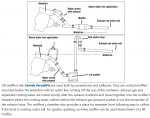
How To Install A Dripless Shaft Seal

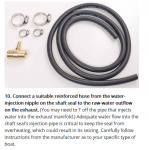
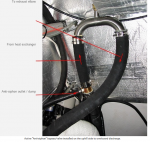
After the raw water has passed through the heat exchanger I've bled off a little water on the "upside" of the ant-siphon loop and injected it into the dripless seal via a (temporary) clear plastic tube.. If you look at this clip carefully you'll see how I've done it. (The whole engine room has to be tidied up)

The bulk of the raw water is then injected into the exhaust and then ejected through the side of the hull with the exhaust gases.

And here you can see water coming out of the propeller tube.
 
This article should explain what is required
How To Install A Dripless Shaft Seal

After the raw water has passed through the heat exchanger I've bled off a little water on the "upside" of the ant-siphon loop and injected it into the dripless seal via a (temporary) clear plastic tube.. If you look at this clip carefully you'll see how I've done it. (The whole engine room has to be tidied up)

The OP says he has a "Volvo 2030C" . Presumably he means a Volvo Penta MD2030C in which case there is virtually no scope for fitting a connection to the HE outlet end cap

VP HE outlet end cap.jpg
The anti siphon loop, if there is one, is located in the pipework between the sea water pump and the HE inlet end cap. It will be necessary to make the connection to the raw water pump to anti siphon valve hose, or if there is no anti siphon loop to the sea water pump to HE hose
 
Last edited:
The OP says he has a "Volvo 2030C" . Presumably he means a Volvo Penta MD2030C in which case there is virtually no scope for fitting a connection to the HE outlet end cap

View attachment 83171
The anti siphon loop, if there is one, is located in the pipework between the sea water pump and the HE inlet end cap. It will be necessary to make the connection to the raw water pump to anti siphon valve hose, or if there is no anti siphon loop to the sea water pump to HE hose

I don't know anything about the MD2030C engine but surely it would not be difficult to bleed a small amount of water off just before it enters the water injector? But why not bleed a small amount off before the heat exchanger? But without a schematic of the engine (or seeing a MD2030C) I can't see a problem.

Exhaust System Basics


By Tom Burden, Last updated 6/25/2019


Screenshot_2020-01-04 Exhaust System Basics West Marine.png

How to install a dripless seal
HOW TO INSTALL A DRIPLESS SEAL

Screenshot_2020-01-04 How To Install A Dripless Shaft Seal - BoatUS Magazine.png
 
Last edited:
When I had a Tides seal I put a T piece in just after the water pump and ran a hose back to the seal. (Volvo 2003). I don't like this system as a failure in the water supply causes the seal to overheat VERY quickly . This happened to mine. I found the solid part to seal had cracked right through and it was only 10mm of the bellows that was stopping a complete failure .
I changed to a PSS that only has a vent pipe.
 
I don't know anything about the MD2030C engine but surely it would not be difficult to bleed a small amount of water off just before it enters the water injector? But why not bleed a small amount off before the heat exchanger? But without a schematic of the engine (or seeing a MD2030C) I can't see a problem.
The HE outlet end cap , which I show in my previous post, connects directly between the HE and the water injection elbow. It is therefore not practical to make a connection there. There is no place where you could fit the little brass "T" piece shown in your post
However a connection can be made easily to the seawater pump outlet hose, before the anti siphon valve if one is fitted.
 
I would have thought that a T inserted into the hose between the pump and heat exchanger would be simple enough. Presumably the flow rate should only be low, so some restriction would be needed.
Quite. That is what the brass "T" piece in one of the pictures in Coopec's post is for.

But if there is an AS (anti siphon) loop the connection should be made between the pump and the AS valve .
Connection between the AS valve and the HE might allow water to siphon from the shaft seal back though this connection and through the HE to flood the exhaust system
 
Quite. That is what the brass "T" piece in one of the pictures in Coopec's post is for.

But if there is an AS (anti siphon) loop the connection should be made between the pump and the AS valve .
Connection between the AS valve and the HE might allow water to siphon from the shaft seal back though this connection and through the HE to flood the exhaust system

I'd be very surprised if there was no anti-siphon loop on a yacht. Of course the reason you have an anti-syphon loop is to stop the exhaust/motor being flooded with sea water (as you have stated)

I'll be following this guy's advice because he says he makes a good living repairing boat engines after the anti-syphon valve fails. Note how he has an "anti-syphon outlet/dump" as well as a valve

Screenshot_2020-01-04 Designing a Marine Exhaust System - Seaboard Marine.png
1578135121884.png

This article is well worth reading.
DESIGNING A MARINE EXHAUST SYSTEM
 
Last edited:

I'd be very surprised if there was no anti-siphon loop on a yacht. Of course the reason you have an anti-syphon loop is to stop the exhaust/motor being flooded with sea water (as you have stated)

I'll be following this guy's advice because he says he makes a good living repairing boat engines after the anti-syphon valve fails. Note how he has an "anti-syphon outlet/dump" as well as a valve

View attachment 83178
View attachment 83179

This article is well worth reading.
DESIGNING A MARINE EXHAUST SYSTEM
In your example the anti-siphon loop is after the heat exchanger. Vic's comment was aimed at a loop before the heat exchanger.

In fact my boat was built without an antisiphon loop and does not have one to this day. I find it difficult to understand how water could ever siphon past the vanes of a seawater pump.
 
In your example the anti-siphon loop is after the heat exchanger. Vic's comment was aimed at a loop before the heat exchanger.

In fact my boat was built without an antisiphon loop and does not have one to this day. I find it difficult to understand how water could ever siphon past the vanes of a seawater pump.

I'd worry that water might leak past a damaged impeller in the water pump but you'd probably argue that you always close the raw water ball valve when leaving the boat. (Of course I will too)
 
Thank you for all the replies so far. The engine is indeed an MD2030C. I think I'm right in saying the water is drawn by the pump through the gearbox. After the pump it goes to the heat exchanger via an anti siphon device. I'm taking, from the answers so far, that the connection should be between the pump and the anti siphon device.
Allan
 
I recently removed a Deep Sea Seal and fitted an Eliche Radice seal. The Deep Sea seal had a water feed taken from a T off the engine cooling water intake just above the sea cock.
In a power boat with high power and revs the Eliche Radice seal requires a water feed but with the low power low revs used by most sailing boats you do not need it. The water spigot can be connected to an air bleed tube looped high up under the counter or cockpit which will allow sufficient cooling water to the seal, rather like continually burping the Volvo seal.
I read it on here somewhere.
 
I recently removed a Deep Sea Seal and fitted an Eliche Radice seal. The Deep Sea seal had a water feed taken from a T off the engine cooling water intake just above the sea cock.
In a power boat with high power and revs the Eliche Radice seal requires a water feed but with the low power low revs used by most sailing boats you do not need it. The water spigot can be connected to an air bleed tube looped high up under the counter or cockpit which will allow sufficient cooling water to the seal, rather like continually burping the Volvo seal.
I read it on here somewhere.
My PSS is plumbed the same way. Seems a simpler, better solution.
 
All of the suggested complication is totally unnecessary . On a sailing boat where the shaft speed is fairly low all tou have to do is attach a tube to the RMTA seal, take the end well above the waterline and leave it open ended. The RMTA seal is just like a Volvo seal, but has a greasing point and a water inlet. The Volvo seal only needs a bit of seawater behind its lips to keep it cool, so you burp it on launch. The open ended tube allows water to flow up to the seal, removing the need to burp it, and that is all that is needed.

I have had an RMTA seal for several years, installed as above and it has remained completely leak free.
 
I've just been reading another thread about fitting a Volvo shaft seal. There's a recommendation for:
https://www.sillette.co.uk/price_pdf_files/deep_sea_mane_craft_shaft_seal.pdf
I'm interested in fitting something like that to our Starlight 35. Can anyone enlighten me as to where the water supply should come from? It's a Volvo 2030C with indirect cooling. I assume the water should come from after the pump but before the heat exchanger. I'm stuck as to how this can be achieved.

The link you've posted has a title which suggests it's the ManeCraft seal you're considering. However, the PDF also has details of the Radice RMTA seal, and I wonder whether this is the seal you're considering? It's certainly been recommended many times as a replacement for the Volvo seal.

If you are fitting the Radice seal, it doesn't need a water feed for your boat, simply an air vent pipe extending well above sea level. Also worth looking at is the Orbitrade seal from ASAP Supplies, slightly different stern tube dimensions and a bit cheaper.
 
I've just been reading another thread about fitting a Volvo shaft seal. There's a recommendation for:
https://www.sillette.co.uk/price_pdf_files/deep_sea_mane_craft_shaft_seal.pdf
I'm interested in fitting something like that to our Starlight 35. Can anyone enlighten me as to where the water supply should come from? It's a Volvo 2030C with indirect cooling. I assume the water should come from after the pump but before the heat exchanger. I'm stuck as to how this can be achieved.
Allan
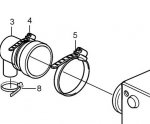
On my Beneteau and others there is a grill thru hull that is connected to a small 8mm tube that goes in to the figlass tube that the volvo seal fits on. When under way the water appears to move allng it.
 
On my Beneteau and others there is a grill thru hull that is connected to a small 8mm tube that goes in to the figlass tube that the volvo seal fits on. When under way the water appears to move allng it.
I worked on a small mobo a couple of years ago that had a similar arrangement. A forward facing tube drove water through the seal when under way.
 
On my Beneteau and others there is a grill thru hull that is connected to a small 8mm tube that goes in to the figlass tube that the volvo seal fits on. When under way the water appears to move allng it.
Yes, a common method on Beneteau motorboats. The grill is shaped to act as a scoop although you still need to burp the seal to eliminate an airlock. Do check that thru hull though. The hose tail on the ball valve was brass, as fitted by Beneteau, and with only light pressure it crumbled (seriously dezinced) and water started to pour in. My natural reaction was to shut the ball valve but the water continued to pour in! I then realised that ball valve was of no value at all as the water was coming the other way from the prop tube. Luckily I was on board but if this hose tail had failed when I was not, even if the ball valve was closed, the boat could have sunk.

Www.solocoastalsailing.co.uk
 

Other threads that may be of interest

Top