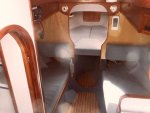
Waste of space- internal layout

pmagowan

Well-Known Member
Joined
7 Sep 2009
Messages
11,836
Location
Northern Ireland
sites.google.com
If you were designing a circa 40 foot sailing boat what would your internal layout be like? What are your priorities?

I was thinking that as you increase the size of a boat more and more space is simply 'wasted' making the boat 'airy'. Coming from old fashioned wooden boats which have poor internal space for length I am used to every bit of space counting. I can't help thinking this way when looking at larger beamier boats. Many of them seem to stick a random sofa in there just because they need to fill a space. It often looks to me like the beam is too wide to allow a central table with seating on either side of the hull so they put the whole arrangement on one side and then don't know what to do with the other. Do you need more than one seat per person?

The other problem is the cabin arrangement. Assuming a 3 cabin layout to accomodate up to 6 people where should the main cabin be? It always seems to be the bow but then this is the worst place to be for slapping up and down and getting noises in the night from chain and mast. Also, if we have loads of headroom should we raise the sole to get extra storage?

And, am I right in thinking that the important bits are an afterthought, engine, services etc. Many seem to be stuck in the most inaccessible places. How many toilets do you need? I will think of a few more questioons but that should keep you going. :)
 
Very difficult questions and the answers are very dependent on personal taste and circumstances.

We are a small family - seldom more than two overnight guests - but we do entertain a lot. Hence we wanted large comfortable bedrooms and a large lounge that could accommodate a fairly large group for a meal - we went for a 43 footer with just two cabins plus a large lounge with a very well equipped galley. We also spend a lot of time in the cockpit, so that has to be large too. The lounge table drops into the sofa to create a very large double bed and the cockpit table also converts to a double bed so, in hot weather at least, we can accommodate up to eight overnight.

The one thing I do miss relative to other boats in the same class that we looked at is a work room/utility room - there are times when that would be very useful.
 
Well, lets take a Bavaria Cruiser 46 which is the most modern fat bummed boat I have sailed and fits your criteria very, very, well, or does it. This boat has two fore cabins, port and starboard, very roomy, very light and airy, wide double berths with lots of storage below and hanging lockers with vanity table and drawers. Aft of the fore cabins was a shared companionway with a heads to starboard and a shower to port. Both the head and shower had locker space as expected with the shower also acting as good wet locker. Plenty of room in the companionway to add hooks or slim cupboards if an owner required that.

Now in the saloon: full length galley on port side with all the storage space you could wish for - dry, refrigerated, accessible, secure. The saloon table easily sat 8 persons with massive under seat storage including the stand alone, fore and aft settee between the galley and saloon table which again had massive storage underneath. Behind the port saloon seat there are the usual variety of cave lockers, shelves and small cupboards. Chart table was not too bad, a bit small for my liking, it too had cave lockers, shelves and cupboards and under seat storage.

The two aft cabins each had their own heads with showers and were very roomy, each being the same size as my Rival 41 fore cabin. Excellent under berth storage, good vanity table with hanging space and drawers.

Then we get to the cockpit which is fabulous. A wide cockpit with a great table in the middle which all 8 can sit around with the leaves up. Central storage space in the table. Cave lockers, under seat shallow lockers. Now the good bit - under the helm seat is a massive cockpit locker, that is the full width of her fat butt, will easily take a very big dinghy deflated and lots of other stuff. The transom also dropped down to make a huge bathing/boarding/smug git GandT platform.

Engine was in a tight space but easily accessed from below the stairs and the two aft cabins; very accessible indeed.

I was sold on the space, the lightness, the volume, the storage and the amount of stuff that would be required to fill it all. Then there is my Rival 41C. Everything is wedged in awkward spaces and it always appears full.

Thats the reality of it as I have experienced.

Hang on I forgot the bow locker - it had steps to climb down into. I could stand up in it.
 
Last edited by a moderator:
A 40ft boat might sleep 6, but you might want 10 to race it or a dozen or so aboard in harbour for a few drinks.
Doing long passages, more than 4 might be a crowd, but the sofa becomes a sea berth.
Different people use their boats in different ways.
 
On a Yarmouth 23, there is not one bit of space that is not used well!
Even the table can be positioned over the galley whilst sailing to provide a chart table.
Great design for a small boat.
interior.jpg
 
Good chart table. Easy to work in galley and, above all, easy access to the engine. There has to be good, perhaps great would be a better word, drying facilities.

How do you get 'great drying facilities'? Do you just put a vent for the eberspacher in at the bottom and an open vent at the top of a locker?

Two aft cabins are the main problems as there is a compromise between them and the cockpit. Also should they all have en-suite or do you simply have one master heads and a spare? What about a bathing platform, are they only of use in the med?

I like engine room space, good chart table, good but compact galley (its a boat not a restaraunt), plenty of room around the main and cockpit table. I think storage space would be fine as I am used to 28' so I can't imagine I would have too little room on 40' plus.

More questions:
Who likes portholes in the hull?
Do you want locker room for fenders?

For a tender I was thinking I could make a custom nesting dingy that breaks down into 2 or 3 parts. This could then be strapped down in the forepeak just in front of the coachroof. I don't like inflating and deflating dinghys. What is the panels thoughts, do you stow, tow or hoist on davits?
 
How do you get 'great drying facilities'? Do you just put a vent for the eberspacher in at the bottom and an open vent at the top of a locker?

Two aft cabins are the main problems as there is a compromise between them and the cockpit. Also should they all have en-suite or do you simply have one master heads and a spare? What about a bathing platform, are they only of use in the med?

I like engine room space, good chart table, good but compact galley (its a boat not a restaraunt), plenty of room around the main and cockpit table. I think storage space would be fine as I am used to 28' so I can't imagine I would have too little room on 40' plus.

More questions:
Who likes portholes in the hull?
Do you want locker room for fenders?

For a tender I was thinking I could make a custom nesting dingy that breaks down into 2 or 3 parts. This could then be strapped down in the forepeak just in front of the coachroof. I don't like inflating and deflating dinghys. What is the panels thoughts, do you stow, tow or hoist on davits?

Few modern boats have any formal wet locker - if we come in soaked, the oilies end up hanging in the shower!

We have portholes in the hull - well, actually, large windows - but we are coastal hoppers - not sure they make much sense if you are likely to see anything like bad weather!

We are happy with a single shared heads - but, as I said above, we generally sail on our own and very seldom have more than two overnight guests. We only wanted two cabins in total, and they are both forward, so there is nothing under the cockpit other than storage and the (very cramped) engine room.

Locker room for fenders? Well, on the Bavaria that we almost bought, there was a utility room that you could enter through the heads and the cockpit locker on that side opened down into the same room, so you could stow fenders in it if you wanted. We have a large anchor locker and tend to put fenders in there.
 
we are living aboard a 40' ketch - hopefully this will be the boat that eventually takes us on ocean passages and I think (hope) it will good for it. In the meantime, it needed to be a floating house. We were massively constricted by our small budget and compromises were made. In terms of our priorities (based on no experience whatsoever!) : we wanted a large saloon for entertaining and relaxing (tick), a decent sized galley (half tick), an island bed (didn't get that), 2 heads (didn't get that, but it was not essential as the second heads was only wanted to be converted into storage). 2 cabins for sleeping (tick), decent chart table (double tick - in fact we have a separate nav room in the portside 'crawl' through and this works well as a good dumping ground leaving other spaces clear). Plus stowage, storage, stowage and storage (tick for below, but not for deck). One thing we have that is great is a tool shed and work bench in the bow. Cupboard doors open from the fore cabin to reveal the bench, vice and tons of storage for all the tools and associated spares.

I would have liked better heads/shower room (what we have is in the starboard crawl through - headroom of about 6')
I would have liked a bit more galley space, but this can be tweaked with a pop up table top I think.
I would have liked bigger deck lockers (but that would have eaten into the space below) Fenders are in baskets and the dingly is in the forepeak in a sail locker. We have everything we need on board but would struggle for stowage if we needed to store the sails below.
I would like an island bed.

re your last two questions. We have portholes in the raised coachroof, nothing in the hull and yes, I would have like to be able to put the fenders away.

Edited to take account of last post - wet locker is important. we have a large wet locker that the eberspacher exhaust runs through, so it's great on wet/cold days.
 
Last edited:
How do you get 'great drying facilities'? Do you just put a vent for the eberspacher in at the bottom and an open vent at the top of a locker?

?

I was on (IIRC) a Hallberg Rassy which had its oily locker under the stairs at the mainhatch where the heat of the engine helped dry them.
 
Put storage and wet areas fwd together with a second heads and/or shower for harbour use. Put a twin bunk cabin midships with top quality sea berths so the are as close to the middle of the boat as possible to minimise movement. Put the java station where movement is limited, access from the deck is quick and easy and any movement of people is as far from sleeping crew as possible. But your double berths aft. Of course if you want one of those great big owners cabins then you have to decide if it is going to be aft and loose the opportunity to have 2 smaller doubles or fwd where it is of little use at sea and takes away the previously mentioned storage area. linear galleys have a lot of space but offshore you need to think carefully about how you secure yourself when trying to cook. Light and airy for me means 'long way to fall' when trying to move around at sea. I even find that the coach roof on the Jeaneau 42DS so high that I don't feel comfortable moving around on it at sea, and it's not that high!

I guess it all depends on expected crew size, what you want to do and what you like. Some people are very happy to have a saloon seating arrangement that changes to a double berth but that is ot to everybodys taste.

Yoda
 
I was on (IIRC) a Hallberg Rassy which had its oily locker under the stairs at the mainhatch where the heat of the engine helped dry them.

I would not want damp near the engine (if avoidable) but perhaps the wet locker could be designed to get as much waste heat as possible from engine exhast, calorifier, heater exhaust and even from a direct heater vent. It would be rather nice to have heated dry oilies to put on when the weather sets in. There is no part of my current boat which could be called dry at present but then it is still a work in progress.

What about heads. How many is too many? I think 1 is too many sometimes. Especially since nobody seems to be able to follow the rather simple instructions on how to use them without either sinking the boat or breaking the rubber valve! I am told as you get older they become more important so perhaps a forward thinking designer would include them in all cabins but then you have lots of holes in your hull and lots of holding tanks full of impending doom.
 
Like many boats, my saloon table is a massive piece of carpentry designed to seat 6 (cos the boat will sleep 6 I guess). I got to thinking: you wouldn't sit round your dining table at home; why do it on the boat? So, I built a new top about a third shorter. Plenty big enough 99% of the time and has transformed the living space. I could have gone further and built a fold away table a la Island Packet. Try taking your saloon table out and be amazed!
 
...

I guess it all depends on expected crew size, what you want to do and what you like. Some people are very happy to have a saloon seating arrangement that changes to a double berth but that is ot to everybodys taste.

Yoda

I would not want to be relying on converting the saloon to a bedroom on a regular basis - it's ok for the occasional overspill.
 
Like many boats, my saloon table is a massive piece of carpentry designed to seat 6 (cos the boat will sleep 6 I guess). I got to thinking: you wouldn't sit round your dining table at home; why do it on the boat? So, I built a new top about a third shorter. Plenty big enough 99% of the time and has transformed the living space. I could have gone further and built a fold away table a la Island Packet. Try taking your saloon table out and be amazed!
Did this on mine. Had a large fixed table with 2 drop leaves. Looked great and practical but really was a pain and took up loads of space. The Jouet 950 has a large V-shaped saloon seat. I made a small table on a pedistal which has served it's function well and when removed there is an infill which converts the saloon area into quite a large berth.
 
Put storage and wet areas fwd together with a second heads and/or shower for harbour use. Put a twin bunk cabin midships with top quality sea berths so the are as close to the middle of the boat as possible to minimise movement. Put the java station where movement is limited, access from the deck is quick and easy and any movement of people is as far from sleeping crew as possible. But your double berths aft. Of course if you want one of those great big owners cabins then you have to decide if it is going to be aft and loose the opportunity to have 2 smaller doubles or fwd where it is of little use at sea and takes away the previously mentioned storage area. linear galleys have a lot of space but offshore you need to think carefully about how you secure yourself when trying to cook. Light and airy for me means 'long way to fall' when trying to move around at sea. I even find that the coach roof on the Jeaneau 42DS so high that I don't feel comfortable moving around on it at sea, and it's not that high!

I guess it all depends on expected crew size, what you want to do and what you like. Some people are very happy to have a saloon seating arrangement that changes to a double berth but that is ot to everybodys taste.

Yoda

What a pain, I had a reply and then lost it to the ether!!

Why do you think the storage should be for'd as I would initially assume that aft was better; no dragging damp dripping clothes through the boat and more convenient for changing and going up the gangway. Also aft tends to be near the stuff that generates waste heat that might be useful for drying things.

With your 'twin bunk midships' do you simply mean sea berths which are generally the saloon seating with a lee cloth. I saw one where the shelf behind the seat made the upper berth. This works well for bunking down under way. I would not want a great big owners berth aft as I could not justify the use of space for something that is simply a bed.

My father has the same idea re handholds and he complains about the modern designs for being poorly equipped with them. I intend to have all the string running back to the cockpit so that above, work on the coachroof is limited.
 
I would not want damp near the engine (if avoidable) but perhaps the wet locker could be designed to get as much waste heat as possible from engine exhast, calorifier, heater exhaust and even from a direct heater vent. It would be rather nice to have heated dry oilies to put on when the weather sets in. There is no part of my current boat which could be called dry at present but then it is still a work in progress.

What about heads. How many is too many? I think 1 is too many sometimes. Especially since nobody seems to be able to follow the rather simple instructions on how to use them without either sinking the boat or breaking the rubber valve! I am told as you get older they become more important so perhaps a forward thinking designer would include them in all cabins but then you have lots of holes in your hull and lots of holding tanks full of impending doom.
Perhaps you need to look around at the various ways builders use the space as they try to adjust it to meet their target market, and very often offer alternatives within the same hull. The majority of the mass production boats are sold in hot climates and then probably more for charter use than private, so it is not surprising that this market's needs dominate the architecture of the boat. So the classic large cockpit, twin aft cabin, small chart table two loo configuration is the most popular as a 40' boat would be licenced for 8 or 10 people to holiday on. The large cockpit suits outside living, open transom for stern to mooring and swimming, lots of cabins so people have their own space, light, open and airy interiors because most time is spent at anchor and so on. So, although the open spaces seem wasted, they are not but just used in a different way. This reflect modern home designs as well as hotels, caravans and so on.

One could go on about the benefits or otherwise of the alternatives and very easily come up very different solutions depending on how and where the boat is going to be used, plus of course the size of crew. Somewhat surprisingly though, even when a couple are specifying a boat for their own use they rarely limit the number of berths to two except on a small boat as there is always an alternate use for the spare space and you can choose to use it for other purposes, but you can't add a berth that is not there. So my 37 footer was available with one aft cabin and bigger saloon with 2 individual seats on one side or a 3 cabin with less lounging space and linear galley. As it was bought for charter it is the latter layout, but when we use it on our own one aft cabin is converted to a single berth and store room.

Loos are an issue. Some users demand instant access to toilet facilities - not just loos but showers and if you have 8 charters on a boat in the height of summer, even 2 is not enough. Remember much of what is in boats is determined by how people live at home and en suite toilet facilities are just a way of life for many people and they are not prepared to compromise on a boat.

As ever. layout choices are a compromise and you need to work out what is best for you. What works in a 2 person ocean voyager may not work in a weekend family cruiser. The trend has been away from filling the hull with as much furniture as possible toward lighter more open layouts as the increased volume to length of modern hulls allows this without significant loss of sleeping and storage space, and more importantly allows more flexibility.
 
My needs are rather odd as I will be designing the boat to be useful single handed but will intend to mostly sail with friends and family. It is likely that we will be needing 3 cabins as this is the likely configuration of people on board. So far, being the skipper, my sleeping arrangements have been based on where I can get easiest access to checking on things in the night. This is the saloon seat in my current boat but it has no real enclosed cabins, just a v-berth and the saloon seats (with feet in holes under the galley). I think if building a boat I would design it for my needs and assuming that I would be the one person who is always onboard (although this would not necessarily be the case). As such I would like a good sized cabin with storage for permanent wardrobe etc. It looks like the configuration I would be looking at presently is the 2 aft cabins with at least 1 heads between them and a forward cabin with head and extra storage space as my cabin. The chart table takes the space of the head at one side aft. Then a somewhat enclosed galley and large lounge with big table.

I know a lot of people have cut down their tables but this is one of the things I like most. We have a very small area on our current boat and I made a large teak table so that we can squeeze 3 in each side and a 7th on the end sitting on the engine cover. I only want the lounge to be for occasional use as beds or as sea berths as required.

The rustler 42 has only 2 cabins, a v berth and an aft double. The other side it a head and storage. The Rustler 45 has a large cabin aft which takes up the whole beam and the v-berth. It restricts the sleeping arrangements somewhat on a large boat. Otherwise I like most of their designs.
 
.... Assuming a 3 cabin layout to accomodate up to 6 people where should the main cabin be? It always seems to be the bow but then this is the worst place to be for slapping up and down and getting noises in the night from chain and mast.

Curious as I find stern cabins by far the noisest places to stay. Main culprit, wave slap on the stern. I had a CC boat before with a massive aft cabin, but the wave slap drove me crazy, so forecabin for me every time.
 
I would just scale up my layout

CC33-Plan.jpg
 
Top