Vulcan anchor and seagrass. Rubbish?

Jonathan, you might be using a light weight anchor, short light chain plus rope, but those other "long term cruisers" are using yachts in the 10-20 tonne range not 7 like yours. Therefore yes they do have 80m of chain and 30+ kgs of anchor. After all I could say "OMG" why are these 7T catamaran sailors so big an anchor compared to mine.


Now if you want me to take you seriously, I need to see some evidence of this please. From what I have seen of the anchor tests over the years, NG anchors have all bettered the Delta, one of the reasons we switched from Delta to Rocna a decade ago. Same weight higher holding power.


If the yacht is your home, what's the problem in ensuring that your anchor is the best you can have?

The latest thread on CF was about a detailed study showing that weight in the chain has little benefit once the wind gets up, instead putting the weight into the anchor achieves much better holding. After all you did just this with short piece of light weight chain and rely on the holding power of the anchor.

The Mantus isn't a well known in the UK, old CQRs continue to rule the roost. Your attacks on one make of anchor is wearing a little thin. If you haven't used it extensively, then I will just dismiss your posts as irrelevant with no personal experience. If you buy one and anchored with it for 300 nights, then come back with photos saying it doesn't work, well that would be more believable. Hey you might even like it and keep it as the main :eek:. After all 30kgs on your 7T yacht is really noticeable is it, particularly if you have hardly any chain. You're down under aren't you? ye gods you probably have more weight in Lager on board.

At the end of the day, a choice and competition is good for the consumer, that's us. Let the manufacturers continue to compete against each other.

Pete

I would expect someone sailing a 20t or 30t yacht to use a bigger anchor than we do - that's what the anchor manufacturer would recommend. I do wonder why they use one bigger than the anchor maker recommends.

I have not seen a flurry of posts of people using, lets call them, New Gen anchors and reporting they have dragged - full stop. People, or some of them buy the size recommended by the manufacturer - and don't report issues. There have been posts of people using NG anchors that have failed (because they caught a beer can in the toe or because they used the anchor in thin mud - that's bad luck and not knowing your anchor).

You do not need to be a live aboard to catch a 55 knot wind. There is nothing 'that' special about being a live aboard - it does not, necessarily make you better - its not your experiences - its what you LEARN and how you apply it.

Point me to 2 items of evidence - the data showing that long term cruisers (not the vocal 'minority') use bigger anchors than recommended and separately data showing that people with correctly sized NG anchors have dragged.

I have the evidence please read the Mantus thread. You are suggesting that all anchors developed since say the year 2000 (or 1990 if you rightly want to include Spade) are all as good and all fall into the NG category. To me a Mantus is a Bugel with a concave fluke - what's special about that - what makes it NG. Wander the Med and you will see Bugel style anchors with concave flukes, twin toes, downturned toes - what makes Mantus so special (except its crown is in the wrong place).

My comments on the Mantus are because there is constant advise the Mantus is as good as Rocna. I have no love of Rocna (the bendy shank saga) but I find it insulting (of Peter Smith). I find the constant recommendation that Mantus is better is wearing a bit thin - especially as there is only vague subjective evidence to support the claim. I have tested Mantus, I have exhaustively researched its design and I have modified my Mantus to prove my point. The fact that some might not agree with the data is their choice - but as long as the comment is made that Mantus is as good as a Rocna - I will try to warn the neophyte.

Maybe you should wonder given that some people do understand what I am saying why there has not been any data proving me wrong - how about some holding capacity data proving I'm an idiot - what better way to silence me.

We do agree, choice and competition between anchor makers (or any other equipment) is healthy and good for the consumer. Constant recommendation of one product without any supporting quantitative data is not healthy and might raise questions of motivation in the minds of some.

Equally interesting - I imply some might have a lack of understanding of basic anchor design - this has not stopped negative comments on basically every other design you can think of. You will note I do not comment on anchors I have not actually used myself - so no comments on Vulcan, no comments on Bugel, no comments on Britany. Anchors I have used I comment on - it is a pity others do not do the same thing.

Maybe you could address focussed comments at others - as on anchors I will continue to comment.

Jonathan
 
... She then said, in her opinion, it was the chain that holds you in seagrass and that you need to put plenty out. In her opinion my 8mm chain was too light and 10mm would be better. This would still not solve my problems because overnight anchoring is different from being out for the day....

I think it is rather obvious she meant long scope.

I don't understand why people complane that an anchor does not set, and they have not tried longer scope. It really can make a difference and is lots easier than endless discussion. No anchor is at it's best at 3:1 scope. Maybe half, maybe less (not counting catenary--there may be little during power setting in shallow water). Unless you know the chain is on the bottom during the full setting process, you may benifit from more scope. Then shorten up if you need to. Easy.
 
I love my Spade but it failed to set three times on seagrass last year. So I wouldn't expect it to be a panacea for this particular problem.

Both attempts were inadvertent - rough water combined with low sun and dusk/near dark respectively. I wouldn't anchor knowingly on seagrass out of respect for the marine habitat (and because it's become clear that my anchor doesn't like seagrass!)
By default I set 5:1 scope and reverse slowly to my chosen chain length, stopper the chain and wait until a transit tells me the boat is not moving then increase the revs over the course of 30 seconds to around 3000rpm (10m, 7T boat, 24HP engine.)

The first occasion was in 6m depth just outside St Antoni on Ibiza and I made three attempts where the anchor would not hold at 3000rpm. It stopped the boat at low revs but it seemed that the anchor was not penetrating very thick healthy seagrass - a couple of thick roots came up with the anchor - as I upped the revs and dragged, so I moved to the next cala.

The second occasion was in the Mar Menor and a repeat of my experience in Ibiza. The third occasion was an hour later well after sunset with a seabed of thin mud over what I think was a hard clay pan with very thin sickly looking seagrass, so doesn't really count for this thread. It took seven attempts to set the anchor that night. I'm glad I persisted as the F6 winds that were forecast came and dawn saw one of the three other boats in the anchorage being towed off the beach
 
I love my Spade but it failed to set three times on seagrass last year. So I wouldn't expect it to be a panacea for this particular problem.

Both attempts were inadvertent - rough water combined with low sun and dusk/near dark respectively. I wouldn't anchor knowingly on seagrass out of respect for the marine habitat (and because it's become clear that my anchor doesn't like seagrass!)
By default I set 5:1 scope and reverse slowly to my chosen chain length, stopper the chain and wait until a transit tells me the boat is not moving then increase the revs over the course of 30 seconds to around 3000rpm (10m, 7T boat, 24HP engine.)

The first occasion was in 6m depth just outside St Antoni on Ibiza and I made three attempts where the anchor would not hold at 3000rpm. It stopped the boat at low revs but it seemed that the anchor was not penetrating very thick healthy seagrass - a couple of thick roots came up with the anchor - as I upped the revs and dragged, so I moved to the next cala.

The second occasion was in the Mar Menor and a repeat of my experience in Ibiza. The third occasion was an hour later well after sunset with a seabed of thin mud over what I think was a hard clay pan with very thin sickly looking seagrass, so doesn't really count for this thread. It took seven attempts to set the anchor that night. I'm glad I persisted as the F6 winds that were forecast came and dawn saw one of the three other boats in the anchorage being towed off the beach
Here a posting I very much like , he perpaired to admin to have to have seven attempts to set his anchor.
A breath of fresh air from some who always manage to get there anchor to set first go and never had the misfortune to drag .
 
The trouble with sea grass is that its impossible to define in terms of 'density' - but we have learnt to simply give it a miss - go elsewhere. You can potentially anchor in grass, power set in reverse but as you engine will only simulate 30 knots - you are at risk - as the roots of the grass to which you are secured may not resist 35 knots of wind.

The 'problem' is not only the ability of the fluke to penetrate but the shank will not cut through grass, the grass will clog and compact at the crown, between shank and fluke, and this compact felt of grass will resist further penetration. Don't be misled into thinking there is an answer - all anchors will clog at the crown, no matter how sharp the toe (the toe is totally irrelevant). Its the clogging at the crown that is the major culprit.

Now if the grass is thin and emaciated - you can force the crown into the weed bed - but with any density of grass anything else is dreaming.

Been there, done that.

Move on.

Jonathan

PS I'm a bit black and white - if you have a large fishermans the fluke will go deep and the clogging at the crown will not be such an issue - the problem now is the fluke is small (and anchor performance is design and surface area).
 
St Antoni was where I first came across he stuff and first dragged with the Vulcan. Knock on the hull got me away from my book - was almost into an expensive classic yacht.
 
Spade purchased. On boat. In mud. Will look for seagrass.

But whatbout the Jambo anchor which popped up unannounced on YouTube? Claims to be perfect forall seabeds.
 
Spade purchased. On boat. In mud. Will look for seagrass.

But whatbout the Jambo anchor which popped up unannounced on YouTube? Claims to be perfect forall seabeds.

Simple, marketing fluff.

The designer who builds the perfect anchor will have a well worn path beaten to his door, there will be rave reviews on every internet forum and magazines and you will see them on every bow roller.

I think the Jambo has a little way to go to merit its claims.

Success of design is only part of the story - marketing is the other key. I could point you at some good marketing and rubbish design - and marketing wins has down.

It will clog in weed. It will have difficulty in seabeds with lots of stones (as it has need to penetrate with 2, rather than one, toe). It will not be as good as a Fortress, optioned at 45 degrees, in thin mud.

I do like the twin toe concept. I like the simplicity, I'm being complimentary - its like a Danforth, basically its all fluke and its the fluke that provides the hold (not the roll bar, not the ballast). Maybe with some further tweaking it could be a better all round anchor - but anchor development is commonly based on one man with an idea - and he has limited resource.

Spade is a brilliant design (you have made an excellent choice), so good it has been copied. Rubbish marketing - with the inevitable result of poor sales (not helped by high prices).

Jonathan
 
Spade purchased. On boat. In mud. Will look for seagrass.

But whatbout the Jambo anchor which popped up unannounced on YouTube? Claims to be perfect forall seabeds.
(Dick Emery )
I think I got it wrong again dad ,
Yes son it's nice sand you need for sand castle not sea grass .
Leave the sea grass for the wise boatie people who think they can anchor in it then sleep like a baby .

Funny anchoring story so far , I seen people drop their anchor in their own dinghy while going stern on a few times while the dinghy was tight to the bow cleats
But the story a fellow sailor wife told the other day beat that by a mile ,
When her husband drop it in someone else dinghy who was moored on the opposite harbour wall in Greece , while dropping it from the cockpit then when stern, he was just about to dig the anchor in when shout from the other side of
hey your Fu@king anchor in my dinghy .
I would had given anything to see that .
 
I despair over this enthusiasm for anchoring in seagrass.

Though it depends on the density of seagrass.

Ii you imagine the seagrass all lying at right angles to the direction you are setting your anchor then it is inevitable that any anchor will clog, and lose ability to penetrate. The seagrass will simply clog at the crown, you will rip some of the grass out and it will slowly or rapidly build up making your anchor inoperative - as all anchors have a shank/fluke interface that at an engaging or setting angle is almost perfectly designed as a weed collector.

Another way of thinking of it is that your shank and fluke is a bit like the profile of an old fashioned sickle (think of the old Soviet flag (if you are old enough :) ). A sickle worked because it was sharp - and your shank is certainly not sharp enough to cut seagrass. You will simply collect a stook of seagrass that will deny safe penetration into the underlying seabed.

A smaller anchor might collect less weed - but I would not bank on it.

If your anchor does not work in weed - neither will any other anchor. Though a Spade with a ballasted toe might work a bit better than some others.

You could try setting parallel to the 'lie' of the weed - if you can see it. In thick weed your hold is a function of root strength

Go find the sand patches.

Jonathan
 
There are some places in the Med which provide shelter but which have no sand. or the sand is too shallow.

Oddly, I do not see many fish where there is thick seagrass. Do they prefer a mix of sand and seagrass? Hard to see how they could get to food in the sand if there is a total, thick cover of seagrass.

The Greek gillnetters seem to prefer laying them above mud or sand.
 
There are some places in the Med which provide shelter but which have no sand. or the sand is too shallow.

Medium or even heavy weed is a fact of life in some locations. I would not be as pessimistic as some of the views expressed in this thread.

It is important that the anchor can engage with the substrate below the weed, but this is achievable:

YpjlFKK.jpg
 
Medium or even heavy weed is a fact of life in some locations. I would not be as pessimistic as some of the views expressed in this thread.

It is important that the anchor can engage with the substrate below the weed, but this is achievable:


To put this in context, commonly omitted

The yacht that uses this anchor is 49' and Rocna would suggest a 33kg anchor for that size of vessel. This anchor weighs in at 50kg or 60kg - its weight has not been mentioned for some time now. If you can bury the anchor sufficiently deeply you might get below the root mass and into the underlying seabed - but you would actually need to dig to find out how deep the roots might be - and I have never seen anyone actually excavating and measure root depth - so - as usual no data.

This anchor looks set - but again there is no data as to the hold actually produced - my guess would be that set in sand to the same depth the hold would be factorially greater. Without data - deeply burying in grass is simply a false sense of security.

Most people who read this forum will have much smaller anchors, even 33 kg will be large (for their yachts) and the ability of driving a small anchor through the grass is difficult if not impossible. The space forward of the crown will clog with weed and the weed that passes over the top of the fluke will compact as weed lump between fluke and roll bar.

Suggesting that a 60kg anchor is comparable to a 20kg anchor takes some stretch of the imagination and in the absence of a direct comparison lacks any credibility.
But 'Hey' who needs data?

A Kobra, which has a narrow and ballasted fluke or a Spade that has a ballasted fluke has no roll bar - but will still collect grass at the crown.

I've tested for it.

The ultimate fall back is the fishermans - but you sacrifice fluke area for penetration ability.

It is commonly said that the grass provides an environment that small and young sea creatures, including food for fish and young fish themselves, can live relatively safely. I have not heard it suggested that grass is where these fish live when they grow older and of edible (to us) size. Seagrass is the nursery and kindergarten for small fish - who then move off (as we do) to schools :)

Jonathan
 
Does nature make monocultures? More like fertilizer runoff. Fish might prefer a more mixed seabed. But what do I lnow.?
 
Does nature make monocultures? More like fertilizer runoff. Fish might prefer a more mixed seabed. But what do I lnow.?

Really? This does not really justify an answer but...

Unless you are somewhere truly remote, the area sea grass is far, far below historic values, so while you favorite anchoring spot is grass covered, like forest, we still need much more. As for whether nature has value, I'm sure you were taught this is school.

I really hate the "but what do I know" argument. Trump uses that when he re-tweats what he knows to be damaging falsehoods. It implies you are that you have no duty to research or support any statement, and that there is no harm in repeating falsehoods or floating harmfull theories. This is an over reaction on my part, but I really hate that figure of speech.

As for ferti;lizer run-off, I think you propbably know that that feeds algae blooms, which block light penetration, and reduce sea grass. You've read that. It's well established as theory, to the point of being fact.
 
Really? This does not really justify an answer but...

Unless you are somewhere truly remote, the area sea grass is far, far below historic values, so while you favorite anchoring spot is grass covered, like forest, we still need much more. As for whether nature has value, I'm sure you were taught this is school.

I really hate the "but what do I know" argument. Trump uses that when he re-tweats what he knows to be damaging falsehoods. It implies you are that you have no duty to research or support any statement, and that there is no harm in repeating falsehoods or floating harmfull theories. This is an over reaction on my part, but I really hate that figure of speech.

As for ferti;lizer run-off, I think you propbably know that that feeds algae blooms, which block light penetration, and reduce sea grass. You've read that. It's well established as theory, to the point of being fact.

Well there you go. I really don't know.
 
To put this in context, commonly omitted

The yacht that uses this anchor is 49' and Rocna would suggest a 33kg anchor ...This anchor looks set - but again there is no data as to the hold actually produced ...Suggesting that a 60kg anchor is comparable to a 20kg anchor takes some stretch of the imagination and in the absence of a direct comparison lacks any credibility.
I saw the Jambo 'user recommendation' video and thought ''swapping a 25kg Delta for a 40kg Jambo (iirc). Well, it'll punch through seagrass but doesn't prove much else.'' Especially as it dragged more than a metre under engine before digging in. When I've noticed my Spade doing that I've either hauled it up and reanchored or taken a concious risk and being caught out twice last year.
I'm not even sure that Rocna is set. Pretty stunted seagrass if it is. I've seen plenty that could bury a Rocna lying on the seabed, rollbar and all

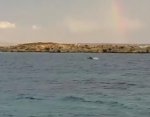
Anyway, as you say, one shouldn't be seeking to anchor in seagrass. As a nature warden in the Balearics explained to me ''its our coral'' and went on to explain its importance as a nursery for sealife and as a carbon sink. She checked that my anchor wasn't disturbing the seagrass and warned me that in a couple of weeks the mooring bouys would be reinstated an I'd be charged for being there but also mentioned where free anchoring was possible nearby. Its another complication to our cruising life but one I think is worth living with. Especially as, the next day, three dolphins came into the bay chasing fish and octopus in the seagrass. Apologies for the poor quality picture. But light patches are sand, dark patcges are seagrass, splashy blob is a dolphin ?
 

Attachments

  • 20201018_201645.jpg
    20201018_201645.jpg
    33.9 KB · Views: 7
Top
