VSR or Split Charge Diode?

...What you are doing is overcharging the battery, so it may appear fully charged, but the faster you charge the lower the available capacity. You get excessive gassing, plus the voltage you read is not the peak voltage, alternator output is a sign wave for each phase, not a straight line....
I've read your profile and viewed your last 200 post looking at anything on batteries or charging, and I can say that most of what you are posting is absolute nonsense - and this from someone who says they design VSR's for a living!!!!

So please could you explain what I have highlighted above.

I have also highlighted other confused posts of yours on other threads which you have failed to respond to.
 
Charging at a higher current limit will cause voltage limit to occur at a lower % SOC.
If we're talking about voltage limits above 14.8V, then I think we need to be quite specific about what exact battery we are considering.
In my scenario, whacking in plenty of current early in the charge is the best route to a high % SOC before the engine goes off and/or the sun goes down.


Yes there is an AC component to the current and voltage waveforms when charging from a normal regulated 3 phase rectified alternator. Some people who know more than me about batteries will tell you that's a good thing, the voltage peaks help to desulphate and various voodoo stuff, others will disagree.

You have to bear in mind that Halcyon thinks BL cars are good and no progress has been made since the Allegro roamed the earth...
 
You have to bear in mind that Halcyon thinks BL cars are good and no progress has been made since the Allegro roamed the earth...

Will you also bear in mind that Halcyon has been designing and building VSR and mains battery chargers since the 1970's, around 5,000 of them.

As for BL it is obvious that you did note read those posts either.

Leave you to your thoughts.

Brian
 
For the avoidance of doubt, perhaps I should have written "...the charge current is governed by how much the batteries can accept at a given charging voltage...". Batteries will only "happily soak up" a certain amount of charge current, regardless of the alternator's ability to output more.

You are perhaps mistakenly thinking that the acceptance phase is constant voltage, it is not. it is ideally constant current. AGM batteries in particular actually last LONGER when charged at very high currents during the acceptance phase. Simple chargers rarely have the ability to do this.
 
....Yes there is an AC component to the current and voltage waveforms when charging from a normal regulated 3 phase rectified alternator. Some people who know more than me about batteries will tell you that's a good thing, the voltage peaks help to desulphate and various voodoo stuff, others will disagree.....

A good alternator should measure less than 0.5v alternating ripple voltage on top of the 14.8v DC charging voltage. That's less than 2% ripple on the DC output, a very small change that is going to do nothing to desulfate a battery. If it did then all sealed FLA batteries would be destroyed pretty quickly. To desulfate a battery a constant DC voltage of about 15.5 v, or about 1v higher than the nominal charging voltage, would be needed for several hours. Desulfation can only occur on the Lead Sulfate crystals that haven't become too hard after being in a Partial State of Charge (PSoC) for maybe a month.

Lead Sulfate crystal are produced as part of the normal discharge process and charging at 14.4v or higher removes most of them before they become hard. When not fully 100% charged, which probably applies to 90% of boats not on shore power, then this PSoC cause the crystals to slowly harden.

There is no AC current componentin the output of an alternator. That would mean the alternator voltage would be going + and then -.
 
You are perhaps mistakenly thinking that the acceptance phase is constant voltage, it is not. it is ideally constant current. AGM batteries in particular actually last LONGER when charged at very high currents during the acceptance phase. Simple chargers rarely have the ability to do this.

Every common-or-garden boat charging system uses voltage limits to control the charging. Probably because that's easier. Perhaps you can suggest some readily available constant current chargers which don't rely on voltage limits.
 
Every common-or-garden boat charging system uses voltage limits to control the charging. Probably because that's easier. Perhaps you can suggest some readily available constant current chargers which don't rely on voltage limits.

Voltage you see with constant current charging is a function of available current. When we made transformer based mains charger's they were constant current up to 14.2/14.4 volt. If the available current was around 10% of amp hour capacity, you had a slow charge and voltage started at 13 volt ish rising up to 14.4 volt. Fit a larger transformer, more amps, faster conversion of active material faster rise to 14.4 volt, at which point controller limited current to stop voltage rise. The down side was the surface tended to get converted giving a false high voltage and earlier current limit, hense faster charge less available capacity after charge. Alternators are the same, they do not generate a fixed voltage, that is the battery, they only limit current to maintain a max battery voltage. Sulphation is a function of excessive discharge and low recharge levels, avoid discharging batteries to low level and normal charge to 14.4 volt should avoid sulphation.

Brian
 
Alternators are the same, they do not generate a fixed voltage, that is the battery, they only limit current to maintain a max battery voltage.

Interesting, I always thought that the regulator on an alternator controlled the maximum voltage...
 
Don't they do this by dynamically controlling the current?
(loke halcyon just said slightly differently..)

They vary the field current continuously, in order to maintain a constant output voltage. That's why they're called "voltage regulators".
 
Every common-or-garden boat charging system uses voltage limits to control the charging. Probably because that's easier. Perhaps you can suggest some readily available constant current chargers which don't rely on voltage limits.

The unit's I have are not production units, but the production version that was derived from them is available from Wakespeed Offshore ... although I am not sure if they have pricing available yet. The unit's I have are what eventually became the WS500

http://www.wakespeed.com/products.html

Wakespeed is basically an ex VP of Balmar ...
 
The unit's I have are not production units, but the production version that was derived from them is available from Wakespeed Offshore ... although I am not sure if they have pricing available yet. The unit's I have are what eventually became the WS500

http://www.wakespeed.com/products.html

Wakespeed is basically an ex VP of Balmar ...

Interesting, but not actually available to buy?
 
They vary the field current continuously, in order to maintain a constant output voltage. That's why they're called "voltage regulators".
So this guy is wrong then?
At a given RPM, the alternator acts as a current-controlled current-source; the output current is proportional to field current,
https://forum.allaboutcircuits.com/threads/dc-excitation-to-car-alternator.118783/

How does the alternator know what the voltage is without a current sink(battery) ?
 
Interesting, I always thought that the regulator on an alternator controlled the maximum voltage...

That is what i said, it limits the charge current to limit the voltage at the battery, take regulator away and output voltage will go high, hence damaged batteries from faulty regulator. A switch mode charger is not the same, you can control output voltage.

Brian
 
He omits to mention that the field current is controlled by the voltage regulator.

In my understanding it is so called because it reads voltage and is controlled by voltage, meaning that the regulator adjusts the current it puts out in order not to overshoot the voltage set point.

Imagine an alternator charging a battery in the absorption phase at, say, 14.4V. Output current is adjusted so that voltage does not exceed 14.4. Then a load, say a 10A flood light, is switched on. The regulator will instantly sense this as a voltage drop and increase the current output in order to feed the load and at the same time maintain the voltage at 14.4.

All IMHO.
 
.....The down side was the surface tended to get converted giving a false high voltage and earlier current limit, hense faster charge less available capacity after charge....
Again some clarification needed please. In bold do you mean less available Ah that can be with drawn before reaching the 50% discharged point. I would suggest this means a lower state of charge is reached by faster charging at the point that the charger (alternator) changes to constant voltage charging. But from here on the battery will take all the current it can get from the charger, so I don't see how a faster charge will mean the battery gets to full any slower.

Here is a post from btrayfors on cruisersforum.com a few years back. He is a very well respected marine consultant in the USA.

Maximum charge acceptance for flooded golf-cart batteries is between 20 and 25% AH rating at 14.4-14.8VDC.
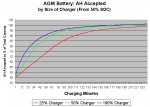
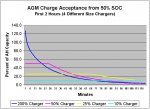
AGMs can accept a LOT more. At 50% SOC, an AGM battery can accept charge amperage initially of more than 100% its AH rating, and at lower SOC AGMs initially can accept as much as 500% of AH rating.

Four years ago durinig a prolonged series of battery tests, we worked together with the Concorde-Lifeline battery company and ran some controlled, measured tests on a new AGM Lifeline battery. The graphs below show actual charge acceptance rates for the first two hours at room temperature, using four different levels of charger capacity.


AH_Acceptance_byChargerSize.jpg4ChargeCurves4DL.jpg


This clearly shows very little difference in the time taken to reach full charge with different charge currents.

.....Sulphation is a function of excessive discharge and low recharge levels, avoid discharging batteries to low level and normal charge to 14.4 volt should avoid sulphation....
Not wishing to be confrontational but this is not a correct description of sulfation.

Sulfation is the formation of lead sulfate crystals on the lead plates as a result of the chemical reaction of any level of current discharge.

The basic lead-acid chemical reactions in a sulphuric acid electrolyte are as follows:
PbO2 + Pb + 2H2SO4 = (discharge____><____charge) = 2PbSO4 + 2H2O

Put in more simple English - when the battery is discharged the lead (Pb) and lead oxide (PbO2) and the hydrochloric acid (2H2SO4) convert to lead sulphate crystals (2PbSO4) and water (2H2O) which dilutes the hydrochloric acid and so lowers the specific gravity.

During charging the reverse happens and the extra water produced is removed and the Specific gravity of the sulphuric acid returns to its original level.

Charging then converts the lead sulfate back to lead and sulphuric acid, but if the battery is not 100% charged - at a voltage of at least 14.4v - then any crystals not converted back to lead will harden over a relatively short time and will provide a permanent layer of lead sulphate crystals on the lead plates which will reduce the capacity of the battery.

It is important to understand exactly what 100% full charged means. It is defined as the end amps flowing into the battery is 0.5% of the Ah battery capacity at the absorption voltage. For a 400Ah battery that would be a current flowing into the battery of 2 amps. But this is in another thread somewhere.
 
He omits to mention that the field current is controlled by the voltage regulator.
How is that relevant?

So you seem to now agree that the output voltage is controlled by altering the current output of the alternator. With the voltage determined by the amount of current going into the battery. Back where we started.
 
How is that relevant?

So you seem to now agree that the output voltage is controlled by altering the current output of the alternator. With the voltage determined by the amount of current going into the battery. Back where we started.

The output of an alternator is controlled by a voltage regulator, the role of which is to maintain a constant output voltage.
 
Top