VP 130S saildrive corrosion due to bad anode contactPenta 130S

yotter

Well-Known Member
Joined
3 Aug 2007
Messages
794
Location
Me Inverkip, boat Kip in winter, Craobh in summer
Visit site
I unfortunately discovered corrosion on my Volvo 130S saildrive lower gear casing (leg). The lack of material loss on the anode provided the hint, and a multimeter confirmed the lack of electrical:-(. The securing screws were found to have white powder on the threads on removal. My propeller is a Kiwi prop and I have an ambassador rope cutter (so all stainless or composite and in good condition).

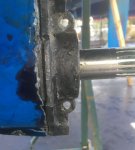
I have attempted to upload an image. This shows the bearing carrier in place. The aft O ring is visible, it goes without saying that it should not be! A section of the flange on the bearing carrier is missing. This was not corrosion but my incompetent attempts at removal a few years ago to replace the internal propeller shaft oil seals. I certainly intend to renew the bearing carrier. This missing metal may not have helped the corrosion on the leg.

The oil came out clean, so the inner O ring has been doing its job.

I am considering repair options....

A new lower leg is perhaps a good option, requires the removal of the whole SD to fit.

Another option pointed out to me is an exoxy repair, and Benzona may well be the best candidate for this.

Any advice or comment most welcome:-)
Angus
 

Attachments

  • VP 130S seals and bolts in place.JPG
    VP 130S seals and bolts in place.JPG
    45.8 KB · Views: 91
Belzona I think you mean.

Or J-B Weld ??

It would be vital to get the surfaces clean and free from oxide

I'd check on the Ambassador installation too
 
Yes, Belzona would make a good repair here, or even Milliput. Ensure you have electrical conductivity to the anode afterwards.
Vyv,
I thought you might be here soon. The Benzona repair (I noted Milliput is some other posts) is my favoured option at the moment. Very little hydrostatic pressure at approx. 1 metre below sea level and hopefully it will withstand vibration.
Angus
 
Apologies Vic, Belzona. J-B Weld certainly looks cheaper. I thing the minimum size for Belzona 1111 is 1 Kg (around £150). I have a dialogue with Bel
Belzona I think you mean.

Or J-B Weld ??

It would be vital to get the surfaces clean and free from oxide

I'd check on the Ambassador installation too

Apologies Vic, you are correct Belzona. J-B Weld certainly looks more cost effective. I thing the minimum size for Belzona 1111 is 1 Kg (around £150). I have a dialogue with Belzona and they have a field engineer visiting a local ship repair yard, he may visit my boatyard if he has time. The Ambassador stripper looks fine, but I will have a closer inspection.
Angus
 
Apologies Vic, Belzona. J-B Weld certainly looks cheaper. I thing the minimum size for Belzona 1111 is 1 Kg (around £150). I have a dialogue with Bel


Apologies Vic, you are correct Belzona. J-B Weld certainly looks more cost effective. I thing the minimum size for Belzona 1111 is 1 Kg (around £150). I have a dialogue with Belzona and they have a field engineer visiting a local ship repair yard, he may visit my boatyard if he has time. The Ambassador stripper looks fine, but I will have a closer inspection.
Angus
J-B Weld is very popular in the US, I believe. I often see it mentioned for patching up damaged outboards.

Something in the back of my mind about the Ambassador and saildrives but the memory is not as good as it used to be. . You might search the Forum for a discussion a few months back
 
I helped a friend of mine with a similar problem some years ago. We used J-B Weld and it worked extremely well, and is still there as far as I know.
 
We used Belzona occasionally on offshore platforms, where it was highly successful. There is no doubt it is very expensive stuff. JBWeld is often recommended here so I guess it makes a reliable repair but I have no experience of it. I have used Milliput in a wide variety of repairs and never had a problem with it. They are all epoxies, the first two with metallic fillers for strength.
 
Vyv,
That is reassuring to know. A Belzona Senior Field Solutions Engineer is visiting a Greenock shipyard on Wednesday and although he has seen my photographs has kindly offered to travel to Kip Marina to use his Mark One Eyeball on the damage. I think I may duty bound to use his product:-)
All
Many thanks for the encouraging posts.
Angus
 
That's pretty severe if the outer O-ring is exposed like that. You might be able to bodge it up with some epoxy, but it will be difficult to create a new mating surface for the o-ring like that. Maybe it's just a scratch, but it also looks like there's a crack where the lower bolt for the bearing housing goes into the leg. If you apply the epoxy with the bearing housing in place, it should last another season though, and meanwhile I would go put an eBay notification for a lower leg or a whole saildrive sold cheap because it has a trashed gearbox or some such. They do pop up now and then. Then you can replace the leg and bearing housing together.

For the future, always put waterproof grease on the bolt and anode where they contact the saildrive (keep the exterior of the anode clean though, or degrease it prior to launch). The grease does not prevent electrical contact (the grease squeezes out where the metals touch), but does stop the anode from eroding in that critical area around the bolts, so it doesn't get lose and rattles around, drops off prematurely or loses electrical contact.
 
Many thanks for your comments. We are going to repair with Belzona 1111. The local Belzona Field Solutions Engineer has viewed the Leg first hand and has also offered to come and help with the repair. I will be on the lookout for a new lower leg (just over £1000 from VP).

I plan to get it as clean and dry as possible and may fit the bearing carrier with some mould release agent (vasoline?) to act as a former. Will discuss this with the Belzona man. I am also tempted to apply some silaflex 291i during final assembly?

There is no crack at the lower bolt. The bearing carrier is being renewed (obviously with new seals and O rings).

That's a good tip about the anode, I believe that the corrosion (white powder on disassembly) between the stainless bolts and the bearing housing had caused the loss of continuity. I am considering using an additional hanging anode as belts and braces since the boat is on a marina berth most of the time (attached to an internal part of the upper gearbox with a wire through the hatch and to the anode over the side.

I will monitor oil quality after each period of use of the engine, although the internal oil removal pipe only goes about 50% down.

Wish me luck
 
That's a good tip about the anode, I believe that the corrosion (white powder on disassembly) between the stainless bolts and the bearing housing had caused the loss of continuity. I am considering using an additional hanging anode as belts and braces since the boat is on a marina berth most of the time (attached to an internal part of the upper gearbox with a wire through the hatch and to the anode over the side.

It might also be worth double-checking that the saildrive is actually electrically isolated from the engine.
 
I checked the continuity from engine block to saildrive. It was 10k ohms. Not sure what the spec is, not sure it will ever be infinity. I will check the manual now, it may be specified?

I'd expect it be be higher than 10k; I doubt that it's in the manual.
 
It might also be worth double-checking that the saildrive is actually electrically isolated from the engine.
I checked the continuity from engine block to saildrive. It was 10k ohms. Not sure what the spec is, not sure it will ever be infinity. I will check the manual now, it may be specified?
I'd expect it be be higher than 10k; I doubt that it's in the manual.
Whether or not the saildrive is isolated does depemd on the engine , bu I dont think Yotter has told us which engine he has
I would expect a 130S dive to be isolated unless fitted to an MD22 or engines earlier that an MD 20x0 B ..................... but refer to the manual

10k ohms seem to low for an installation that should be isolated but too high for one that is not
 
Top