jwfrary
Well-Known Member
Nitrile Impellers are for bilge water or oil/diesel. They are harder and fail quickly I'f run dry. A neoprene impeller is far more tolerant in all cases except for when faced with oily water in which case they break down.

Indeed - I know about Nitrile v Neoprene and one is more suitable for these pumps and I did make a note but can't find it....I had impellers broken every year with my Johnson pump using genuine Johnson spares (which I believe are Nitrile). I changed to Jabsco replacements and they last several seasons. I understand they are Neoprene - they feel far more flexible in the hand.
.

A flexible vane pump positively displaces water and to some extent air so it will self prime i.e. suck. The down side is friction.A very clever little pump.
It prompts two questions in my mind:
1. Is it possible to pump in too much water for the exhaust pressure to eject?
2. Many pumps have solid vanes, like this one , washing machines and C/H circulation pumps. Why do the pumps on marine engines need flexible vanes?
I think Vyv Cox has the answer. I’ve got a 2010 which has a similar pump. The part which he calls the cam, I’m sure that it’s thinner on my pump. From recollection it looks like crescent moon. I’ve had no problems with mine other than being supplied with the wrong size impeller as there are two very different pump sizes.I think the doubled over vane is probably normal behaviour. There is a video on my website showing that rubber vane pumps reverse themselves readily without any problem.
However, I wonder if the cam is correctly located/damaged/the right one. It looks a bit severe in the photos.

This is only a theory & you can shoot me down. Others will certainly try.We checked to see if it was a corroded piece from the top of the exhaust elbow, it's in reasonable condition, thanks.

A build up of carbon and salts, causing a restriction which then makes the positive ish displacement pump work harder and this then fatigues the blades. I suspect you have found the problem!Thank you again for all the contributions, suggestions and advice on my VP MD 2020 D.
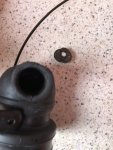
So here's an update. While flushing out the heat exchanger, we went looking for the missing paddle from the impeller. We found it as usual in the boot before the heat exchanger. We then decided to remove the heat exchange cylinder for cleaning, so removed the rear boot attached to the exhaust elbow. Inside that boot was what looked like some sort of restricter, but on further examination it popped out, and I attach photo of same.
It looks hard, but will break with a little finger pressure. We have no idea what it is, or how it got there. Is there any reason why an engineer would place such a restricter in the boot just before the exhaust elbow, or is it a build up of some form of dirt/shale etc., ?
Thanks again.View attachment 151322