Volvo penta Exhaust Elbow

Jon magowan

Well-Known Member
Joined
23 Jan 2023
Messages
155
Visit site
I’m thinking of changing the elbow on my Volvo Penta D1-30f.
It’s working fine and has about 550 hours on it, but I have read in so many places that these things get coked up leading to overheat problems etc.
It looks like there are stainless steel versions as well as cast iron versions out there.
Which should I go for ?
If I go with stainless are there any issues with galvanic corrosion?
Is it feasible to clean up the original elbow or is that not a practical option ?
If I did clean it, what is the best way to do that ?

As always, many thanks in anticipation………
 
You can try cleaning it, but if those hours are over a long period of time (over 5 years ) then you may well find that it is well coked up and when you start poking around you may well break through the wall. However you don't know until you get it off.

Stainless every time. This one has an isolating gasket to minimise chances of corrosion, although stainless and iron are fairly happy together. parts4engines.com/volvo-penta-d1-30-stainless-steel-exhaust-outlet-kit/
 
Thanks Tranona. That’s exactly the sort of response I was hoping for. Yes, the boat is 10 years old and I’m thinking it’s not a simple job to get it off simply to check it, so might as well go the whole hog and change it.
Stainless ? Makes sense to me !
 
I’m not convinced that a stainless one is a good idea when mated to a cast ali heat exchanger - see my post here: Volvo Penta Heat Exchanger corrosion poll - please help
If you are going stainless then do use a non-metallic gasket.

Regardless I wouldn’t have a fabricated stainless one again due to the weld cracking, cast stainless elbows are available for my engine (MD2020). Whatever you decide do check the mating face of the heat exchanger for corrosion whilst you have the elbow off.
 
Thank you Mike. Really useful feedback. All this stuff is new to me so any input is appreciated. So much to learn 😳‼️
 
I’m thinking of changing the elbow on my Volvo Penta D1-30f.
It’s working fine and has about 550 hours on it, but I have read in so many places that these things get coked up leading to overheat problems etc.
It looks like there are stainless steel versions as well as cast iron versions out there.
Which should I go for ?
If I go with stainless are there any issues with galvanic corrosion?
Is it feasible to clean up the original elbow or is that not a practical option ?
If I did clean it, what is the best way to do that ?

As always, many thanks in anticipation………
Different engine but I changed my VP cast iron elbow at 21 years 1300 hours. Mine has a stainless insert so the seawater is injected between the stainless and the cast iron. I only changed it due to the difficulty of removing all the crud in the void between the two metals that was restricting the water flow. There was no significant corrosion and have cleaned it as best as i can for a spare. Based on this experience the new one was the same cast iron design which avoids the risk that some people have with weld failures on the fabricated stainless ones.

www.solocoastalsailing.co.uk
 
Different engine but I changed my VP cast iron elbow at 21 years 1300 hours. Mine has a stainless insert so the seawater is injected between the stainless and the cast iron. I only changed it due to the difficulty of removing all the crud in the void between the two metals that was restricting the water flow. There was no significant corrosion and have cleaned it as best as i can for a spare. Based on this experience the new one was the same cast iron design which avoids the risk that some people have with weld failures on the fabricated stainless ones.

www.solocoastalsailing.co.uk
The stainless elbows for the D1 30 in question are cast rather than fabricated. The issue is potential corrosion between the flange and the aluminium heat exchanger housing which happens with the standard iron one and might be worse with stainless. The stainless one linked to earlier comes with an isolating non metallic gasket which should reduce this possibility.
 
I think the point made about the fall of exhaust hose from the elbow is a good one. I find it surprising that so much corrosion occurs upstream of the water injection point. The inner tube described by Plum also seems a good method of reducing water backflow. Yanmar welded ones are made this way but they fail by thermal fatigue.
 
Hi
On my md2020 changed cast iron original exhaust elbow to stainless after 13 years 2120 hours no corrosion on mating face of heat exchange I filted new standard penta gasket, I dont know what material.
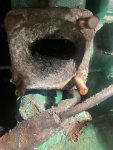
Now 6 years later and an additional 1300 hours heat exchanger mating face etc totally corroded as photo. Luckily have located cheap newish hear exchanger but am reticent to purchase another stainless elbow. What do you think is best stainless or iron? Thanks. Jerry1228597d-46b5-4274-a849-e1edf08c2805.jpg
 
Hi
On my md2020 changed cast iron original exhaust elbow to stainless after 13 years 2120 hours no corrosion on mating face of heat exchange I filted new standard penta gasket, I dont know what material.
Now 6 years later and an additional 1300 hours heat exchanger mating face etc totally corroded as photo. Luckily have located cheap newish hear exchanger but am reticent to purchase another stainless elbow. What do you think is best stainless or iron? Thanks. JerryView attachment 153226
Wow, looks exactly like mine did. To be fair there are many horror stories like this with cast iron elbow so it’s hard to be definitive.
 
Top