Volvo oil pressure gauge deviation

Kingruar

Member
Joined
15 Jul 2017
Messages
38
Visit site
Hi All,

Finally got my new addition (thanks to your help)
With the new purchase, onto the fresh start approach. New filters, oil & fuel, filter change etc.

Then onto the first sea trial. I did notice that both lumps were hitting approx 80 - 85 psi on oil pressure, pooping pants time!
So whilst going through general fixes and assessing true oil levels (I may have overfilled)

So today whilst assessing oil levels, I have noticed that on the ignition switch, if I drop the key down one stage which drops the alternator off, the oil pressure gauge also drops by a bit say from 60 psi (cold idle) to say 45psi.
So my issue is, at what stage are my gauges correct? (Oil pressure gauge immenant).
I am presuming that I am getting some sort of electrical surge through the gauge and the true reading should be noted with the alternator off and assume that the gauge is offset by say 15 psi when all systems are on.

If I rev the engine with the ignition on then I get a surge of pressure heading towards the 90 area. If I do it with the ignition off, it will creep to 60

These are 2 Volvo TAMD-41p

area.https://youtu.be/N_QxdAphBJY

Please see video. Cheers !
 
The problem with boats and oil capacity is the inclination of the sump and the position of the dip stick .Plus it’s calibration .
Some calibrate them some do not .
Second is actually how the oil is removed .If it’s sucked out from a dip tube 1/ 2 way across the sump length and the engine is tilted then a certain amount , the bit below the central dip tube will remain .
Always put back the same volume you remove for starters with Volvos .
eg for the sake of easy maths if the book says 10 L and 2 lurks in the inclined pocket and you suck it out =8 L without measuring , sump it and toss a fresh 10 back in then it’s now got 12 , 20 % more overfilled .

Having said that can’t see overfilling actually bumping up pressure that much as the pump just fills , once it’s maxed it’s maxed and the surplus is just dumped back in .
Crank re breather might blow out a bit and over oil the induction apparatus .

The true reading should be when it’s running which means the alternator running .
Here are my readings.
Yours are not that far away .
Our boat has its change pumps fitted at the lowest part of the sump the engines are tilted for shafts .
The exact “ book “ vol comes out fortunately we measured it .

2B70A131-5E25-47BF-A38B-5A1A26D0AC4A.jpeg
4.9 bar is 71 psi .^

AB2B2E11-127E-4BEE-9D15-2674B8240EDD.jpeg
2.7 bar is 39 psi .

The low speed pressure is the most important as you do not want the crank journals drying up
 
Thanks portofino for your reply.

So you are running lower pressures than where I ideally want to be. The only thing I guess is to find out where others with the same engines are running. If everyone is running with 80 odd psi underway then that's good with me, a quirk of the engine I guess.

I am just cautious as these are new to me so I'm trying to get used to them. Little vibrations etc. The boat has seemingly been running fine before purchase so I'll assume all was in good order. Loads of paperwork to back it up. I just don't want a detonation or failed engine when out.

I have took approx 3 litres out of each so I'm halfway on the dipstick. Now and only dropped a little pressure.

The only thing that bothers me is if I can't cut out the alternator, how am I able to get a reading of the gauge?

I have read about engine flushes etc. Something I'm not really keen on doing as I don't want to open up something that is sealed with gunk. But it maybe my only option. Plus I'll have to replace all that lovely new oil ££££
 
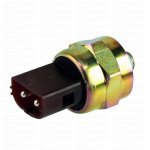
That pressure sender is in a right tight space. Luckily I can get myself next to it. I take it I have to undo it with a stUmpy spanner? I don't suppose you can twist the body off can you?
 
So today whilst assessing oil levels, I have noticed that on the ignition switch, if I drop the key down one stage which drops the alternator off, the oil pressure gauge also drops by a bit say from 60 psi (cold idle) to say 45psi.
So my issue is, at what stage are my gauges correct? (Oil pressure gauge immenant).
I am presuming that I am getting some sort of electrical surge through the gauge and the true reading should be noted with the alternator off and assume that the gauge is offset by say 15 psi when all systems are on.

If I rev the engine with the ignition on then I get a surge of pressure heading towards the 90 area. If I do it with the ignition off, it will creep to 60

These are 2 Volvo TAMD-41p

Please see video. Cheers !

When the alternator is running the system voltage could be as high as 14.4 volts. When the alternator is disconnected the system drops to about 12.8 or less. The is bound to affect certain systems. The overfilling will not affect the oil pressure. This is determined by the setting of the internal oil pressure relief valve.

It is easy to see what this is doing. With the engine warmed up and idle note the oil pressure. Rev the engine up slowly watching the oil pressure.. Note if it stops rising before you reach full speed and then stays steady for further speed increases or does it continue to rise till full speed. ( With Alternator connected) Do with both engines. Let us know how you get on.
 
  • Like
Reactions: vas
I have the same engines, running oil pressure when warm is around 4 bar, the analogue gauges aren't precise enough for more specific figures, although one appears to be slightly higher than the other. Cold, on starting, they're around 5-6 bar.
 
I have the same engines, running oil pressure when warm is around 4 bar, the analogue gauges aren't precise enough for more specific figures, although one appears to be slightly higher than the other. Cold, on starting, they're around 5-6 bar.
That is the pressures I would expect and be happy with. Also about the pressure the OP gets when running at battery voltage.
 
B28596C0-EBDF-426E-A5F5-86BA217EA6BA.jpeg
you can use a long socket…the sort used for wheel nuts etc…but be gentle. The thread into the engine is like 1/8npt of something
 
Last edited:
You might be over worrying .
Fresh oil regularly + filter is all you need .
1 / 2 way between the marks imho is also the way to go .This is because with “ marine “ at rest ie the boats sat in a Marina for weeks something might be leaking into the oil , ie a failed oil cooler seeping back in .The level will rise .
With 1/2 n 1/2 regime you should spot it doing your pre start checks .

When it’s running it’s a bit late as the oil P exceeds the coolant P and oil pisses out into the closed coolant …..not good .
Checking coolant levels is also a good idea after a long ish halt .If it’s low after checking the bilge for coolant , and the dip stick mark is increased - Hmm ?

Too much pootling that’s running high speed planing boats at D speed say 1000 rpm or worse lower all day for days on end is not good .The rings never seal properly because they are designed to expand to achieve the optimal seal at sat 500-650 degrees not 250-300 degrees .
The oil leaks past and is consumed.This eventually knackers the tips of the injectors , minute holes get clogged with poorly burnt oil + fuel .
So The oil level starts to drop .The bilge is dry and the white ( or green ) paint unmarked - ie no leaks .

How ever with old school mech pumps the fuel amounts are high at low rpm s so the fuel air mix gets cocked up and indeed prolonged running leads to excess diesel washing the bores and the direction of travel of fluids is the other way downwards .
Surplus fuel gets down past the poorly fitting rings and is dissolved into the oil .
So the dip mark rises .But and it’s a big but the oil gets knackered loosest it lub capacity and additives are destroyed as more and fuel is dissolved in .Bearings are at risk of a premature end .They basically get the lub ness washed off = get hotter than normal and wear faster .

With modern electrotwackerey ECUs running the show the fuel amount is reduced to go some way to cross compensate .
So the modern CR / EDC guys kinda get away with this aspect but not the poor ring seal ,oil getting up into the combustion chamber point .

So they run the risk of shortening the injector tip life .This is because CR tips have multiple even smaller holes to optimise spray patterns .A shed load of burn’t sump oil , more than tolerance is doing those cannuli no favours .
Also this may lead to catastrophic tip failure later when / if they decide to run them hard because all that accumulated extra carbon stuff sticking to the tightly machined tip leads to the thing overheating and melting it tip off , which intern leads to fuel hosing and a piston melting a hole in it .So much fuel now sprays out and burns at near WOT or what ever high rpm they now run , the temperature exceeds the melting point of the piston. Again not good .

So just operate them as designed by the boat builder The engines have been carefully matched by the manufacturer to suit the brief .
The manufacturers issue a kinda guide of load vs hrs .You can go slow and equally at WOT , but within the guides , the rated guides .
 
Thanks guys ?

Ill take her out for a run tomorrow morning (hangover depending) and have a play.

I'll also do an ohm reading directly off the sender and match it to what's expected at any reading, I've found a previous post on here with that info
That way I can see if there is a change in the wiring or if the 14.4 is affecting anything.

The sender has a larger body that the plug goes into before the nut feels like 15 / 17mm kinda sized.
My current gut feeling is that it's the 14.4v boost that's somehow affecting the ground this the reading. Well I'm hoping!!

Also crusing RPM to be around 3400 giving me approx 15/16 knots. Again still getting used to it.

I'm religious for annual filter and oil changes so hopefully will flush out by products in the meantime.
 
Last edited:
There's a thread I started some time ago a year or more most likely.
Bilgediver nails it. Dash gauges are powered from engine and obvs move from 12-14+V. That it the trigger/exciter/power call it as you wish voltage sent to the sender. Gauge measures voltage drop based on resistance of the sender due to different pressures dealt.
This means that pressure may fluctuate up to a bar.
Being slightly anal, ended up using buck converters to feed the gauges with cleanish stable voltage. Defo ott, I know

V
 
These are isolated return senders too so corroded connections on the loom plugs can easily throw things out.

If you have access to a different ve- source behind the dash (not coming from the engine/dash loom), connect that to the oil pressure gauge ve- and see what changes. Also…turn the gauge illuminations on and off to see what that does.

Id still get a a manual oil pressure reading just for piece of mind….so then you know it’s defo an electrical issue
 
  • Like
Reactions: vas
Hi All,

Finally got my new addition (thanks to your help)
With the new purchase, onto the fresh start approach. New filters, oil & fuel, filter change etc.

Then onto the first sea trial. I did notice that both lumps were hitting approx 80 - 85 psi on oil pressure, pooping pants time!
So whilst going through general fixes and assessing true oil levels (I may have overfilled)

So today whilst assessing oil levels, I have noticed that on the ignition switch, if I drop the key down one stage which drops the alternator off, the oil pressure gauge also drops by a bit say from 60 psi (cold idle) to say 45psi.
So my issue is, at what stage are my gauges correct? (Oil pressure gauge immenant).
I am presuming that I am getting some sort of electrical surge through the gauge and the true reading should be noted with the alternator off and assume that the gauge is offset by say 15 psi when all systems are on.

If I rev the engine with the ignition on then I get a surge of pressure heading towards the 90 area. If I do it with the ignition off, it will creep to 60

These are 2 Volvo TAMD-41p

area.https://youtu.be/N_QxdAphBJY

Please see video. Cheers !
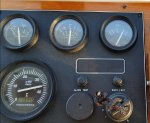
I have the same engine (just the one!) and the picture below shows my instruments. Are you saying that you turned the ignition switch back one notch while the engine was running? You should not do that as it may ruin your alternator. All gauges should be expected to read correctly with the ignition switch in the usual "run" position. Over filling the oil will not affect pressure but is not good for your engine if seriously over filled. Are you aware of the false oil level you can get with the dipstick on this engine? Sometimes when you extract the dipstick there will be no oil on it at all! Don't start adding lots of oil. Wait a minute, put the dipstick fully in and remove it to reveal there was oil there all the time. Because there is an O-ring sealing the top of the dipstick and the tube goes to the bottom of the sump the oil level in the tube stabilizes only when the dipstick is first removed and reinserted.

20210821_203319.jpg
 
At cruising revs (3krpm) my TAMD41P runs at a reported 85psi and has done since I bought it. Drops to around 30 at idle when hot. All seems to be ok.
 
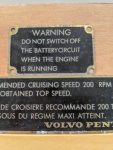
Couldn't attach this earlier as I was on my tablet with poor internet connection, but Volvo specifically states not to switch off the battery circuit when the engine is running, (which you appear to have been doing). the photo shows the label on part of my panel.

warning small.jpg
 
Hi all,

An update of the last week.

Put an oil pressure test kit on the block where the oil pressure switch is located.
Sure enough the the pressure gauge matched the reading of the pressure gauge on the dash. So pressure sender failure has been eliminated as well as gauge reading.

So, still higher readings than I would like. (60 psi cold idle) 85 psi under load ( 3400rpm). Eventually 30psi+ (ish) once warm.

I couldn't figure out why the readings were so high, but a combination of other people having the same running pressures and others basically saying don't worry about it, I decided to do a 50 mile round trip.

During the first 25 mile leg,I nursed the engines(3000 / 3250 rpm) whilst keeping an eye on temps and noises. Everything seemed fine. Once coming into port and ruining just above tickover,I was at a smidge over 30psi. So low pressure side of things,I'm good. How it's getting to 85 is beyond me.
Return trip made and all good.

So I have engines that seem to running fine, just displaying high pressures. The fact that others are running at the same psi tells me to do a number of things.

1. Leave it alone, monitor it and enjoy.

2. Assume oil filters are not providing the correct gph rating. Source some alternative filters (Mann)with a higher gph rating hoping that the issue is with the flow inside the filter.

3. On next oil change, run an engine flush. Although need advise on this as I don't want to do damage. Anyone have any good results?

4. I could employ a marine engineer to investigate but figure this would lead to long hours to diagnose potentially resulting in an engine out job. Very reluctant and this stage as it's working!
 
What’s the exact oil make and viscosity that went in ?
Did you eye ball it being poured ? .

Pressure increases when cold and with thicker oil .
Pressure decreases with thinner oil and hot oil .
 
Maybe the OP doesn't believe what he was told elsewhere. :)

https://boatdiesel.com/Forums/index.cfm?CFAPP=0&Forum_ID=83&Thread_ID=71869&Search=2&SR=21

(See the bottom of the page.)

It is also mentioned elsewhere on this forum that the oil pressure relief valve can be adjusted to obtain the desired oil pressure as on most engines and on the 41 the relief valve is mounted on the oil pump body . It seems however that 90 PSI is not considered abnormal. It certainly would not concern me if it was my engine, particularly if it got thrashed from time to time when all that oil leads to more cooling of hot surfaces.
 
Technical manual say normal oil pressure range hot oil at operating speed is 59.7–92.5 psi

I’d move on with life now you know the real figures via the manual gauge check
 
Top