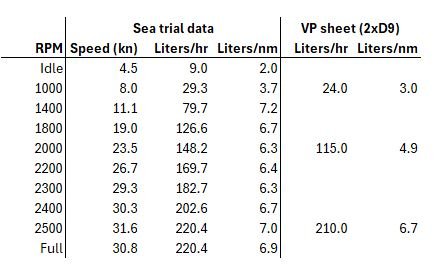
Volvo D9 575 - Full revs / fuel usuage real world

Last edited:
Hi this is an older post so hoping folks still around to comment.
We also have a T47 with D9-575 and generally cruise at 1900 RPM or 20knts.
I found the report surprising in that the efficiency as measured by l/NMi seems to be about the same or better at 2400 RPM or WOT? that seems counter-intuitive no? 1900 feels like a steady cruise whereas 2400 feels like it should be a lot less efficient in terms of fuel for distance covered. This is the case on our other boat where much more than 20kts becomes a gas guzzling exercise that is not offset by additional speed. Am I missing something?
 
Hi this is an older post so hoping folks still around to comment.
We also have a T47 with D9-575 and generally cruise at 1900 RPM or 20knts.
I found the report surprising in that the efficiency as measured by l/NMi seems to be about the same or better at 2400 RPM or WOT? that seems counter-intuitive no? 1900 feels like a steady cruise whereas 2400 feels like it should be a lot less efficient in terms of fuel for distance covered. This is the case on our other boat where much more than 20kts becomes a gas guzzling exercise that is not offset by additional speed. Am I missing something?
Yes it is a bit counter intuitive. I had a Sealine T50 with D9 575s. That was most economical at 23 knots. Then again 160l/hr doesn't "feel" very economical.
 
Yes it is a bit counter intuitive. I had a Sealine T50 with D9 575s. That was most economical at 23 knots. Then again 160l/hr doesn't "feel" very economical.
It seems too good to be true. Everything I have ever been told is that going faster than a cruising plane is "expensive" aka no efficient. 23 its is reasonable fro a 50' boat to cruise efficiently but never heard of a 47' boat be remotely efficient at WOT doing 32 kts. Something not adding up for me, is this really what people experience? if so I have been driving way too slowly and wasting a lot of time in an attempt to be economical.
 
Comparing the sea trial report data with the generic VP spec sheet for the D9-575hp (link), it seems the fuel consumption figures differ significantly, which may be why you're confused. According to the fuel consumption chart in the VP sheet, the engine consumes c.12 liters/hour at 1,000 rpm, c.57.5 liters/hour at 2,000 rpm, and c.105 liters/hour at 2,500 rpm. Comparing these figures to the average consumption and speed figures reported on page 5 of the sea trial report, the difference at 2,000 rpm is particularly notable:
RPM comparison.JPG

VP D9-575hp fuel consumption chart:
VP D9 fuel consumption chart.JPG
 
Last edited:
I have had real time file monitoring on several boats.

1. The lt per nm is always pretty flat until you get right to the top range. Maybe 1lt per nm different. At the top end it falls off and gets worse.

2. They have different sweet spots. My squadron 65 the lowest lt per nm was 29 kts.

Just fit fuel monitoring. It is cheap.
 
I have had real time file monitoring on several boats.

1. The lt per nm is always pretty flat until you get right to the top range. Maybe 1lt per nm different. At the top end it falls off and gets worse.

2. They have different sweet spots. My squadron 65 the lowest lt per nm was 29 kts.

Just fit fuel monitoring. It is cheap.
I’ll start by admitting that the boats I’ve sailed did not have real-time fuel consumption sensors, so my personal knowledge and experience on this topic are limited. However, I was surprised by the liters/nm data from the sea trial report, as well as your observation in point 1. I don’t think it’s trivial that the Targa 47 should show this kind of downward-trending/flat fuel consumption (liters/nm) between 1400 and up to 2500 RPM. I would maybe expect that in very high-speed planing, surface drive, or jet-type boats. But for the typical shaft-drive sports cruiser or flybridge, the relationships between fuel consumption and RPM/speed and between speed and drag on the boat is both non-linear. I agree that most boats will have these certain RPM levels that are less efficient, in my experience its often somewhere between pootling and cruising speed, but I always believed as a general rule of thump that the slower you go, the longer the total range (higher efficiency).

Regarding your point 2: I imagine that at 29 knots in your Squadron 65, you must be close to WOT. If that was indeed the most economical speed (presumably you mean above cruising RPM levels), it suggests to me that this particular boat/hull was maybe just performing poorly at speeds closer to cruising?

Now, I don’t pretend to be an expert on the subject, but it’s interesting to me, so I’m definitely keen to hear about other experiences and opinions on this!
 
Last edited:
The overall interaction of how much hull is in the water , the impact on the bow angle and the impact of any hull chines etc is complex ( and not known to me ) but it is what it is !

Get real time fuel monitoring. On my current boat squadron 58 now down ( so tabs fully down ) leads to lower fuel burn per nm as to impact of running flatter outweighs the drag. Again it is what it is.

Boat loading will also play a part as will a large rib and a gyro on the back !
 
Top