
Volvo 2003 rev-counter problem on Moody 31

AntarcticPilot

Well-Known Member
Joined
4 May 2007
Messages
11,119
Location
Cambridge, UK
www.cooperandyau.co.uk
Last weekend, when I started up the Volvo 2003 on my Moody 31, the rev counter did not work. I immediately checked that the alternator was working (it is), and on inspection both at the rev-counter and at the alternator I couldn't spot any loose wires. I will repeat this last check with the wiring diagram in hand next time I'm on the boat - it is still the most likely cause. The control panel is the simple kind - three buttons (on/off, alarm test and engine start), with indicator lamps for oil pressure and temperature and a rev-counter (no hour meter).

Any other ideas as to things I could check?
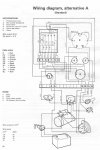
 
Last weekend, when I started up the Volvo 2003 on my Moody 31, the rev counter did not work. I immediately checked that the alternator was working (it is), and on inspection both at the rev-counter and at the alternator I couldn't spot any loose wires. I will repeat this last check with the wiring diagram in hand next time I'm on the boat - it is still the most likely cause. The control panel is the simple kind - three buttons (on/off, alarm test and engine start), with indicator lamps for oil pressure and temperature and a rev-counter (no hour meter).

Any other ideas as to things I could check?

Are you sure your VP2003 doesn't have a tach sensor near the oil fill cap?

https://www.dropbox.com/s/ul4q4iyqt4jhn58/VP 2003 Engine & Dash Wiring.pdf?dl=0

https://www.dropbox.com/s/6mudjj9eplvtgjf/VP 2000 Dash Manual.pdf?dl=0

Cheers/ Len
 
Last edited:

No, I'm not, though I thought mine took the tachometer pulse from the alternator. Certainly when I've had trouble in the past with the alternator retaining bolt shearing, the immediate symptom was the rev counter not reading. I think mine is like this:
wiring.jpg
 
OK, I've been to the boat with circuit diagram in hand.It still isn't working, but I've made the following observations:

1) The tachometer is fed from the alternator, not from a separate sensor in the cylinder block; i.e. it is according to the diagram I posted, not the one Len Ingalls (thanks, Len!) posted. But it was good to eliminate the possibility of another system.
2) All the connections to the alternator are fine, and I have continuity to the plug at the engine where the wiring loom leading to the instrument panel connects to the engine electrics. The alternator is charging the batteries.
3) There is 12V to the back of the rev counter (black and red/blue wires on the diagram above). I was not able to check the output from the alternator at that end; I couldn't figure out how to undo the plug at the back of the alternator (I didn't want to pull too hard without being sure it just pulled out!)
4) A voltmeter connected between the tachometer output from the alternator and the cylinder block gives a fluctuating reading around 6V. I presume this is the best it can do with a pulsed output!
5) Everything else in the instrument panel is working, suggesting that the wiring loom from the engine to the instrument panel is OK.
6) I unplugged the wiring loom at the engine end and the connections all appeared clean and otherwise OK.
7) There isn't the slightest "kick" on the needle of the rev-counter, no matter how hard the engine is revved. In fact. the needle doesn't move under any circumstances.

Where do I go from here? At present I suspect the rev counter itself is dead, in which case I don't suppose Volvo make their own, so does anyone know if there's a direct replacement? I'll post photos tomorrow.
 
I have a key start. Sometimes the rev counter hasnt kicked in because the key hadn't returned to the normal position after starting the engine. A wiggle of the key did the job. A later squirt of WD40 has solved it long term. If it does it now then a good rev wakes it up. So you have found 12v on the back of the rev counter but how about after starting the engine.
 
I think this is a common problem with Volvo rev-counters. They just die.
I've had to change mine, but used a generic one and a flange to allow it to fit the original same panel.
 
If your revcounter is broken it may be cheaper to have it mended - here is a firm in your area - obviously I can't make any recommendations but it's worth having a wee google about and making a few phone calls:-

http://www.jdo1.com/rev_counters.html

I know you live in another country but that firm is in Keighley, W. Yorkshire (almost another country). ;-)
 
You have done a very thorough check.
The intermittent Ign swx is a definite possibility.
Test for 12V at tach with eng. running.
If no joy after above-
With power off,use ohmmeter to check for some continuity between tach alt. input & neg @ tach with input wire disconnected.
I don't know for sure but I think you should see some continuity-even high resistance.
Possibly tapping the ohmmeter lead rapidly against terminal may cause tach needle to flutter a bit.
The above suggestions are a last ditch effort to prove tach. & are "guesswork"
 
Where do I go from here? At present I suspect the rev counter itself is dead....

You could apply 6V at between 200 and 500Hz to pin 13 of the panel connector (Pin 1 = +12V and Pin 16 = 0V). Maplin sold an oscillator as one of their 'experiment' kits that does the job. (I have a whole panel test box, but, as said previously, Cornwall is yet another country - so not a convenient solution.)
Attached is a diagram of the test box circuit.
Good luck
Bob

View attachment VP panel test box.pdf
 
Last edited:
Another case where an oscilloscope would be handy; they are so cheap now it's almost a no-brainer.

Measuring with an oscilloscope I got around 17V peak to peak at the tachometer terminal, but this depends on your alternator; testing at home the tachometer worked down to about 8V. You may well have sufficient voltage, but meters can vary, even on the AC range.

I do know that the motors can burn out, they get noisy first but of course you can't normally hear them.

I've got a test rig at home that can prove it faulty, happy to test it for you. If you can source a donor unit I can easily put a new motor in.
 
Last edited:
...Where do I go from here? At present I suspect the rev counter itself is dead, in which case I don't suppose Volvo make their own, so does anyone know if there's a direct replacement? I'll post photos tomorrow.

If you dont fancy the testing and other proposals made here, ASAP do a range of generic replacements at around the £100 mark - had a look the other day as the hours counter on mine has failed but I'm going to try the OLED/Arduino route for that first
 
I have a key start. Sometimes the rev counter hasnt kicked in because the key hadn't returned to the normal position after starting the engine. A wiggle of the key did the job. A later squirt of WD40 has solved it long term. If it does it now then a good rev wakes it up. So you have found 12v on the back of the rev counter but how about after starting the engine.

Mine isn't a key start, just two push buttons, one to switch the panel on, one to start the engine. As far as I can see, the first simply toggles on/off, and the panel is definitely on after pressing it. The second simply starts the engine!

Tried tapping the glass or revving the engine? Worked for mine.

Tried both - the needle remains rock solid.

You have done a very thorough check.
The intermittent Ign swx is a definite possibility.
Test for 12V at tach with eng. running.
If no joy after above-
With power off,use ohmmeter to check for some continuity between tach alt. input & neg @ tach with input wire disconnected.
I don't know for sure but I think you should see some continuity-even high resistance.
Possibly tapping the ohmmeter lead rapidly against terminal may cause tach needle to flutter a bit.
The above suggestions are a last ditch effort to prove tach. & are "guesswork"

First two addressed above; there's 12V at the meter with the instrument panel on - not sure if I tried with the engine running, but I don't see why it should be different, according to the wiring diagram. Problem with the wiring diagram is that the function of the PCB isn't clear!

You could apply 6V at between 200 and 500Hz to pin 13 of the panel connector (Pin 1 = +12V and Pin 16 = 0V). Maplin sold an oscillator as one of their 'experiment' kits that does the job. (I have a whole panel test box, but, as said previously, Cornwall is yet another country - so not a convenient solution.)
Attached is a diagram of the test box circuit.
Good luck
Bob

View attachment 59110

Thanks! You may overestimate my electronic ability :o

If you dont fancy the testing and other proposals made here, ASAP do a range of generic replacements at around the £100 mark - had a look the other day as the hours counter on mine has failed but I'm going to try the OLED/Arduino route for that first

No hour meter on mine, but thanks for the heads-up about replacements.

The repair route may be interesting; I'm sure there'll be a place that can look at it near Cambridge.
 
Before condemning the tacho. outright, I'd be somewhat suspicious of the alternator "W" output. A fluctuating 6 volts is maybe not right. For my alternator, ( not Volvo ), a meter reading nearer 9 volts is quoted, AC of course.
My electronics is limited, but I do know, from making a pulse counting circuit for a tacho. that the trigger threshold for operation can be quite sharply defined.
Below that, the instrument is dead.
I'm afraid that I can't think of a simple test for checking the tacho. away from the alternator though.
 
Last edited:
Before condemning the tacho. outright, I'd be somewhat suspicious of the alternator "W" output. A fluctuating 6 volts is maybe not right. For my alternator, ( not Volvo ), a meter reading nearer 9 volts is quoted, AC of course.
My electronics is limited, but I do know, from making a pulse counting circuit for a tacho. that the trigger threshold for operation can be quite sharply defined.
Below that, the instrument is dead.
I'm afraid that I can't think of a simple test for checking the tacho. away from the alternator though.

I oversimplified. By "fluctuating" I simply meant that the reading wasn't steady; I wasn't seeing individual pulses but an "average" of the pulse. So I'd expect a reading somewhere between 0 and 12V, depending on the mark/space ratio rather than anything else. Most of the fluctuation was probably because I was holding the probes on at arms length while avoiding hot or moving bits of metal!
 
AntarcticPilot - If you were closer I'd call over with an oscilloscope and a spare tacho to prove which part is at fault. Tricky to diagnose without seeing the actual signal as received at the back of the tacho. As Nigel says a small oscilloscope is handy for this issue - I think we both have the small DSO oscilloscope on board (available for just over £100).

RobbieW - If you're going down the Arduino Nano route in order to get a working OLED hours display then let PM me if you need a hand with the code. There are two examples that are easy to find online, one which reads the actual parts of the 7 segment display as seen on the I2C wire and replicates the 7 segment bars by displaying the output as multiple point to point lines on the OLED thus simulating a 7 segment display. The other reads the 7 segment bars from the I2C and converts them to a sequence of alphanumeric characters for direct display. The second is the way I went but the code examples were wrong on one character (thus if I remember correctly wouldn't decode the '7' correctly). I seem to remember the code shown online expected the '7' to be received as a character with the upper left bar displayed as well as the top and right hand side bars.
(Please forgive thread drift).
 
Top