Volvo 2003 alarm

crispy

New Member
Joined
16 Oct 2007
Messages
14
Visit site
I have a 18hp Volvo 2003 and am questioning if the alarm buzzer should sound when turn the ignition switch to run position. I thought it did when I bought it last year but now it is silent ( unless I press the test button)

 
I think you will find that the alarm test button is provided because the audible alarm does not sound at switch on.

I am tempted to suggest you read your owners manual but it is rather confusing because it seems to suggest one thing for a keyswitch system and the other for a non-keyswitch system. I don't believe they are really different because they both have the same electronic module which is what controls what happens.

If you want to confirm that the alarm will sound with low oil pressure or high temperature you could try shorting the relevant sensors To the the block if you have a non isolated DC system ( usual for a shaft drive installation) or both connections together with two-wire sensors ( normal for a sail drive installation) Take care though messing about on a running engine with an exposed alternator drive belt
 
I think you will find that the alarm test button is provided because the audible alarm does not sound at switch on.

I am tempted to suggest you read your owners manual but it is rather confusing because it seems to suggest one thing for a keyswitch system and the other for a non-keyswitch system. I don't believe they are really different because they both have the same electronic module which is what controls what happens.

If you want to confirm that the alarm will sound with low oil pressure or high temperature you could try shorting the relevant sensors To the the block if you have a non isolated DC system ( usual for a shaft drive installation) or both connections together with two-wire sensors ( normal for a sail drive installation) Take care though messing about on a running engine with an exposed alternator drive belt
That certainly makes sense as you couldn't operate the test button otherwise. I will check as you suggest. Many thanks.
 
For what it is worth, my VP 2003 28HP sounds the alarm loudly when I switch on the power on the engine panel. The alarm ceases when the engine fires and is running. This seems a sensible arrangement to me, since it confirms that the alarm is functioning each time the engine runs and also, when the engine is stopped serves as a reminder that the engine panel is still powered up.
 
For what it is worth, my VP 2003 28HP sounds the alarm loudly when I switch on the power on the engine panel. The alarm ceases when the engine fires and is running. This seems a sensible arrangement to me, since it confirms that the alarm is functioning each time the engine runs and also, when the engine is stopped serves as a reminder that the engine panel is still powered up.
Thats odd because my understanding of the workings of the electronic module is that it will not sound the audible alarm when the alternator warning light is on , which it is when the panel is first powered up and when the engine is stopped. A no-charge warning when the engine is running will not sound the audible alarm It will, however sound with either a low oil pressure or a high temperature.

It is because the audible alarm is muted at switch on that the panel has an alarm test button.
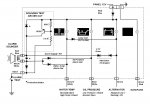
You should be able to figure out from the schematic ( drawn by another forum member, not me) how this all works.

VP electronic module.jpg
 
#2 and #7
I haven't commented before because I was a +1 with Vic. If the panel is unaltered from its original state then the alarm should not sound at switch on.
My 2003 panel no longer follows this rule because I have made use of the unused 4th lamp for a coolant flow alarm (see my diagram in Vic's #7). If no such change has been made to the panel then no alarm should be heard.
I was very confused by the workings of the panel when I bought the boat. It caused me to build a test box - you are welcome to its circuit design if you feel you could use it.
Cheers
Bob
P.S.
Also here's an extract from my personal boat manual prior to my panel modification:-

"Notes on the circuit diagram:

The diode from the temp circuit to the alternator circuit allows the temp lamp to be checked at switch on by connecting it to ground through the alternator (61 lead). This is why the water lamp illuminates as well as the charge lamp if there is a charging fault. It also provides an alternate excitation feed should the charge warning lamp fail.
How the Volvo Alarm Panel works.
In all engine states:-
The alarm sounds ONLY if:-
  • The test button is pressed
or, provided the alternator is generating an output:-
  • Oil pressure is low
  • Water temperature is high."
 
I haven't commented before because I was a +1 with Vic. If the panel is unaltered from its original state then the alarm should not sound at switch on.
My 2003 panel no longer follows this rule because I have made use of the unused 4th lamp for a coolant flow alarm (see my diagram in Vic's #7). If no such change has been made to the panel then no alarm should be heard.
I was very confused by the workings of the panel when I bought the boat. It caused me to build a test box - you are welcome to its circuit design if you feel you could use it.
Cheers
Bob
P.S.
Also here's an extract from my personal boat manual prior to my panel modification:-

"Notes on the circuit diagram:

The diode from the temp circuit to the alternator circuit allows the temp lamp to be checked at switch on by connecting it to ground through the alternator (61 lead). This is why the water lamp illuminates as well as the charge lamp if there is a charging fault. It also provides an alternate excitation feed should the charge warning lamp fail.

How the Volvo Alarm Panel works.
In all engine states:-
The alarm sounds ONLY if:-
  • The test button is pressed
or, provided the alternator is generating an output:-
  • Oil pressure is low
  • Water temperature is high."
I wonder why some people report that the alarm sounds at switch on

There must be power to terminal 5 of the sounder for that to happen.
A high resistance in the alternator field circuit, although that would produce other symptoms such as the alternator being slow to start generating ?
A component failure in the alarm sounder driver circuit ?
Failure ( short circuit) of the diode between terminals 6 & 7 ?
 
Yes Vic - Intriguing!
The answer may lie in an earlier post by Billba which I will have to reread in detail.
Volvo Penta 2000 series owners take a note.
If not and no one has come up with a definitive answer in the meantime, it sounds like an interesting issue to spend some CV19 time on.

Also scottie made a good point in #13 of that 2014 post:-
"From memory there were three versions of earthing on 2000 series
Earth return through the block
Totally isolated return
(******ised )semi isolated that used solenoids to earth the starter when an isolated starter is used on an earth return engine
Throw in at least 2 totally different starter motors
So nothing is straight forward
Best to check which form you have first"
Cheers
Bob
 
CV19 permitting, it would help diagnose why some panels alarm on switch-on, if Kalanka and Contest1 could disconnect both Temp and Oil sensors at the engine before switch-on and check if the alarm still sounds. Disconnecting both these engine sensors deprives the alarm circuit of two of its three return (0V) paths.
Cheers
Bob
 
Thank you for all your advice. Fortunately the boat is on my drive so I can access it to check out your theories and will report back shortly.
 
I might try that but having the alarm sound on power up then off then the engine starts seems too me to confirm that the engine alarm is operational.
Why would I not want this.
Also reminds me to isolate the circuit after use as the alarm sounds when the engine stop is pulled. The panel lights are barely visible in sunshine.
PS. On the earthing point. Mine earth's via the engine block and has both positive and nuteral keyed switches.
 
Last edited:
I might try that but having the alarm sound on power up then off then the engine starts seems too me to confirm that the engine alarm is operational.
Why would I not want this.
Also reminds me to isolate the circuit after use as the alarm sounds when the engine stop is pulled. The panel lights are barely visible in sunshine.
PS. On the earthing point. Mine earth's via the engine block and has both positive and nuteral keyed switches.
I guess VP's logic s to avoid the irritation of the alarm sounding unnecessarily. Of more significance perhaps on later engines with glow plugs. The test button will allow you to test that is is operational .
True though that its a useful reminder to switch off the power after stopping the engine although no big deal apart from the warning lights and tachometer remaining on if your don't.

If your engine has a negative return via the engine block you presumably have a shaft drive , not a sail drive. A negative isolator switch is a bit of a surprise but consider it a bonus.

I think I would check to see if I could find a reason for the alarm sounding when in theory it shouldn't. If it's a fault in the alarm test circuit probably no big deal ... enjoy .
If it turns out to be a bad alternator earth or high resistance elsewhere in the warning light circuit / field excitation circuit it gives you the opportunity to rectify something that could bite you at some later date if it deteriorates
 
I think I would check to see if I could find a reason for the alarm sounding when in theory it shouldn't. If it's a fault in the alarm test circuit probably no big deal ... enjoy .
If it turns out to be a bad alternator earth or high resistance elsewhere in the warning light circuit / field excitation circuit it gives you the opportunity to rectify something that could bite you at some later date if it deteriorates
+1

Contest1 - My suggestion in #12 was in the spirit of diagnosis, not suggesting you permanently alter an arrangement you are happy with. When I investigated oddities in my own panel I found the PO had incorrectly replaced some of the blade terminals and broken the locking ring on the harness connector making for a loose connection and something intermittent. Like you, my alarm sounds when I switch the panel on (and when I stop the engine). I deliberately altered the wiring in this way to add a coolant flow alarm (in reaction to my one and only major engine issue to date which was when the coolant flute tube blocked). I can't see the engine panel from a normal steering position so a loud alarm is my preference.
Cheers
Bob
 
Alarms are designed
I might try that but having the alarm sound on power up then off then the engine starts seems too me to confirm that the engine alarm is operational.
Why would I not want this.
Because alarms are designed to alert you of a problem!

A test button is there to confirm that the alarm is functioning correctly.
 
Hi All, I think I have solved the problem. The plastic screen on the warning lights has become unstuck and let water onto the PCB which in turn corroded the negative wire which was no longer connected to the PCB. Having cleaned and resoldered, hopefully all seems to be working ok with the alarm not sounding on startup. Thanks for you interest and help.
 
Hi All, I think I have solved the problem. The plastic screen on the warning lights has become unstuck and let water onto the PCB which in turn corroded the negative wire which was no longer connected to the PCB. Having cleaned and resoldered, hopefully all seems to be working ok with the alarm not sounding on startup. Thanks for you interest and help.
Thanks for the feed back
Pleased you've restored it to normal working order .................. can't explain it though. :unsure:
 
Top