Volvo 2002 Fuel Filter Changing

Fulmarjon

New Member
Joined
20 Feb 2011
Messages
21
Visit site
I’ve always put off changing the fuel filter on my ageing Volvo 2002. I do other straightforward bits and pieces but usually get someone in to do this for me as I’m not entirely sure what to do to avoid getting air in the system!
However I think it’s about time I changed it myself. Has anybody got a Volvo 2002 engine and if so could you kindly give me a step-by-step guide on how I should change the fuel filter?
Apologies if it is somewhere on the forum already but I have looked and can’t find anything. Many thanks in advance!
 
I’ve always put off changing the fuel filter on my ageing Volvo 2002. I do other straightforward bits and pieces but usually get someone in to do this for me as I’m not entirely sure what to do to avoid getting air in the system!
However I think it’s about time I changed it myself. Has anybody got a Volvo 2002 engine and if so could you kindly give me a step-by-step guide on how I should change the fuel filter?
Apologies if it is somewhere on the forum already but I have looked and can’t find anything. Many thanks in advance!

The fuel filter on the 2002 engine simply unscrews. Screw on a new one, unscrew the little bleed screw on the top plate by a couple of turns, then keep pressing the little lever on the fuel lift pump until bubble-free fuel comes out of the bleed screw. Tighten the bleed screw.

There are pictures in the operator manual, which you can download free from the Volvo Penta website.
 
The fuel filter on the 2002 engine simply unscrews. Screw on a new one, unscrew the little bleed screw on the top plate by a couple of turns, then keep pressing the little lever on the fuel lift pump until bubble-free fuel comes out of the bleed screw. Tighten the bleed screw.

There are pictures in the operator manual, which you can download free from the Volvo Penta website.

Fulmarjon, it really is as simple and straightforward as pvb says. I am confident enough to do simple servicing on my VP 2001.
Have a container/plastic bag (!) at hand to put old filter in. Don't tighten it too much or it may be tricky to undo next time.
 
I'm pretty sure this is the same as the 2003 fuel filter. This is an easy job.

I always start the engine first so that if it doesn't start afterwards I know it's a fuel issue. Obviously stop it before doing this job!
The fuel filter spins off like the oil filter but you may need a filter wrench if it has been on for ages. Keep it upright as it is full of fuel.
Wipe a bit of diesel on the rubber seal of the new filter and screw it in - hand tight is enough.
On the top of the housing nearest you is the bleed screw and that should be loosened a few turns.
On the right side of the engine as you look at it is a lift pump,with a lever you can move up and down. Doing this pumps the fuel through and fills up the filter. Keep going until the fuel coming out of the bleed screw has no bubbles of air. Tighten the bleed screw ( not too hard). If the pump lever is not doing anything then turn the engine over a bit so that the cam inside comes in the right place.
Start the engine, crack open a beer!
 
I assume you also have a primary filter/water trap which you should also change. Slightly different in that the cartridge is on top of the water bowl and held in a stack with a through bolt - undo the nut at the top to dissemble - also, has about three gaskets of different sizes in the stack.
I no longer have a 2002 so have thrown out literature but I do remember the actual bleed screw on top of the (secondary) filter housing is not the one shown on the VP literature I had.
 
I assume you also have a primary filter/water trap which you should also change. Slightly different in that the cartridge is on top of the water bowl and held in a stack with a through bolt - undo the nut at the top to dissemble - also, has about three gaskets of different sizes in the stack.
I no longer have a 2002 so have thrown out literature but I do remember the actual bleed screw on top of the (secondary) filter housing is not the one shown on the VP literature I had.

There's only one filter on my 2003. There is a water trap near the fuel tank - if there's no water or black diesel bug in it then leave it alone.
 
Thank you so much guys for your help. Really kind of you and most appreciated.

TBH some of those tips are not sitting in my manual which is why I’m doubly grateful for your help!

One final point (please excuse my stupidity if it’s obvious) is there any valve anywhere along the fuel line that I need to turn off before I do the job and turn back on again when finished or do I simply start by taking off the old fuel filter as described? Thanks again everybody
 
Thank you so much guys for your help. Really kind of you and most appreciated.

TBH some of those tips are not sitting in my manual which is why I’m doubly grateful for your help!

One final point (please excuse my stupidity if it’s obvious) is there any valve anywhere along the fuel line that I need to turn off before I do the job and turn back on again when finished or do I simply start by taking off the old fuel filter as described? Thanks again everybody
No valve. Just do it!
 
Thank you so much guys for your help. Really kind of you and most appreciated.

TBH some of those tips are not sitting in my manual which is why I’m doubly grateful for your help!

One final point (please excuse my stupidity if it’s obvious) is there any valve anywhere along the fuel line that I need to turn off before I do the job and turn back on again when finished or do I simply start by taking off the old fuel filter as described? Thanks again everybody

The only likely valve is a tank outlet valve. Close it if the fuel level in the tank is higher than the level of the filter in order to stop fuel spilling out while you have no filter in position. Open again when the filter is fitted and before bleeding.

Make sure you have a suitable container to catch the fuel which will leak as you remove the old filter, you will spill when you have removed it and will come out of the bleed screw while you are bleeding it. Some absorbent rag too .. sacrifice some of those worn out grundies.
 
One caveat:

If you attempt to start the engine before completely bleeding the air from the top of the fuel filter, you may get air into the high-pressure part of the fuel system. The most obvious symptom is that you will not be able to start the engine again. Don't ask me how I know.

The remedy is to bleed the air from the high-pressure part of the fuel system. This should really be carried out by two persons, one at the engine and the other one at the engine control panel.

You do this by loosening the nuts of both fuel injectors (for about 1/2 turn). These are located on the top left of the engine, as seen from the side of the fuel filter.

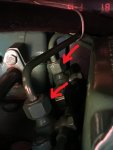
See image... IMG_2373.jpg

Then operate the decompression lever (the lever situated on the front side of the cylinder block just behind the fuel filter) by pointing it "up" to make sure the engine will not attempt to start while bleeding. Put some tissue around the injectors to soak up any leaking diesel fuel.

Ask the second person to crank the engine for about 30-60 seconds. Any air present in the high-pressure fuel lines will now escape at the injectors (accompanied by a bit of fuel). While still cranking, tighten the nuts of the fuel injectors. After tightening, stop cranking and turn off the decompression lever by turning it horizontal again.

Remove the tissues from around the injectors there should be some diesel fuel on them. If not, the injector nuts were not loose enough and you will have to start over.

Your engine will now probably/hopefully start normally.
 
One caveat:

If you attempt to start the engine before completely bleeding the air from the top of the fuel filter, you may get air into the high-pressure part of the fuel system. The most obvious symptom is that you will not be able to start the engine again. Don't ask me how I know.

The remedy is to bleed the air from the high-pressure part of the fuel system. This should really be carried out by two persons, one at the engine and the other one at the engine control panel.

You do this by loosening the nuts of both fuel injectors (for about 1/2 turn). These are located on the top left of the engine, as seen from the side of the fuel filter.

See image... View attachment 78213

Then operate the decompression lever (the lever situated on the front side of the cylinder block just behind the fuel filter) by pointing it "up" to make sure the engine will not attempt to start while bleeding. Put some tissue around the injectors to soak up any leaking diesel fuel.

Ask the second person to crank the engine for about 30-60 seconds. Any air present in the high-pressure fuel lines will now escape at the injectors (accompanied by a bit of fuel). While still cranking, tighten the nuts of the fuel injectors. After tightening, stop cranking and turn off the decompression lever by turning it horizontal again.

Remove the tissues from around the injectors there should be some diesel fuel on them. If not, the injector nuts were not loose enough and you will have to start over.

Your engine will now probably/hopefully start normally.

That's utter nonsense! I never ever had to do that when I had a 200x engine. The Operator Manual actually says "The fuel injection pump is vented automatically when the engine is started".

Screenshot 2019-06-03 at 18.41.58.png
 
That's utter nonsense! I never ever had to do that when I had a 200x engine. The Operator Manual actually says "The fuel injection pump is vented automatically when the engine is started".

View attachment 78216
I must have been really unlucky then. Anyway, I got my 2002 running again immediately by doing just what I described, after unsuccessfully attempting to bleed it in the normal way for an hour or more.
 
I must have been really unlucky then. Anyway, I got my 2002 running again immediately by doing just what I described, after unsuccessfully attempting to bleed it in the normal way for an hour or more.

So why did you try "to start the engine before completely bleeding the air from the top of the fuel filter"?
 
The only likely valve is a tank outlet valve. Close it if the fuel level in the tank is higher than the level of the filter in order to stop fuel spilling out while you have no filter in position. Open again when the filter is fitted and before bleeding.

Make sure you have a suitable container to catch the fuel which will leak as you remove the old filter, you will spill when you have removed it and will come out of the bleed screw while you are bleeding it. Some absorbent rag too .. sacrifice some of those worn out grundies.

If you are changing the separator filter, turn off the tank outlet valve as the filter is below the tank. I still managed to spill the content into the bilges as it's awkward to get to. If you have any specific Fulmar questions the Westerly Owners Association forum is a good starting point https://westerly-owners.co.uk/activity/
 
Bleeding the 2002 is straightforward. The lift pump will work in all positions except one, when the difference can be felt when pumping, unlike later engines which will only work in one position.
 
Bleeding the 2002 is straightforward. The lift pump will work in all positions except one, when the difference can be felt when pumping, unlike later engines which will only work in one position.
FWIW I got tired of using the (perhaps smaller) finger-powered lift pump when bleeding the fine fuel filter as it took ages to bleed my elderly VP MD6.

I fitted a (petrol outboard engine) primer bulb (and a fuel cutoff lever) at the tank outlet. The combo makes changing the fine filter painless - one or two squeezes on the bulb and the bubbles are gone.

The cutoff lever prevents flow of fuel while swapping filters.

I recently changed the bulb after at least 5 years as it was getting hard to squeeze.

Afterwards I tested the old bulb by standing on it - no sign of it splitting.
 
I have a 2003 with the same filter and an engineer told me the easy way to change the fuel filter with no bleeding or pumping needed.
Leave the fuel on, put a container under the filter as you unscrew it to catch the filter and some fuel.(I use an ice cream tub), hold the new filter under the fuel coming out and fill it up then screw it on. I have paper towels ready but it is not as messy as it sounds.
I have done it this way for 12 seasons and the engine always starts first time with plenty of throttle. The engine is self bleeding as said by others.
 
Top