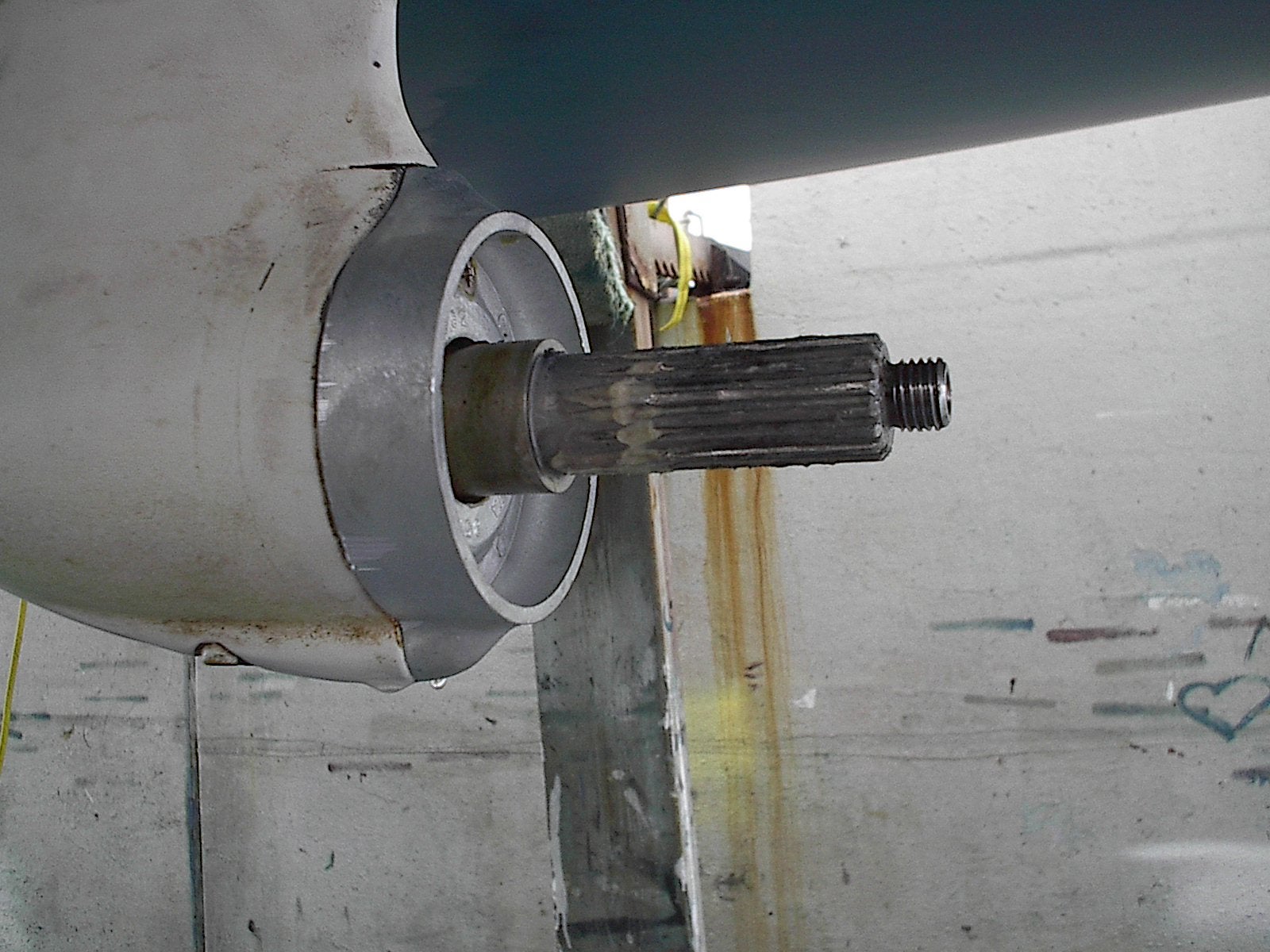
Volvo 120e saildrive

Nope, they're for 130 and up. The 120S-E has the very annoying ring anode (depicted below) that requires taking off the propeller to change - you can't even access the bolts with the propeller on.

There is however an adapter sold by boatzincs.com - and you'll then have to buy their special adapted split anodes, that can be changed in the water. Might get one myself, but haven't figured out if it's compatible with our rope cutter yet (which also requires a modified anode - although just an extra hole).

post-220-1224809173.jpg
 
Have to look into it in that case ,
I asking because I just spend the day under water removing my brumton prop to get to mine Anode when I found it to be loose ,
Brumton prop isn't just a heavy to remove but it has a nut and two bolts which are very fiddly to remove under water .
 
When installing the ring anode on the 120S-E, I put Loctite on the bolts and waterproof grease on the anode around the bolt holes. The Loctite keeps the bolts from shaking loose and the grease keeps the anode bolt holes from eroding away around the bolt. With this, ours doesn't come lose anymore.

Doing this under water would be tricky though. Fluid Loctite won't work, you'd need something like Dri-Loc I guess.
 
Might get one myself, but haven't figured out if it's compatible with our rope cutter yet (which also requires a modified anode - although just an extra hole).

Bit more than an extra hole. The recess is also enlarged to take the body of the cutter.
 
When installing the ring anode on the 120S-E, I put Loctite on the bolts and waterproof grease on the anode around the bolt holes. The Loctite keeps the bolts from shaking loose and the grease keeps the anode bolt holes from eroding away around the bolt. With this, ours doesn't come lose anymore.

Ditto for the locktite, and I screw those bolts in as tight as possible. But I’ve not done the grease around the bolts, because I thought the bolt-anode contact was needed for the anode to be effective.... ie the anode-saildrive contact was not electrically sufficient without the bolt-anode interface (?). I have no expertise hear, and I’m happy to be corrected.
 

Looks like significantly less weight to the anode. The standard is pretty small anyway if you have high erosion. One of the reasons for the change to split ring on the 130 drive was to increase the size of the anode - it is nearly twice the weight. mine is still the original fitted in 2015 and probably needs replacing this winter. However the smaller one on my old 120 drive lasted 7 years in the Med - but out of the water 6 months a year.
 
sailaboutvic, nice find on the UK seller. It seems they're made by Tecnoseal, part number 00706-1 for the anode, PLAC-2 for the adapter kit.

Our anode seems to last two years though, which seems to be our haulout interval for one reason or another (Velox plus wants refreshing after two years, the saildrive wants an oil change, etc.) - so no big pressure to fit the split conversion. If the anode lasted less than the haulout interval, or we'd go further afield where haulouts get more difficult, I'd probably fit the split anode adapter.

Tranona, my worry is that the stainless adapter plates would interfere with the rope cutter body, not the anode itself, which is easily modified with a Dremel cutter/grinder (although a template would be needed if fitting underwater, as you can't just hold it up to there and then grind some more if it doesn't quite fit). Good point about reduced anode area. Point against fitting one unless it saves a haulout.

Venus1, that's why grease is used, not paint - upon torquing up the bolt, the grease will squeeze out of the contact areas, but remain in any gaps where the metals are not quite in touch. Same way grease on battery terminals or other electrical contacts works. So now the electrolyte (seawater) cannot get at these areas and the anode will not erode around the bolts and start rattling around. Just don't smear the whole anode in grease (even a good idea to degrease and gently abrade it before launch - lots of oily paws around saildrives).
 
Venus1, that's why grease is used, not paint - upon torquing up the bolt, the grease will squeeze out of the contact areas, but remain in any gaps where the metals are not quite in touch. Same way grease on battery terminals or other electrical contacts works. So now the electrolyte (seawater) cannot get at these areas and the anode will not erode around the bolts and start rattling around. Just don't smear the whole anode in grease (even a good idea to degrease and gently abrade it before launch - lots of oily paws around saildrives).
Thanks Yngmar, I’ve learnt something, and will use that knowledge to modify my method :)
 
Split anode adapters for Saildrive 120S-E are made by Tecnoseal, part number 00706-1 for the anode, PLAC-2 for the adapter kit.

Haven't figured out if it's compatible with our Ambassador Stripper rope cutter yet.

Answering my own question, for the sake of future web searchers. I've asked Ambassador Marine (makers of the Stripper propeller protector, as it's apparently now called), and their answer was sadly a definite no:

Unfortunately our rope stripper can not be fitted with the Technoseal split type anode as the stainless steel adapter plates prevent the fixed cutter pin from locating into the saildrive correctly.

So that's a no for me - I rather have the rope cutter than the split anode.
 
Top