Viktron Blue Power IP22 Battery charger as power supply

So, to clarify.

I would like to know. Can I use my charger as a power supply (when connected to shore power, naturally) independantly of the batteries? And if so, how is that wired up. Directly to the - and + buses or via the batteries?

You could use it independently of the batteries, but there's no need to, and it would be rather complicated. Just leave it connected to the batteries and use 12v power as you wish.
 
You could use it independently of the batteries, but there's no need to, and it would be rather complicated. Just leave it connected to the batteries and use 12v power as you wish.

which is exactly what i suggeted in #3

Leave it connected as at present. Close the isolator and run 12 equipment in the normal way
 
Thanks again. I felt I did need to clarify that I wasn't expecting a disconnected charger to run my system! Hope you saw the funny side.

No problem Rich.

But I'm still intrigued. You've presumably got a 12V cigarette outlet on the boat or similar? When you plug something into it, either with shorepower on or off, does it not work? :)

Richard
 
No problem Rich.

But I'm still intrigued. You've presumably got a 12V cigarette outlet on the boat or similar? When you plug something into it, either with shorepower on or off, does it not work? :)

Richard

Hi Richard,

No, not when a battery is not present even though the charger is outputing power and the isolator is closed.

I will be down at the boat next weekend so i'm going to check to see if there is a main fuse to the + bus that has blown. Something strange has happened all round as the 240v sockets are no longer working either, yet the charger is receiving power.
 
Hi Richard,

No, not when a battery is not present even though the charger is outputing power and the isolator is closed.

I will be down at the boat next weekend so i'm going to check to see if there is a main fuse to the + bus that has blown. Something strange has happened all round as the 240v sockets are no longer working either, yet the charger is receiving power.

I see the problem. It a bit of an usual one because I doubt many of us have ever tried to use our 12V outlets when there is no battery connected .... I certainly haven't.

In principle I don't see why it wouldn't work from the circuitry point of view. However, the problem might be that the charger will not produce any output if it detects that no battery is connected because it might decide that the infinite resistance is indicative of a failed battery. As you say, switching the charger to power supply mode should produce an output without a battery being connected. If that doesn't work then it does indeed sound like a fuse or switch problem.

Richard
 
I see the problem. It a bit of an usual one because I doubt many of us have ever tried to use our 12V outlets when there is no battery connected .... I certainly haven't.

In principle I don't see why it wouldn't work from the circuitry point of view. However, the problem might be that the charger will not produce any output if it detects that no battery is connected because it might decide that the infinite resistance is indicative of a failed battery. As you say, switching the charger to power supply mode should produce an output without a battery being connected. If that doesn't work then it does indeed sound like a fuse or switch problem.

Richard

RTM

3.7 Can be used as a power supply
The charger will supply DC loads when no battery is connected.


3.3 When a load is connected to the battery
A load can be applied to the battery while charging. Please note
that the battery will not be charged if the current to the load is
higher than the output current of the charger.
Reconditioning is not possible when a load is connected to the
battery.
 
Thanks for the reply Vic. I'm satisfied that my question regarding the 12v system has been answered and will investigate the issues i'm having.

On to my second question regarding the 240v problem.

My 240v system is pretty simple. I have an RCD that distributes power to a couple of sockets but power is not reaching them. Power is getting to the charger from the mains hook up. How do I go about troubleshooting this issue?

Rich
 
Thanks for the reply Vic. I'm satisfied that my question regarding the 12v system has been answered and will investigate the issues i'm having.

On to my second question regarding the 240v problem.

My 240v system is pretty simple. I have an RCD that distributes power to a couple of sockets but power is not reaching them. Power is getting to the charger from the mains hook up. How do I go about troubleshooting this issue?

Rich

You should have a common RCD that supplies everything and circuit breakers( or fuses ) supplying the individual circuits . Most likely one for the charger and one for the sockets.

There fore check the circuit breaker (or fuse) that supplies the sockets.

Check the RCD too just incase only the sockets are supplied from it. ( it would be wrong if there was not an RCD protecting the whole craft , however)

Hopefully yout charger has not been installed without an RCD in its supply
 
You should have a common RCD that supplies everything and circuit breakers( or fuses ) supplying the individual circuits . Most likely one for the charger and one for the sockets.

There fore check the circuit breaker (or fuse) that supplies the sockets.

Check the RCD too just incase only the sockets are supplied from it. ( it would be wrong if there was not an RCD protecting the whole craft , however)

Hopefully yout charger has not been installed without an RCD in its supply

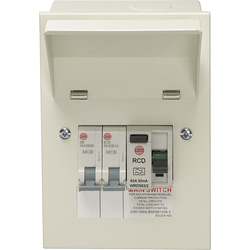
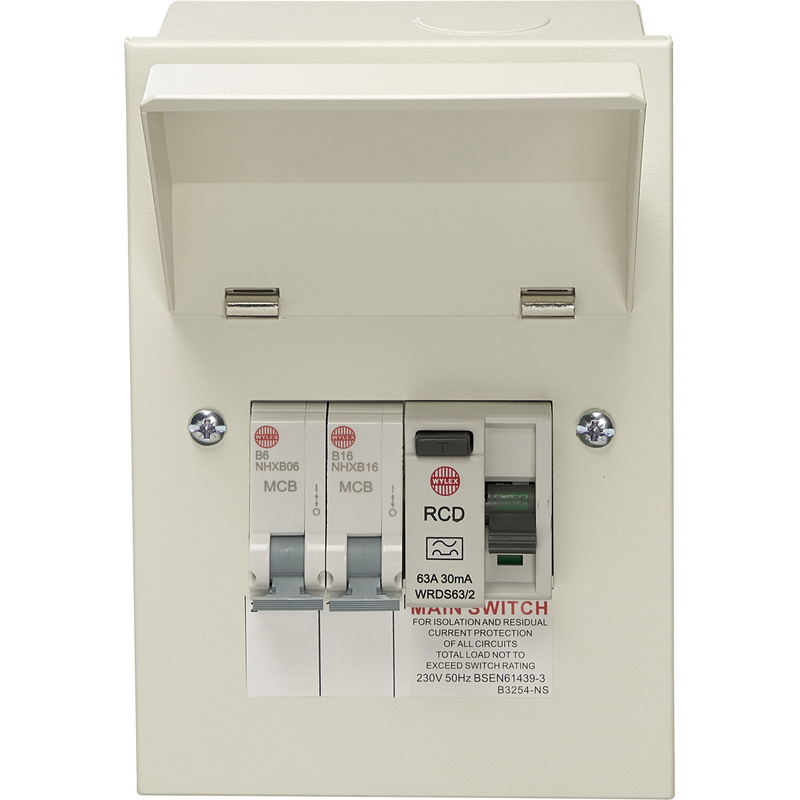
Using this sort of thing, known a s a "Garage consumer unit", is a popular method of providing an RCD and a couple of MCBs for simple shorepower installations

34307.jpg


( we will now get a string of posts explaining the shortcomings etc of such a unit !!!!! )
 
I have an RCD that distributes power to a couple of sockets but power is not reaching them. Power is getting to the charger from the mains hook up. How do I go about troubleshooting this issue?

The fact that you're asking the question suggests that you might be advised to ask a qualified electrician to sort it out. It shouldn't take long, but mains electricity needs treating with respect.
 
You should have a common RCD that supplies everything and circuit breakers( or fuses ) supplying the individual circuits . Most likely one for the charger and one for the sockets.

There fore check the circuit breaker (or fuse) that supplies the sockets.

Check the RCD too just in case only the sockets are supplied from it. ( it would be wrong if there was not an RCD protecting the whole craft , however)

Hopefully yout charger has not been installed without an RCD in its supply

The consumer unit is one of those caravan style, 2 way units with a master switch (as per your image). Do these have a fuse or does the trip do that job?

If I wanted to add another socket, or two would I need a new unit to cover the extra sockets? If I thought the unit wasn't appropriate for a boatthen I would upgrade to something that was.
 
The consumer unit is one of those caravan style, 2 way units with a master switch (as per your image). Do these have a fuse or does the trip do that job?

If I wanted to add another socket, or two would I need a new unit to cover the extra sockets? If I thought the unit wasn't appropriate for a boatthen I would upgrade to something that was.

I am not familiar with caravan electrics but there unit I illustrated has, on the right, an RCD, which is also the master switch , and to the left of that two circuit breakers.
One of which is only rated at 6 amps, and in an outbuilding would probably supply the lighting but in a boat is useful for a charger.
The other is rated at 16 amps which can supply the sockets. There is no limit to the number of sockets but the total power you can utilise is limited to the equivalent of 16 amps ( ie about 3½ kilowatts) Your shorepower supply is probably limited to 16A anyway.

34307.jpg


Worth noting perhaps that the latest IEE wiring regulations ( for buildings) requires enclosures for consumer units etc to be metal ........ Pity if it's for boat use and a darned good reason to keep an old plastic one if that's what you have.
 
Last edited:
I am not familiar with caravan electrics but there unit I illustrated has, on the right, an RCD, which you could consider to be a master switch I suppose, and to the lrft of that two circuit breakers.
One of which is only rated at 6 amps, and in an outbuilding would probably supply the lighting but in a boat is useful for a charger.
The other is rated at 16 amps which can supply the sockets. There is no limit to the number of sockets but the total power you can utilise is limited to the equivalent of 16 amps ( ie about 3½ kilowatts) You shorepower supply is probably limited to 16A anyway.

34307.jpg


Worth noting perhaps that the latest IEE wiring regulations ( for buildings) requires enclosures for consumer units etc to be metal ........ Pity if its for boat use and a darned good reason to keep an old plastic one if thats what you have.

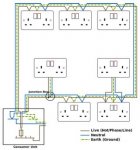
So, no need for an MCB for each socket then. I don't see how it builds up a ring though. Wouldn't the last socket in the circuit need to feed back to the consumer unit? As per the diagram below.

Ring_circuit.jpg
 
So, no need for an MCB for each socket then. I don't see how it builds up a ring though. Wouldn't the last socket in the circuit need to feed back to the consumer unit? As per the diagram below.

yes you could put in a ring, as you illustrate, but not a great deal of point as you will be using a 16 amp mcb rather than a 32 amp one that you would use for a domestic ring circuit. There are a number of criticisms of ring circuits anyway which may explain why they have not been widely adopted outside the Uk.

For a simple boat installation with a relatively small number of outlets a radial system may well be the way to go.
 

Are you telling me to RTM or the OP? If you're telling me to read it then please let me know because my response will be very short and very succinct.

Either way, the section of the manual you have quoted agrees perfectly with my post, so it appears that I certainly don't need to read it, viz, the charger can be switched to a power supply mode as I recommended. What the section you have quoted does not say is whether the charger in battery charging mode will even start to supply current if no battery is connected or whether it will detect a fault and shut down, which is why I specifically covered this point.

Richard
 
Are you telling me to RTM or the OP? If you're telling me to read it then please let me know because my response will be very short and very succinct.

Either way, the section of the manual you have quoted agrees perfectly with my post, so it appears that I certainly don't need to read it, viz, the charger can be switched to a power supply mode as I recommended. What the section you have quoted does not say is whether the charger in battery charging mode will even start to supply current if no battery is connected or whether it will detect a fault and shut down, which is why I specifically covered this point.

Richard

Yes You because some of the things you were saying indicated that you had not read it.

I try to read the mauals when possible before answering questions as that is how i I learn about things but I suppose i am not so clever as you.... I dont instinctively know it all.

The manual says nothing about being "switched to a power supply mode" it merely says what I quoted

There appear to be 5 modes: Normal ( 14.4V), High (14.7 V), Recondition, Li-ion and Night

How do you suggest it is switched to power supply mode. There nothing mentioned in the manual but you seem to now more about the thing than the manual tells.

The manual simply says it can be used as a power supply without a battery being connected. Why on earth would this be stated if as you suggest it might detect a fault and shut down if there is no battery connected?

Climb down off your high horse and read the manul.
 
Last edited:
Yes You because some of the things you were saying indicated that you had not read it.

I try to read the mauals when possible before answering questions as that is how i I learn about things but I suppose i am not so clever as you.... I dont instinctively know it all.

The manual says nothing about being "switched to a power supply mode" it merely says what I quoted

There appear to be 5 modes: Normal ( 14.4V), High (14.7 V), Recondition, Li-ion and Night

How do you suggest it is switched to power supply mode. There nothing mentioned in the manual but you seem to now more about the thing than the manual tells.

The manual simply says it can be used as a power supply without a battery being connected. Why on earth would this be stated if as you suggest it might detect a fault and shut down if there is no battery connected?

Climb down off your high horse and read the manul.

You need to curtail your point scoring and grow up Vic. If your aim is to try and prove to other forumites that you know more than me about internal combustion engines and their ancillaries, I'm afraid that you are doomed to failure. :)

It is totally inappropriate for you to rudely tell me to "RTM" for equipment that is not mine. That is up to the owner of the equipment. If you choose to do the same then that is your decision but to criticise me because I have not done so is pathetic.

The OP owner of the equipment simply stated that his charger can also be used as a power supply. On many chargers this requires a different setting to be selected to avoid the charger detecting a failed battery. The OP then clarified his problem by explaining that he was trying to use the charger with no battery connected (that information being obtained by yours truly asking further questions in an effort to help the OP) but the charger was not producing 12V.

The obvious first point is to check that the power supply setting has been selected, if there is one. If it has been selected, or does not need to be selected, then the problem is likely to be a fuse or switch, as I stated.

I believe that I covered these points in a systematic manner albeit without reading the manual and the OP appeared to appreciate my efforts to solve his problem.

You may wish to consider the above and reflect upon whether I am owed an apology.

Richard
 
Top