
Viking Navigation

Danny_Labrador

Well-Known Member
Joined
13 Oct 2004
Messages
14,189
Location
Harrogate
Visit site
Ancient legends of Viking mariners using mysterious sunstones to reveal the position of the sun on a cloudy day may well be true, according to a new study.

Before the invention of the compass, Norse adventurers travelled thousands of kilometres across the oceans toward Greenland and most likely as far as North America centuries ahead of Christopher Columbus.

Evidence shows that these fearless seamen navigated by reading the position of the sun and stars along with an intimate knowledge of landmarks, currents and waves.
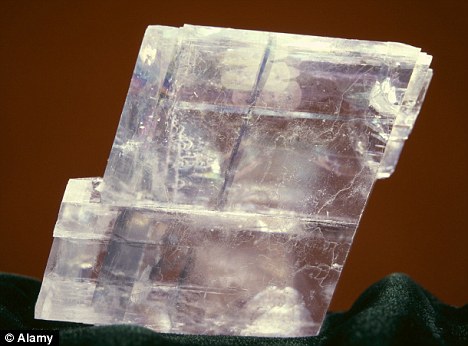
Inventive: A new study claims to have revealed how the Vikings were able to navigate on cloudy days with a sunstone

Inventive: A new study claims to have revealed how the Vikings were able to navigate on cloudy days with a sunstone

But how they could voyage such distances across seas at northern latitudes while hampered by light obscuring clouds and fog remained a mystery.
article-2056479-0EA2446100000578-166_468x346.jpg


Vikings, they argue, used transparent calcite crystal - also known as Iceland spar - to fix the true bearing of the Sun to within a single degree of accuracy.

The naturally occurring stone has the capacity to 'depolarise' light, filtering and fracturing it along different axes, the researchers explained.

The recent discovery of an Iceland spar aboard an Elizabethan ship sunk in 1592 - tested by the researchers - bolsters the theory that ancient mariners were aware of the crystal's potential as an aid to navigation.


More here:-http://www.dailymail.co.uk/sciencetech/article-2056479/Vikings-used-mysterious-sunstone-sat-nav-sail-America.html
 
Interesting. A few years ago a (very skint) Ozzie round-the-worlder showed my a 'sextant' utilising a natural crystal, mounted in a frame which allowed the image of the sun to be taken down to the horizon and the angle noted. He didn't claim to have invented the device, so it must be known to some degree. Whether it might have worked in an overcast or partial overcast I've no idea.
 
This isn't news, it is (to borrow from Terry Pratchet) olds!

Although there is no physical evidence, analysis of the Viking Sagas and other sources has long led researchers to conclude that Norse navigators had crude compasses (made of magnetite) and probably used some form of backstaff (the precursor to the sextant) or even a crude sextant using a natural crystal to fix their position from the sun and stars

They were also masters of the ocean currents and waves, able to read the sea in a way we find hard to comprehend in this modern age
 
However they did it they were great at it.
Trouble is they seemed a bit angry when they got where they were going.

I suspect they were rather happy - it's just that their idea of fun wasn't the same as their victims... :D

The BBC article for it went on about how difficult it would be to navigate without seeing the stars for months - obviously written by someone with no idea of geography...
 
Was it Studland? ;)

Not in this context, the Vikings were good navigators - and from what I've read used magnetised needles floating in bowls as compasses - and the 'pillaging' bit is rather down to a bad press propaganda, I have met their descendants and they were actually traders rather than warriors unless pushed.

They hadn't invented scuba gear or 'conservation as a BBC lifestyle' either ! :rolleyes:
 
From what I read (I think in the Heimskringla) at least one of them took a raven with him. He let it free when out of sight of land and expecting landfall. It would fly around and either come back to the boat, or fly off over the horizon, in which case they'd follow it towards land.
 
My theory is that longships were so unstable in cross seas that they had to keep sailing in straight lines. That's why they discovered so much...
 
The greatest surprise to me on this thread is that no one has suggested that we all ought to carry these crystals in the event of GPS, sextant, astrolabe failure :)
 
Great Navigators they may have been, but they were not daft and did not lose sight of land if they could help it.

The first raid in England was at Sandwich in Kent by Danes who had just sailed down the north European coast and then did a quick hop across.
 
The early history of transatlantic navigation is fascinating. I would thoroughly recommend "The Farfarers" by Farley Mowatt which tells the story of Celtic peoples of either Ireland or Scotland who reached America some 50 years before the Vikings (they were trying to get out of their reach). There is an archaological record which has not been properly documented, partly because it upsets the presumed "First Peoples" Canadian story (even though the Innuit acknowlege that the well lichened, and obviously very old, remains are not theirs).
 
Last edited:
I agree with the sentiment that this is "olds", in Terry Pratchett's inimitable style! I too read the BBC article and wondered what the paper actually said - it has been well known that the Vikings could use Icelandic Spar (clear crystals of calcite) to aid navigation for a very long time!

However, the way these were used was NOT to determine the altitude of the sun, but to allow it's approximate azimuth to be determined in cloudy conditions. Calcite crystals are naturally polarized, and allow the direction of the sun to be observed in overcast conditions, when the sun is not visible. Bees and some other insects can use the same trick; their eyes sense polarization.
 
Colombus who ?

Although in itself a work of fiction, try 'An Old Captivity' by Nevil Shute, which I doubt I am alone in thinking contains many truths.

I believe Viking building remains were discovered in Nova Scotia, and we know they got to Greenland, possibly the greatest Estate Agent's BS of all time calling it that, Eric ! :)
 
Although in itself a work of fiction, try 'An Old Captivity' by Nevil Shute, which I doubt I am alone in thinking contains many truths.

I believe Viking building remains were discovered in Nova Scotia, and we know they got to Greenland, possibly the greatest Estate Agent's BS of all time calling it that, Eric ! :)

Yes, at L'Anse aux Meadows (yes, it is a linguistic oddity). This is the only fully authenticated Viking site in the New Word, though there is evidence that the Greenland Vikings got wood from Newfoundland. There are a variety of other "Viking" remains from North America, but they are all strongly suspected of being hoaxes, mainly because the runes used on inscriptions don't match those known to have been used during the Viking age. Some have definitely been exposed as hoaxes.

I too like the story about Erik the Red naming Greenland! However, having been there I have to say that it actually merits the name in the south west coastal region where the Vikings settled, which is surprisingly green - even though the highest plant is less than a metre tall. Erik didn't know that the inland was solid ice!

PS, I too like "An Old Captivity" - but I'd treat the ancient history as dubious. Some is OK, but the story of Haki and Hekja (which is in the sagas) is regarded as being more to do with Norse story-telling than with history!
 
Last edited:
AntarcticPilot,

I sincerely bow to your superior knowledge.

I wonder what Tim Severin & Sir Robin Knox Johnston think, both having tried Viking boats & navigation ?

That makes me think, even more books to read !
 
Dr David Lewis has done a lot of work on ancient navigational techniques. But it may only be published as papers for the Navigational Institute (err, Society? or what ever the body is called). His sailing books (eg Ice Bird) are worth reading tho.
 
AntarcticPilot,

I sincerely bow to your superior knowledge.

I wonder what Tim Severin & Sir Robin Knox Johnston think, both having tried Viking boats & navigation ?

That makes me think, even more books to read !

Lots of Viking ship replicas have been made and sailed across the Atlantic; the first back in the 19th century soon after the discovery of the Oseberg and Gokstad ships. I recall that the interesting point was that long-ships are sufficiently flexible to "snake" across the waves; the keel is only attached to the ribs by the bottom strakes; the ribs are not directly attached to the keel, and the planking is attached to the ribs by lashings, not "hard" fastenings. The planks are riveted together.

An interesting point, though, is that the vessels used by Erik the Red and co. were probably NOT long-ships like the Oseberg and Gokstad ships; these were war-craft whose primary source of power was oars, no sails. What they probably used were Knarr, trading vessels like the vessels recovered from Roskilde Fjord. A replica of these (the Saga Siglar; sadly no good web-site, though a search will get you plenty of hits including a Norwegian Wikipedia page) has made a circumnavigation, and is actually a much more sea-worthy craft than the Long-ships.
 
What they probably used were Knarr, trading vessels like the vessels recovered from Roskilde Fjord. A replica of these (the Saga Siglar; sadly no good web-site, though a search will get you plenty of hits including a Norwegian Wikipedia page) has made a circumnavigation, and is actually a much more sea-worthy craft than the Long-ships.


Thanks, suspected as much; I never did imagine it was Tony Curtis in a horned helmet !

I seem to remember Sir Robin trying a hand held sun sight job, I'd think everything - including releasing and / or observing birds, and wave formations would be used as aids.

I have often wondered about dowsing too, now this may sound like nonsense or 'black magic' for those who haven't tried it, but I have used it on land many times and it works ( how is a another matter ); always been too busy or forgetful to try it at sea !

There are accounts of early navigators in most races being feared as 'sorcerers', I suppose like anyone who has more knowledge...
 
Top