Viking Anchors have an other model, Odin

The photographs illustrate the problem with Spade anchors:

View attachment 182672

A look around a marina shows most of them are like that, seems to be regardless of level of use. Nor are they simple to refurbish.

A Spade anchor produced by someone else would be good - maybe the Scots who make such a good job of the Knox.

.

.
This corrosion can be 'managed' - grit blasting and or acid washing will remove the rust and the surface will look almost as good as new. There is no flaking of pieces of rust - it seems to be superficial (but its just a picture and the corrosion might be more serious than illustrated).

Galvanising works on clean steel - no rust, no paint. Even a grit blasted steel piece left overnight (during which it will continue to corrode, rust) will not galvanise well. The steel needs to be clean, grit or acid, and immediately galvanised.

The problem is that the Spade shank is hollow and its impossible to see the state of corrosion inside the shank (and the shank is a pretty critical component). The interior corrosion might be superficial - but galvanising will not 'work' on an unclean surface. You could pickle, acid wash, but too much acid will attack the steel and the welds - and even if you acid wash you have no idea how successful might be the practice.

So the interior of the shank cannot be galvanised - it will continue to rust.

From memory the amount of steel used to make a Spade shank is not much different to make an Excel, Rocna etc etc shank. I'd take a high tensile strength piece of steel, like Bis 80 (800 Mpa) and make a new shank from a piece of plate based on a plate thickness of twice the wall thickness of the anchor in question. I'd make it exactly the same profile, but beef up the tongue of the tongue and groove to fit the joint. The shank will then be, effectively the same weight as the old one (so balance the same) but will undoubtedly be stronger. I'd then galvanise the new shank.

Small Spades, upto I think the S80, have simple shanks, not the hollow shanks of the largest models. My idea is hardly novel.

On reflection - the issue is either fashionable or becoming of increasing frequency. I'd do this of any Spade with corrosion as illustrated - I'd not waste my time, money, trying to save the original shank.

You could do this at home - if you can source the steel. All you need is an angle grinder, the thin blades used to cut stainless, some abrasive discs to smooth out the curve + patience and time. When you have the correct shape you will need the joint beefed up (you will need to cut out the 2 needed pieces - and the have them welded). Make the new shank slightly over size at the joint and grind it down to a good fit (remembering the new shank will be slightly bigger (200 microns of gal) Finally you will need to abrade down to bare metal. You might think you need to profile the shank, make it knife like (as per the original) - research suggests this is 'nice' (as in pretty) but technical unnecessary. Just 'buff' the edges, round them off - to accept the galvanising. And round/buff the shackle slot. Then galvanise. Try to abrade back the day before you have it galvanised and oil as soon as you finish abrading, store in a sealed poly bag.

Nice, Pretty - Excel, Supreme work perfectly well with an un-machined shank - the machined shank looks nice, it looks like attention detail, it looks sensible - but a waste of time and money (tests have been done).

Jonathan
 
I have had my Spade anchor galvanised. Extracting the lead wasn't so hard. One of those burners used by roofers that do flat roofs got it our pretty easily. I used a blowtorch with Mapgas to put the lead back. I sealed it with some epoxy resin. Today, I will paint the yellow bit back on. It will be interesting to see how the galvanising compares to the original Spade galvanising as I will be doing the same route back to the Caribbean as I did in 2021. The original Spade galvanising was failing within 12 months.
and of course, all done safely...as melting or cutting of lead can be harmful
 
For the selling price it can only be made from the cheapest mild steel. History tells us that when some Rocna anchors were made with soft shanks they bent. The resulting furore caused the company to collapse until bought out by the current owners
The other problem:

Rocna is based on the Spade design. Spade is a ballasted anchor, it has lead in the toe. Look at an original Rocna it has a double thickness of steel in the toe, its the ballast.

The images for this new model don't show the double steel thickness in the toe, it might be there but I cannot see it and I would not buy based on the information available.

As Vyv says - remember the Rocna bendy shank saga - most people have both forgotten and for given.

But people are not all members of YBW, have never heard of the bendy shank saga, don't appreciate the location of ballast.

Jonathan
 
I had another look at the pictures of the Marine Now Rocna clone.

I'm pretty sure they have omitted the ballast in the toe. The pictures show some decent looking welds of the shank to fluke and the weld in the middle of the heel of the upturn. There is no weld where the extra thickness of the ballast steel should be. If you look at the original Rocna, before they changed to the cast fluke - there is a weld line across the fluke, sort of under the crown. The fluke, for the Marine Now anchor, is a simple plate, no ballast, but the crown (junction of fluke and shank) is located in the same place as it would be for a ballasted anchor.

They had no idea of anchor design.

Unballasted fluke anchors like Brittany, Fortress, Bugel, Bruce all have the crown at the heel (Bruce is behind the heel - the shank sticks out the back). Ballasted anchors, Spade, Rocna, Manson Supreme, Excel, Kobra all have the crown further forward.

This clone from Marine Now will set shallow like a Mantus, M1, and have poor hold (to be more precise - have the same hold as a Delta of the same weight whereas a genuine Rocna would have 'about' twice the hold (of a similarly weighted Delta) for the same weight).

Jonathan
 
I would like to ask a generic question......this Odin is designed to fit on a Lewmar bow roller.....since the bow roller was designed initially for the Delta, a deeply flawed anchor, and nearly all new generation anchors are made to fit the same bow roller....are they all inherently flawed?
Allow me to add to my argument....the Rocna is often criticized....but the Vulcan gets much praise....and the Vulcan is a Rocna designed for a different bow roller
Rocna is a 'copy' of Spade. They simply took the Spade design and identified ways of manufacturing more cheaply. They could not have such focussed ballast, as they used steel as the ballast and this necessitated using the roll bar. Vulcan is closer to Spade and the Vulcan design has effectively updated the Spade design (improvements that Spade should have done themselves).
 
I would like to ask a generic question......this Odin is designed to fit on a Lewmar bow roller.....since the bow roller was designed initially for the Delta, a deeply flawed anchor, and nearly all new generation anchors are made to fit the same bow roller....are they all inherently flawed?
Allow me to add to my argument....the Rocna is often criticized....but the Vulcan gets much praise....and the Vulcan is a Rocna designed for a different bow roller
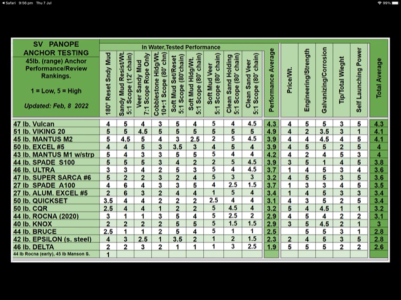
Odin will enjoy widespread public release ready for the northern hemisphere summer. The website is to be updated. The anchor remains the same as in this thread. Odin effectively uses the same concept as the original Viking and will enjoy the same characteristics as on the Panope spread sheets - rated as one of the better anchors - but improved over the original design as it has no roll bar and no ballast - the 'steel' you buy is focussed at hold.

As fas as I know Odin is the only self righting anchor without a roll bar and without ballast. Proving that anchor design is moving forward.

Details of Odin does not yet appear on the website Viking Anchors - Advanced Anchoring Systems but there is a release of information on Odin and timing of availability - but you need to contact Viking Anchors or wait for the updated website to be finished.

Jonathan
 
Last edited:
Viking sent a new mail to their mail list defining the characteristics of Odin. I'm not copying their marketing of the technical advantages of Odin but this is a quote on availability and the update of the website.

I don't think YBW support businesses using the forum as a marketing platform for product.

quote:

Important Update: Logistics and Website

As part of our ongoing commitment to providing you with the best service, we are currently making some changes to our logistics process and updating our website. These improvements are designed for convenience and will enhance your overall experience with us. Please note that our website will not be able to accept orders in the next few days. We apologize for any inconvenience this may cause and appreciate your understanding.

Availability

The Odin anchor will be available for purchase this summer. We will update you with more details as the launch date approaches. In the meantime, please feel free to contact us with any questions or to express your interest in the new Odin anchor.

Thank you for your continued support and trust in our products. We are excited to provide you with the best anchoring solutions.

Best regards,

unquote.

Hopefully this does not invoke the wrath of members nor the Mods. Their mail shot included some pictures of Odin on a bow roller - and I assume if you contact them direct you would have the images in their reply.

Jonathan
 
Viking sent a new mail to their mail list defining the characteristics of Odin. I'm not copying their marketing of the technical advantages of Odin but this is a quote on availability and the update of the website.

I don't think YBW support businesses using the forum as a marketing platform for product.

quote:

Important Update: Logistics and Website

As part of our ongoing commitment to providing you with the best service, we are currently making some changes to our logistics process and updating our website. These improvements are designed for convenience and will enhance your overall experience with us. Please note that our website will not be able to accept orders in the next few days. We apologize for any inconvenience this may cause and appreciate your understanding.

Availability

The Odin anchor will be available for purchase this summer. We will update you with more details as the launch date approaches. In the meantime, please feel free to contact us with any questions or to express your interest in the new Odin anchor.

Thank you for your continued support and trust in our products. We are excited to provide you with the best anchoring solutions.

Best regards,

unquote.

Hopefully this does not invoke the wrath of members nor the Mods. Their mail shot included some pictures of Odin on a bow roller - and I assume if you contact them direct you would have the images in their reply.

Jonathan
Jonathan, do you think that this will really be something special....or just another Epsilon moment ?
 
Jonathan, do you think that this will really be something special....or just another Epsilon moment ?
I'm biased.

I think its a step forward. I think thin HT steel and the 'wings' are a winning combination. I think designing out ballast, hinges and roll bars are the way forward and I've never like roll bars in the first place (because unless they are huge they induce clogging)

If you had asked the same question 5 years ago I would have said that we had reached the point of diminished returns for anchor design. Characteristics could be tweaked but nothing new was possible. Then Viking would have proved me wrong when they used high tensile steel to maintain strength and cut back on plate thickness to save weight (an 8kg Viking has a similar hold to an 8kg Fortress). Knox use HT steel - but its not thinned down to save weight. Asked again 2 years ago I'd have said design could not be improved further - and then Odin came on the scene, again proving me wrong (I'm often wrong :) ).

So.... if you like the Knox design - and I think it good - they could save some weight by thining the steel AND maintain all the good characteristics.

Is this the end of development? I hope not, but I see nothing else, yet, on the horizon - maybe I'm right for once and Odin is the ultimate, bar some tweaking.

Anchors have come in 3 forms,

hinged, Like Danforth/Fortress - great anchors but have weaknesses - weed and stone locking the 'folding' mechanism, difficult to store neatly on a bow roller. But because the hinge does not increase weight, or not by much, the design lends itself to high hold (if you can accept the disadvantages of the hinge etc). Fortress constantly outperforms any other anchor, weight of anchor vs hold - its just the downsides you need to accept (and for many the downside are simply too great). Fortress also underlines that weight is unnecessary - arguably all anchors could be made from aluminium and still perform better (weight to hold), or as well as their steel counter parts, Spade, Excel and Fortress being the prime examples.

Ballasted, like CQR, Delta, Epsilon, Excel, Vulcan, Spade, Epsilon- where to induce self righting some of the steel does not contribute to hold (its needed to have the anchor self right)

Roll barred - like Bugel, Rocna, Viking where the roll bar encourages the fluke to choke and the anchor can be difficult to store on some bow rollers.

You can add your own disadvantages... :(

My idea of the ideal is an anchor that does not need a roll bar, does not need ballast, does not need a hinge and 'saves' weight by being made from aluminium or high tensile steel. The anchor maker then has to focus on a design to encourage increased hold.


To me Odin comes close to being perfect - but I might be missing some key negative characteristic - in my desire that we are closing in on the best compromise.

The fluke of Odin is as close to identical to the original Viking, the shackle location is in the exact same location as on Viking - so Odin will address the seabed in the same way as Viking and have similar 'anchor characteristics' to those listed on Steve Godwin's Panope spread sheet.

The anchor self rights quickly so that it addresses the seabed in the same orientation as Viking and the 'wings' offer increased stability and hold in a veering wind, as does the shank - they act like vertical flukes. The wings act like an aircrafts wing - providing 'lift' to encourage the anchor to self right as it is tensioned (power set) in the seabed. When you watch Odin setting its uncanny how it self rights.

IMG_9522.PNG

It has been pointed out that having the crown, the junction of shank and fluke, on the heel (or close to) will allow the toe to damage the yacht's stem. This was never a disadvantage for Bruce, where the crown is actually behind the heel, and has been shown to be the location to engender the highest hold in unballasted anchors (which is why Fortress has the hinge at the heel and why Viking has twice the hold of Mantus).

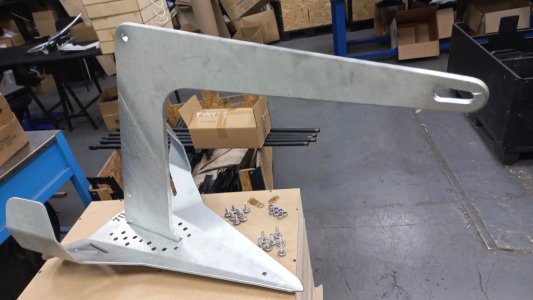
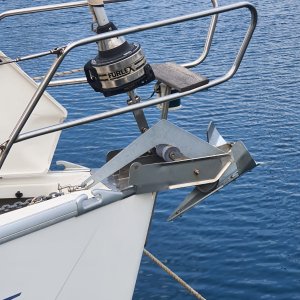
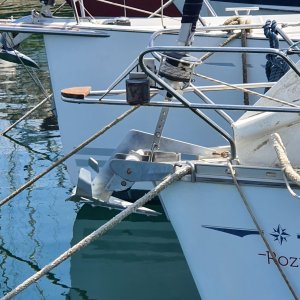
The images in the Viking mail shot, I copy and paste, suggest that it is possible to house Odin without damage.
Odin production photo.jpeg

odin 10 11.jpeg

odin 10 8.jpeg

I have been shown to be wrong on numerous occasions on anchor design and we seem to enjoy constant improvements to design and manufacturing techniques - so I don't think Odin is the ultimate - someone will offer some improvements.

Currently I find Odin to be a major positive step forward.

Jonathan
 
If the ideal is achieved by designing out, "ballast, hinges and roll bars" you need look no further than the original Bruce. Sadly, no longer made.
 
If the ideal is achieved by designing out, "ballast, hinges and roll bars" you need look no further than the original Bruce. Sadly, no longer made.
The big difference, dictated I suspect by changes, improvements, through decades in manufacturing, casting vs cutting, folding and welding of HT steels. But a modern version of the original Bruce design, which is still brilliant, would be 'that' ideal. The Bruce concept lives on in the oil industry where a version of the design is claimed to be the only self righting oil rig anchor.

Jonathan
 
Any updates on the Odin? Any real world use out there recently? I am in the middle of a boat refit and to take my mind of the somewhat slowwww progress I am thinking about anchors. I have used an Excel #2 and Viking 10 on my previous boat (5400 lbs) and am looking to use a Viking on my new (but old) boat (10,000 lbs), and am intrigued by the their new offering of the Odin....
 
Your Viking 10, in my estimation, was too big for your previous yacht. I had a Viking 10, a No 4 Excel (both steel and aluminium) and a A80 aluminium Spade.. And the Viking 10 (10kg) was about the right size for our 38' x 7t cat (and Excel No 4 is around 15kg). We used a 6mm high tensile chain for our rode. The problem with the Viking was that it did not fit on our bow roller at all.

Viking Anchors had a batch of 40 Odin's made and offered them at a discounted price on their Facebook page. The reports on Odin are on the same Facebook pages.

I confess I'm not a Facebook fan, nor a member, and only looked, some time ago, because of Viking.

The company is gearing up to make a new introductory batch to be available for the European summer, so your timing is opportune. Contact Viking Anchors and they will give you chapter and verse and I assume you would then be added to their mail list on updates.

The packing and assembly of Odin is similar to Viking.

I had a sample from the first batch of 40 anchors. It engages and sets exceptionally well and develops hold quickly. There were some minor issues wth my sample with galvanising (the edges of the cut steel were too sharp and the galvanising chipped). The factory have bought a new machine to allow all the edges to be rounded off and this issue should not occur in the future (this smoothing/rounding process has a name, I think - but I don't know the technical term :( ).

It is extraordinary that Viking have made an anchor with no roll bar (which adds nothing to hold) and no ballast (which also adds nothing to hold). The wings allow the anchor to roll to the correct engagement orientation and with tension in the rode the anchor sets and self rights with the 2 wings sitting 'upright' as they bury. Like Viking the anchors has a setting angle of 25/30 degrees to the seabed surface - the ideal angle to develop hold.. Odin remains light and exceptionally strong (as its made. shank and fluke, from Hardox 450 so the steel is thin and tough).)

Hardox 450, made to be hard - but high hardness is also high tensile strength (the two go together) - yield 1200 Mpa, tensile strength 1400 Mpa (compare that to the tensile strengths quoted on the current thread Rocna Style Anchor or Delta?

The wings add hold as they resist cyclical veering when the wind comes from 2 repetitious directions but are not so resistant to 'sliding round' if the wind is actually veering.

The hold of Odin is similar to that of the similarly sized Viking, the Odin 40 is the same fluke size as the Viking 10 and similar hold to the Excel No4 or the Spade A80 (I've made the comparison), the steel No4 is 15kg and the A80 about 8kg (same weight as the Viking 10).


Downside - its made in Ukraine and manufacturing a leisure product in a war zone is not easy. Transportation is a nightmare and any and all males walking to work is stopped on the street and questioned - and if not gainfully employed 'frog marched' to the nearest recruitment location.

Hopefully things will change and the Ukrainians will be rewarded for their tenacity.

Just out of interest -where are you located?

Jonathan
 
Your Viking 10, in my estimation, was too big for your previous yacht. I had a Viking 10, a No 4 Excel (both steel and aluminium) and a A80 aluminium Spade.. And the Viking 10 (10kg) was about the right size for our 38' x 7t cat (and Excel No 4 is around 15kg). We used a 6mm high tensile chain for our rode. The problem with the Viking was that it did not fit on our bow roller at all.

Viking Anchors had a batch of 40 Odin's made and offered them at a discounted price on their Facebook page. The reports on Odin are on the same Facebook pages.

I confess I'm not a Facebook fan, nor a member, and only looked, some time ago, because of Viking.

The company is gearing up to make a new introductory batch to be available for the European summer, so your timing is opportune. Contact Viking Anchors and they will give you chapter and verse and I assume you would then be added to their mail list on updates.

The packing and assembly of Odin is similar to Viking.

I had a sample from the first batch of 40 anchors. It engages and sets exceptionally well and develops hold quickly. There were some minor issues wth my sample with galvanising (the edges of the cut steel were too sharp and the galvanising chipped). The factory have bought a new machine to allow all the edges to be rounded off and this issue should not occur in the future (this smoothing/rounding process has a name, I think - but I don't know the technical term :( ).

It is extraordinary that Viking have made an anchor with no roll bar (which adds nothing to hold) and no ballast (which also adds nothing to hold). The wings allow the anchor to roll to the correct engagement orientation and with tension in the rode the anchor sets and self rights with the 2 wings sitting 'upright' as they bury. Like Viking the anchors has a setting angle of 25/30 degrees to the seabed surface - the ideal angle to develop hold.. Odin remains light and exceptionally strong (as its made. shank and fluke, from Hardox 450 so the steel is thin and tough).)

Hardox 450, made to be hard - but high hardness is also high tensile strength (the two go together) - yield 1200 Mpa, tensile strength 1400 Mpa (compare that to the tensile strengths quoted on the current thread Rocna Style Anchor or Delta?

The wings add hold as they resist cyclical veering when the wind comes from 2 repetitious directions but are not so resistant to 'sliding round' if the wind is actually veering.

The hold of Odin is similar to that of the similarly sized Viking, the Odin 40 is the same fluke size as the Viking 10 and similar hold to the Excel No4 or the Spade A80 (I've made the comparison), the steel No4 is 15kg and the A80 about 8kg (same weight as the Viking 10).


Downside - its made in Ukraine and manufacturing a leisure product in a war zone is not easy. Transportation is a nightmare and any and all males walking to work is stopped on the street and questioned - and if not gainfully employed 'frog marched' to the nearest recruitment location.

Hopefully things will change and the Ukrainians will be rewarded for their tenacity.

Just out of interest -where are you located?

Jonathan
Good info thanks!
New Zealand where you can be regularly gale bound in an anchorage, although holding is generally good almost everywhere.
Viking 10 fitted my double-roller nicely despite only being a 26 footer.
 
Top